From the ‡Proteome Center Tuebingen, Interfaculty Institute for Cell Biology, University of Tuebingen, Tuebingen, Germany.
§Center for Dermatooncology, Department of Dermatology, University of Tuebingen, Tuebingen, Germany.
Mol Cell Proteomics. 2019 Jun;18(6):1096-1109. doi: 10.1074/mcp.RA119.001302. Epub 2019 Mar 19.
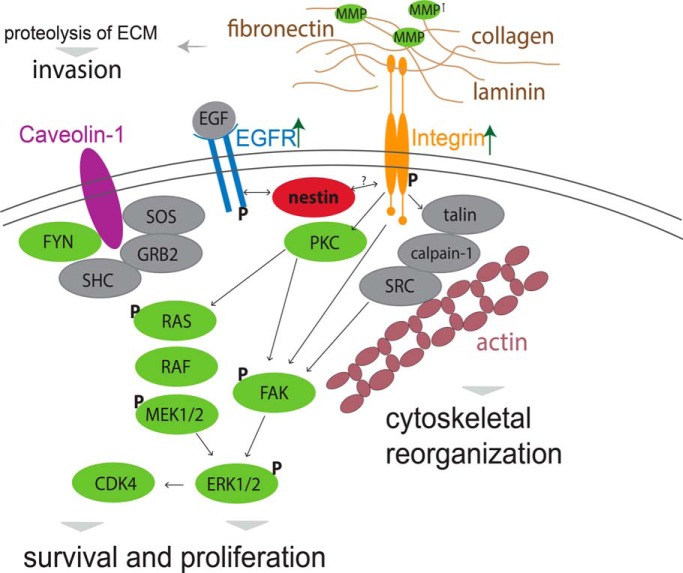
Targeted inhibition of mutated kinases using selective MAP kinase inhibitors in malignant melanoma often results in temporary improvement of clinical symptoms followed by rapid development of resistance. To gain insights in molecular processes that govern resistance, we performed SILAC-based quantitative proteomics profiling of vemurafenib-resistant and -sensitive melanoma cells. Among downregulated proteins in vemurafenib-resistant cell lines we detected multiple proteins involved in cytoskeletal organization and signaling, including the intermediate filament nestin, which was one of the most downregulated proteins. Previous studies showed that nestin is expressed in various types of solid tumors and its abundance correlates with malignant phenotype of transformed cells. However, the role of nestin in cancer cells regarding acquired resistance is still poorly understood. We performed CRISPR/Cas9 knockout of the nestin gene () in vemurafenib-sensitive cells and showed that loss of nestin leads to increased cellular proliferation and colony formation upon treatment with BRAF and MEK inhibitors. Moreover, nestin depletion led to increased invasiveness and metalloproteinase activity like the phenotype of melanoma cells with acquired resistance to the BRAF inhibitor. Finally, phosphoproteome analysis revealed that nestin depletion influenced signaling through integrin and PI3K/AKT/mTOR pathways and led to increased focal adhesion kinase abundance and phosphorylation. Taken together, our results reveal that nestin is associated with acquired vemurafenib resistance in melanoma cells.
使用选择性 MAP 激酶抑制剂靶向抑制恶性黑色素瘤中的突变激酶,通常会导致临床症状暂时改善,随后迅速产生耐药性。为了深入了解控制耐药性的分子过程,我们对vemurafenib 耐药和敏感的黑素瘤细胞进行了基于 SILAC 的定量蛋白质组学分析。在 vemurafenib 耐药细胞系中下调的蛋白质中,我们检测到多个参与细胞骨架组织和信号转导的蛋白质,包括中间丝巢蛋白,它是下调最明显的蛋白质之一。先前的研究表明,巢蛋白在各种类型的实体瘤中表达,其丰度与转化细胞的恶性表型相关。然而,巢蛋白在获得性耐药的癌细胞中的作用仍知之甚少。我们使用 CRISPR/Cas9 敲除了 vemurafenib 敏感细胞中的巢蛋白基因(),并表明巢蛋白的缺失导致 BRAF 和 MEK 抑制剂处理后细胞增殖和集落形成增加。此外,巢蛋白缺失导致侵袭性增加和金属蛋白酶活性增加,类似于对 BRAF 抑制剂获得性耐药的黑素瘤细胞的表型。最后,磷酸化蛋白质组分析显示,巢蛋白缺失影响整合素和 PI3K/AKT/mTOR 通路的信号转导,并导致粘着斑激酶丰度和磷酸化增加。总之,我们的结果表明巢蛋白与黑素瘤细胞获得性 vemurafenib 耐药性有关。