Department of Brain and Cognitive Sciences, Massachusetts Institute of Technology, Cambridge, MA, 02139, USA.
McGovern Institute of Brain Research, Massachusetts Institute of Technology, Cambridge, MA, 02139, USA.
Nat Commun. 2019 Mar 19;10(1):1258. doi: 10.1038/s41467-019-09239-1.
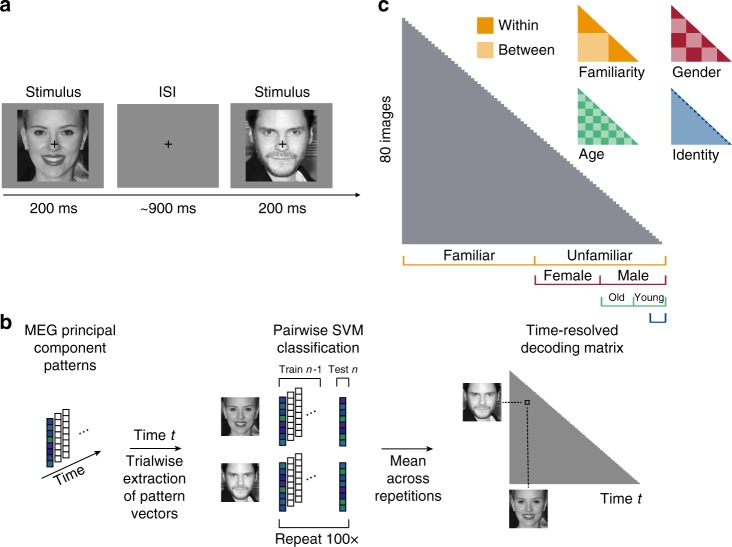
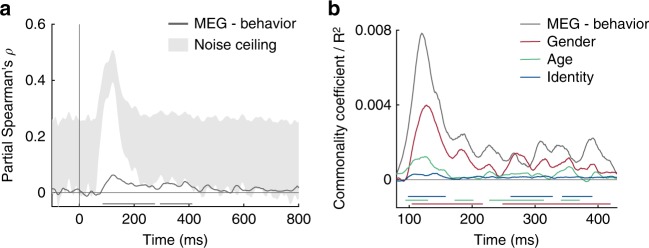
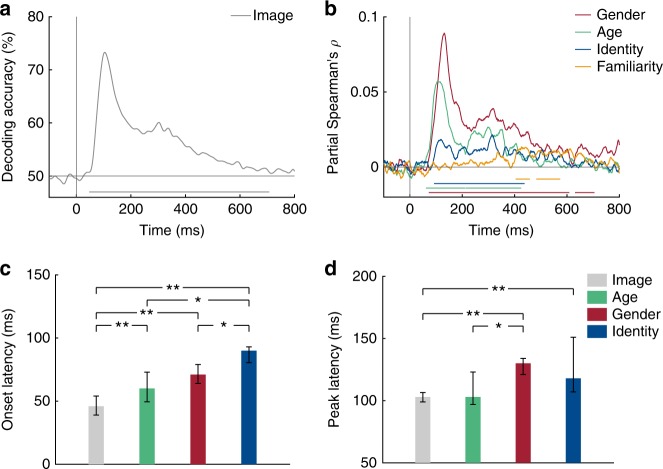
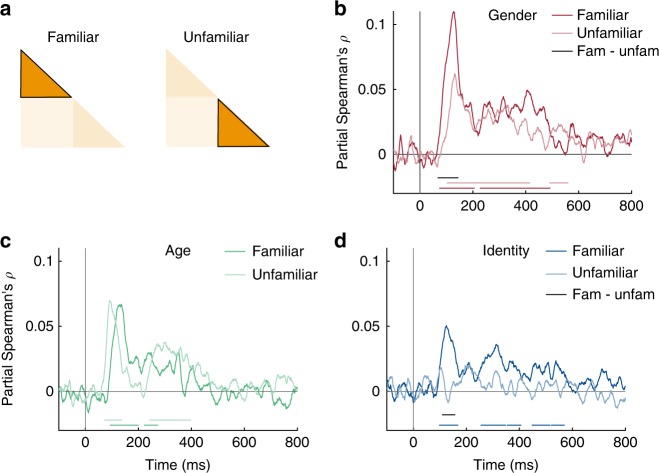
Within a fraction of a second of viewing a face, we have already determined its gender, age and identity. A full understanding of this remarkable feat will require a characterization of the computational steps it entails, along with the representations extracted at each. Here, we used magnetoencephalography (MEG) to measure the time course of neural responses to faces, thereby addressing two fundamental questions about how face processing unfolds over time. First, using representational similarity analysis, we found that facial gender and age information emerged before identity information, suggesting a coarse-to-fine processing of face dimensions. Second, identity and gender representations of familiar faces were enhanced very early on, suggesting that the behavioral benefit for familiar faces results from tuning of early feed-forward processing mechanisms. These findings start to reveal the time course of face processing in humans, and provide powerful new constraints on computational theories of face perception.
在看到一张脸的一瞬间,我们已经确定了它的性别、年龄和身份。要全面理解这一非凡的能力,需要对其涉及的计算步骤进行特征描述,以及在每个步骤提取的表示进行描述。在这里,我们使用脑磁图(MEG)来测量对人脸的神经反应的时间过程,从而解决关于面孔处理随时间展开的两个基本问题。首先,使用表示相似性分析,我们发现面部性别和年龄信息先于身份信息出现,这表明对面部维度的处理是从粗到精的。其次,熟悉面孔的身份和性别表示很早就得到了增强,这表明熟悉面孔的行为优势来自于早期前馈处理机制的调整。这些发现开始揭示人类面孔处理的时间过程,并为面孔感知的计算理论提供了强有力的新约束。