Department of Public Health Sciences, The University of Chicago, Chicago, IL, United States of America.
Department of Human Genetics, The University of Chicago, Chicago, IL, United States of America.
PLoS Genet. 2019 Mar 20;15(3):e1007984. doi: 10.1371/journal.pgen.1007984. eCollection 2019 Mar.
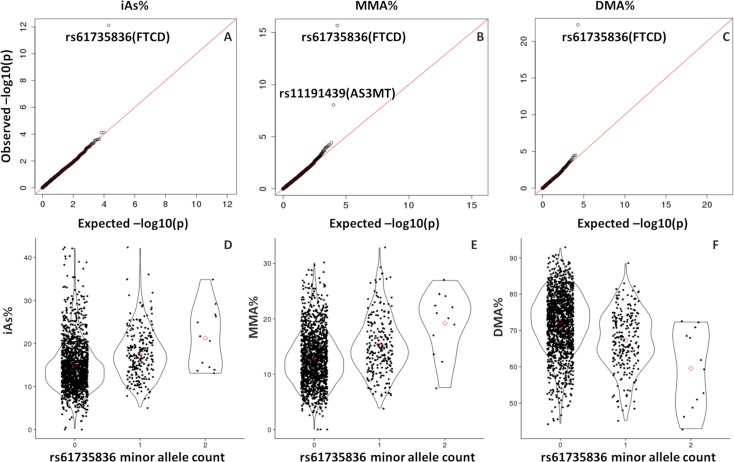
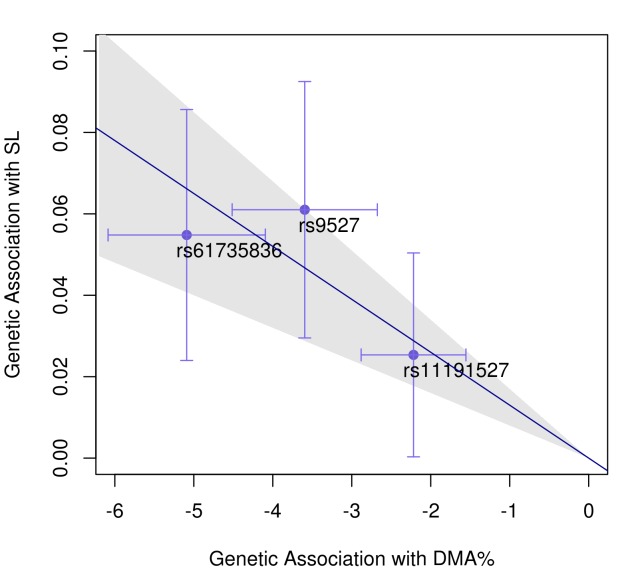
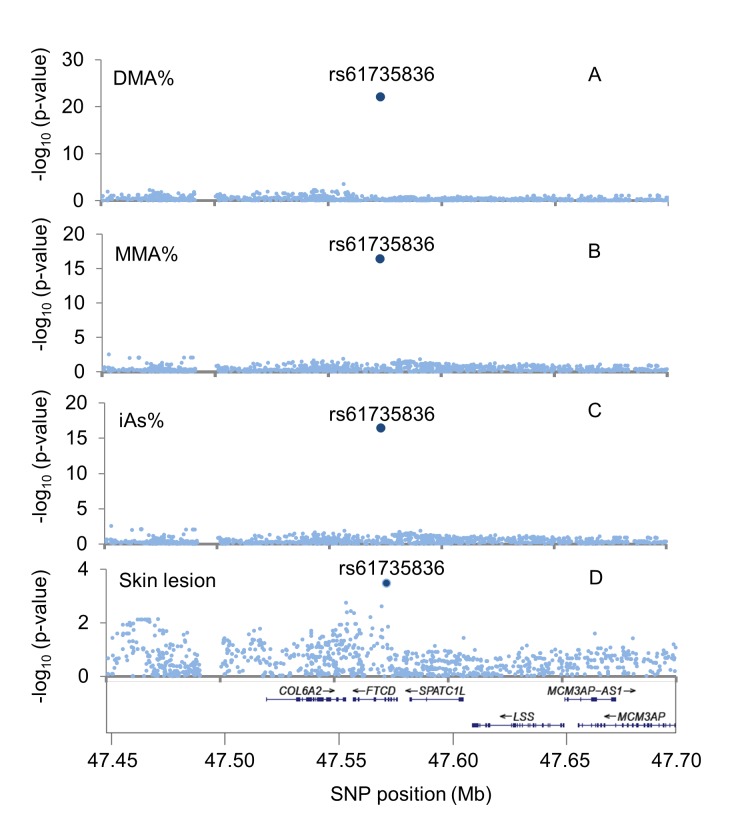
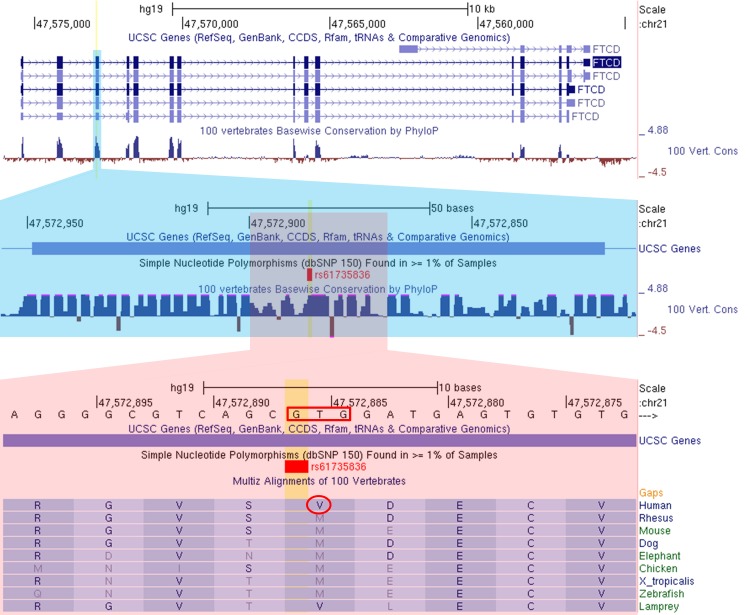
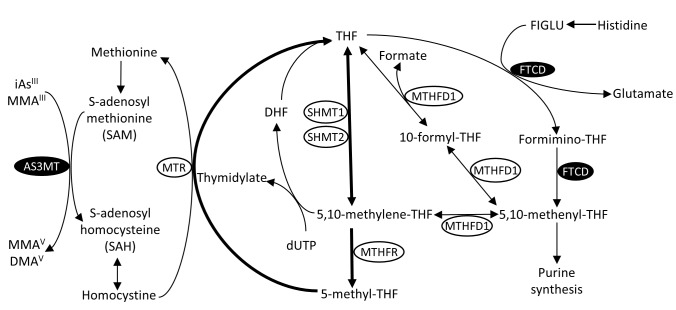
Inorganic arsenic (iAs) is a carcinogen, and exposure to iAs via food and water is a global public health problem. iAs-contaminated drinking water alone affects >100 million people worldwide, including ~50 million in Bangladesh. Once absorbed into the blood stream, most iAs is converted to mono-methylated (MMA) and then di-methylated (DMA) forms, facilitating excretion in urine. Arsenic metabolism efficiency varies among individuals, in part due to genetic variation near AS3MT (arsenite methyltransferase; 10q24.32). To identify additional arsenic metabolism loci, we measured protein-coding variants across the human exome for 1,660 Bangladeshi individuals participating in the Health Effects of Arsenic Longitudinal Study (HEALS). Among the 19,992 coding variants analyzed exome-wide, the minor allele (A) of rs61735836 (p.Val101Met) in exon 3 of FTCD (formiminotransferase cyclodeaminase) was associated with increased urinary iAs% (P = 8x10-13), increased MMA% (P = 2x10-16) and decreased DMA% (P = 6x10-23). Among 2,401 individuals with arsenic-induced skin lesions (an indicator of arsenic toxicity and cancer risk) and 2,472 controls, carrying the low-efficiency A allele (frequency = 7%) was associated with increased skin lesion risk (odds ratio = 1.35; P = 1x10⁻⁵). rs61735836 is in weak linkage disequilibrium with all nearby variants. The high-efficiency/major allele (G/Valine) is human-specific and eliminates a start codon at the first 5´-proximal Kozak sequence in FTCD, suggesting selection against an alternative translation start site. FTCD is critical for catabolism of histidine, a process that generates one-carbon units that can enter the one-carbon/folate cycle, which provides methyl groups for arsenic metabolism. In our study population, FTCD and AS3MT SNPs together explain ~10% of the variation in DMA% and support a causal effect of arsenic metabolism efficiency on arsenic toxicity (i.e., skin lesions). In summary, this work identifies a coding variant in FTCD associated with arsenic metabolism efficiency, providing new evidence supporting the established link between one-carbon/folate metabolism and arsenic toxicity.
无机砷(iAs)是一种致癌物质,通过食物和水摄入 iAs 是一个全球性的公共健康问题。仅受 iAs 污染的饮用水就影响了全世界超过 1 亿人,其中包括孟加拉国的约 5000 万人。一旦被吸收到血液中,大多数 iAs 会转化为单甲基化(MMA)和二甲基化(DMA)形式,从而促进尿液排泄。砷代谢效率在个体之间存在差异,部分原因是 AS3MT(亚砷酸盐甲基转移酶;10q24.32)附近的遗传变异。为了确定其他砷代谢基因座,我们对参加健康影响砷纵向研究(HEALS)的 1660 名孟加拉国个体的人类外显子组进行了编码变异的全蛋白编码变体的测量。在全外显子组分析的 19992 个编码变异中,FTCD(氨基甲酰基转移酶环脱氨酶)外显子 3 中的 rs61735836(p.Val101Met)的次要等位基因(A)与尿 iAs%增加(P=8x10-13)、MMA%增加(P=2x10-16)和 DMA%减少(P=6x10-23)相关。在 2401 名患有砷诱导性皮肤损伤(砷毒性和癌症风险的指标)的个体和 2472 名对照中,低效率 A 等位基因(频率=7%)携带者的皮肤损伤风险增加(比值比=1.35;P=1x10⁻⁵)。rs61735836 与附近所有变体均处于弱连锁不平衡状态。高效/主要等位基因(G/缬氨酸)是人类特有的,消除了 FTCD 第一个 5´-近端 Kozak 序列中的起始密码子,表明选择了替代的翻译起始位点。FTCD 对组氨酸的分解代谢至关重要,该过程会产生一碳单位,可进入一碳/叶酸循环,为砷代谢提供甲基。在我们的研究人群中,FTCD 和 AS3MT SNPs 共同解释了 DMA%变化的约 10%,并支持砷代谢效率对砷毒性(即皮肤损伤)的因果效应。总之,这项工作鉴定了与砷代谢效率相关的 FTCD 中的编码变异,为一碳/叶酸代谢与砷毒性之间的既定联系提供了新的证据。