Clinic of Paediatric Oncology and Haematology, Faculty of Medicine, University of Rzeszow, ul. Kopisto 2a, 35-310 Rzeszow, Poland.
School of Chemistry, University of Bristol, Bristol BS8 1TS, UK.
Molecules. 2019 Mar 19;24(6):1075. doi: 10.3390/molecules24061075.
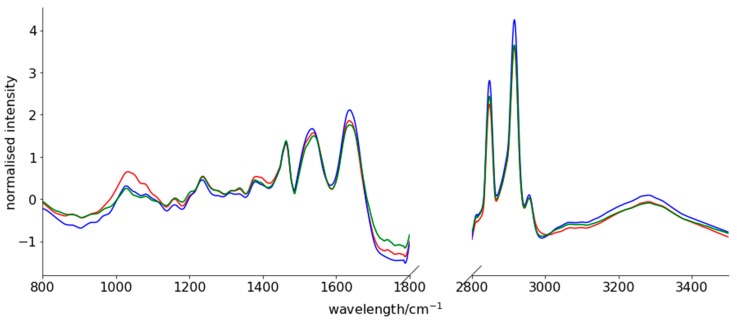
Improved outcome prediction is vital for the delivery of risk-adjusted, appropriate and effective care to paediatric patients with Ewing sarcoma-the second most common paediatric malignant bone tumour. Fourier transform infrared (FTIR) spectroscopy of tissues allows the bulk biochemical content of a biological sample to be probed and makes possible the study and diagnosis of disease.
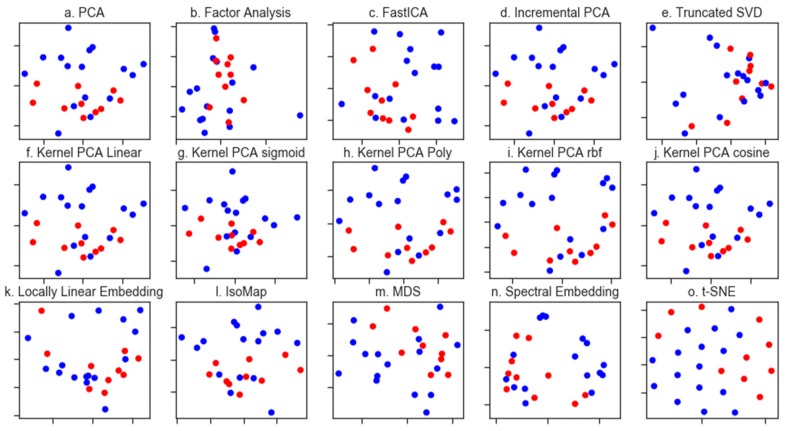
In this retrospective study, FTIR spectra of sections of biopsy-obtained bone tissue were recorded. Twenty-seven patients (between 5 and 20 years of age) with newly diagnosed Ewing sarcoma of bone were included in this study. The prognostic value of FTIR spectra obtained from Ewing sarcoma (ES) tumours before and after neoadjuvant chemotherapy were analysed in combination with various data-reduction and machine learning approaches.
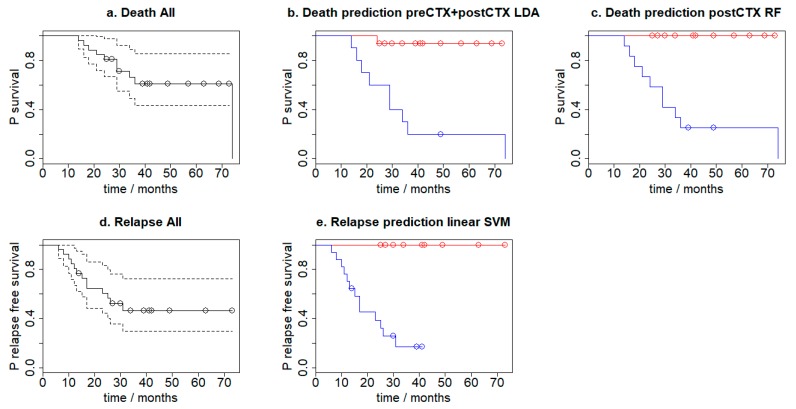
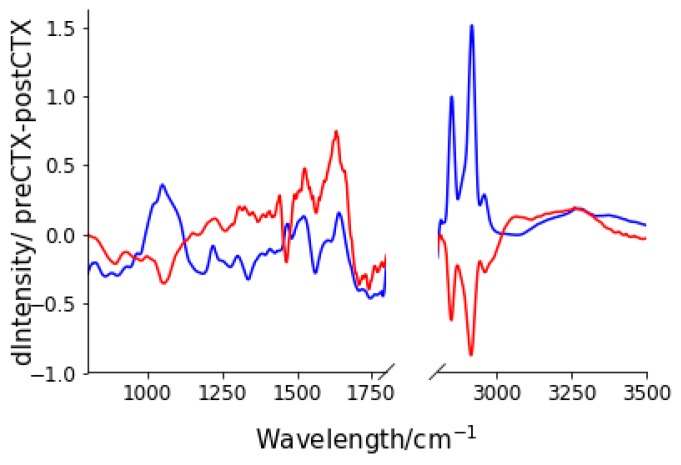
Random forest and linear discriminant analysis supervised learning models were able to correctly predict patient mortality in 92% of cases using leave-one-out cross-validation. The best performing model for predicting patient relapse was a linear Support Vector Machine trained on the observed spectral changes as a result of chemotherapy treatment, which achieved 92% accuracy.
FTIR spectra of tumour biopsy samples may predict treatment outcome in paediatric Ewing sarcoma patients with greater than 92% accuracy.
对于小儿尤文肉瘤(第二大常见的儿童骨恶性肿瘤)患者来说,提供风险调整后的、适当的和有效的护理至关重要,改善预后预测是关键。组织的傅立叶变换红外(FTIR)光谱分析允许探测生物样本的大量生化含量,并使疾病的研究和诊断成为可能。
在这项回顾性研究中,记录了活检获得的骨组织切片的 FTIR 光谱。本研究纳入了 27 名新诊断为骨尤文肉瘤的患者(年龄在 5 至 20 岁之间)。使用各种数据降维和机器学习方法,分析了来自新辅助化疗前后尤文肉瘤(ES)肿瘤的 FTIR 光谱的预后价值。
随机森林和线性判别分析监督学习模型能够使用留一法交叉验证在 92%的病例中正确预测患者的死亡率。预测患者复发的最佳表现模型是基于化疗治疗引起的观察到的光谱变化训练的线性支持向量机,其准确率达到 92%。
肿瘤活检样本的 FTIR 光谱可以预测儿科尤文肉瘤患者的治疗结果,准确率超过 92%。