Environmental Futures Research Institute, Griffith University, 170 Kessels Rd, Nathan, Queensland, 4111, Australia.
Biodiversity and Geosciences Program, Queensland Museum, South Brisbane, Queensland, 4101, Australia.
BMC Evol Biol. 2019 Mar 20;19(1):81. doi: 10.1186/s12862-019-1408-1.
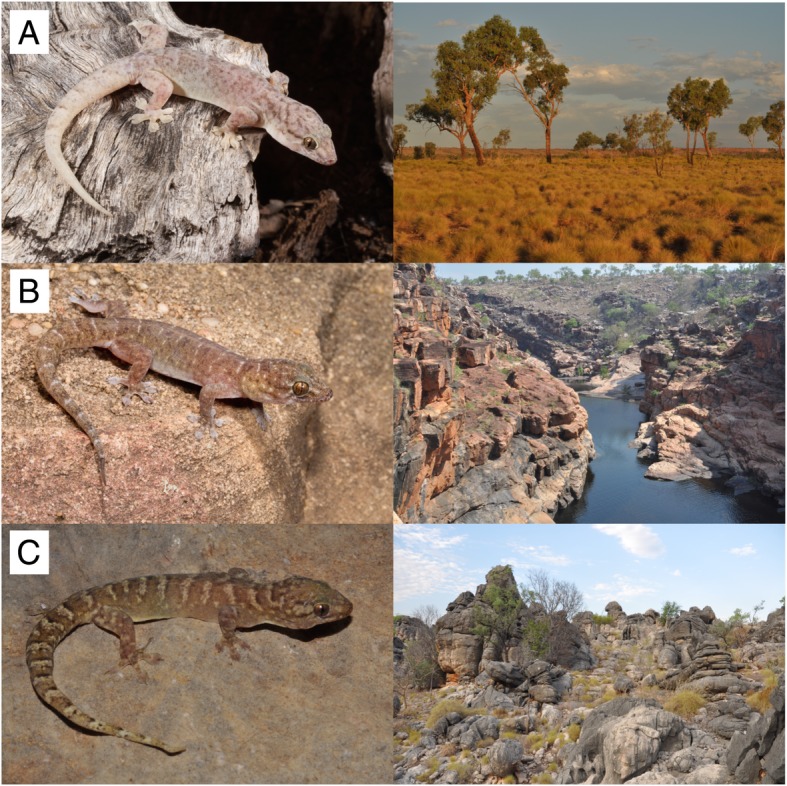
Congruent patterns in the distribution of biodiversity between regions or habitats suggest that key factors such as climatic and topographic variation may predictably shape evolutionary processes. In a number of tropical and arid biomes, genetic analyses are revealing deeper and more localised lineage diversity in rocky ranges than surrounding habitats. Two potential drivers of localised endemism in rocky areas are refugial persistence through climatic change, or ecological diversification and specialisation. Here we examine how patterns of lineage and phenotypic diversity differ across two broad habitat types (rocky ranges and open woodlands) in a small radiation of gecko lizards in the genus Gehyra (the australis group) from the Australian Monsoonal Tropics biome.
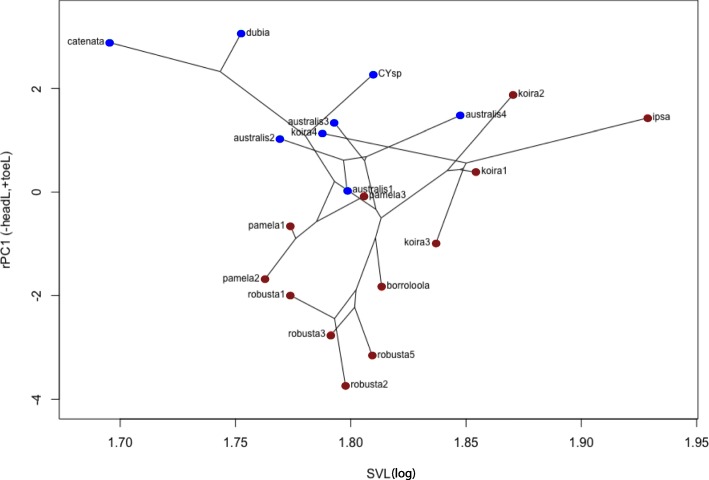
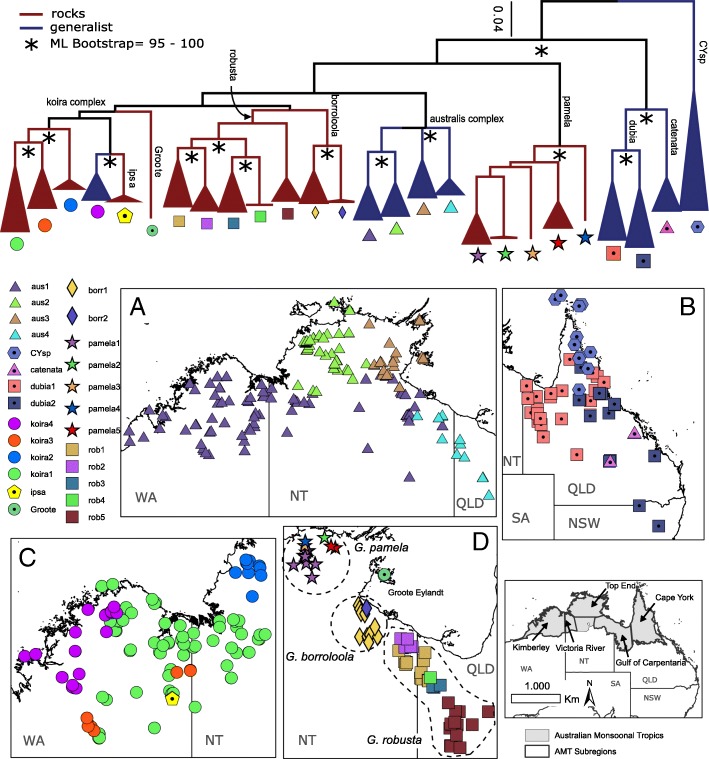
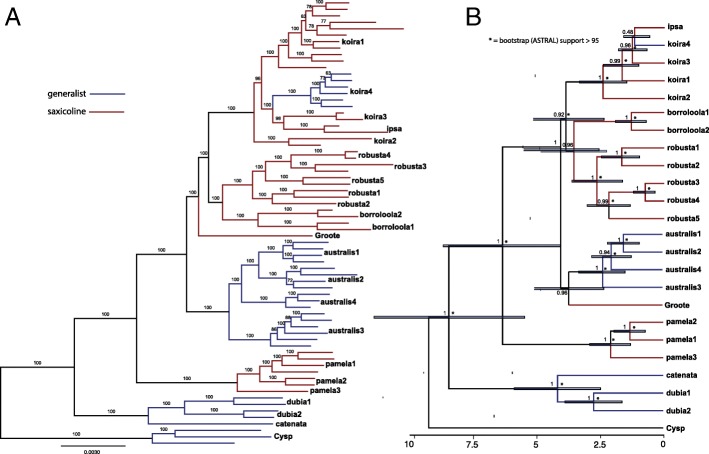
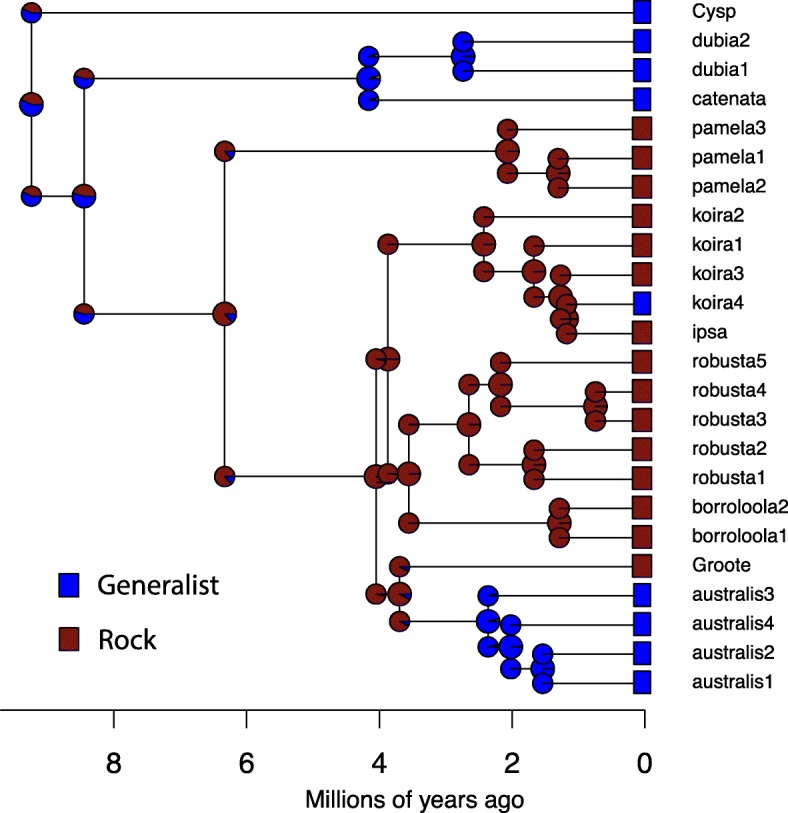
Using a suite of approaches for delineating evolutionarily independent lineages, we find between 26 and 41 putative evolutionary units in the australis group (versus eight species currently recognised). Rocky ranges are home to a greater number of lineages that are also relatively more restricted in distribution, while lineages in open woodland habitats are fewer, more widely distributed, and, in one case, show evidence of range expansion. We infer at least two shifts out of rocky ranges and into surrounding woodlands. Phenotypic divergence between rocky ranges specialist and more generalist taxa is detected, but no convergent evolutionary regimes linked to ecology are inferred.
In climatically unstable biomes such as savannahs, rocky ranges have functioned as zones of persistence, generators of diversity and a source of colonists for surrounding areas. Phenotypic divergence can also be linked to the use of differing habitat types, however, the extent to which ecological specialisation is a primary driver or secondary outcome of localised diversification remains uncertain.
生物多样性在不同地区或生境中的分布模式一致,表明气候和地形变化等关键因素可能可预测地塑造进化过程。在一些热带和干旱生物群系中,遗传分析揭示了岩石山脉中的遗传谱系多样性比周围生境更深、更局部。岩石地区局部特有现象的两个潜在驱动因素是气候变化下的避难所持续存在,或生态多样化和特化。在这里,我们研究了在澳大利亚季风热带生物群系中壁虎属(澳大拉西亚组)的一个小辐射中,两种广泛的生境类型(岩石山脉和开阔林地)之间谱系和表型多样性模式的差异。
使用一系列用于划定进化独立谱系的方法,我们在澳大拉西亚组中发现了 26 到 41 个可能的进化单位(而目前识别出的是 8 个物种)。岩石山脉是更多谱系的家园,这些谱系的分布范围也相对较窄,而开阔林地生境中的谱系则较少,分布较广,而且在一个案例中,有扩展范围的迹象。我们推断至少有两次从岩石山脉转移到周围的林地。在岩石山脉特化和更普遍的分类单元之间检测到表型分歧,但没有推断出与生态相关的趋同进化模式。
在像稀树草原这样气候不稳定的生物群系中,岩石山脉一直是持久的区域、多样性的产生者以及周围地区的殖民者来源。表型分歧也可以与不同生境类型的使用联系起来,但是,生态特化是局部多样化的主要驱动因素还是次要结果仍然不确定。