Rodríguez López Jesús, García Lara Nadia Raquel, López Maestro María, De la Cruz Bértolo Javier, Martínez Ávila José Carlos, Vento Máximo, Parra Llorca Ana, Izquierdo Macián Isabel, Pellicer Adelina, Marín Huarte Natalia, Asla Elorriaga Izaskun, Román Echevarría Lourdes, Copons Fernández Cristina, Martín Ancel Ana, Cabañas Fernando, García Algar Óscar, Pallás Alonso Carmen Rosa
Neonatology Department, 12 de Octubre, University Hospital, Avenida de Córdoba s/n, 28041, Madrid, Spain.
Neonatology Department, La Fe University Hospital, Avenida de Fernando Abril Martorell, 106, 46026, València, Spain.
Trials. 2019 Mar 20;20(1):179. doi: 10.1186/s13063-019-3256-0.
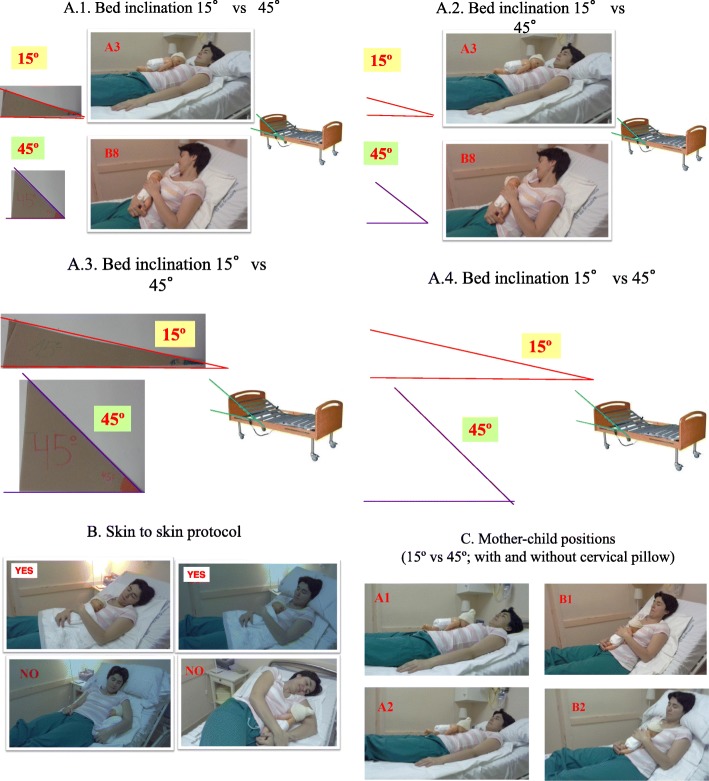
Early mother-child skin-to-skin contact (SSC) in the first 2 h postpartum is highly beneficial for both mother and child. However, cases have been reported of newborns who have experienced apparently life-threatening events (ALTEs) or sudden death during this procedure. The causes of these events are unknown. Newborn's prone position could influence the onset of these events but there is very little evidence to support any recommendation. We hypothesize that newborns' breathing obstruction episodes increase as mothers lie more horizontally. The main objective of this study is to compare the occurrence of desaturation and bradycardia episodes as a function of mother's bed incline. The study is designed as a randomized, controlled, assessor blind, multicenter, superiority trial with two parallel groups and 1:1 allocation ratio.
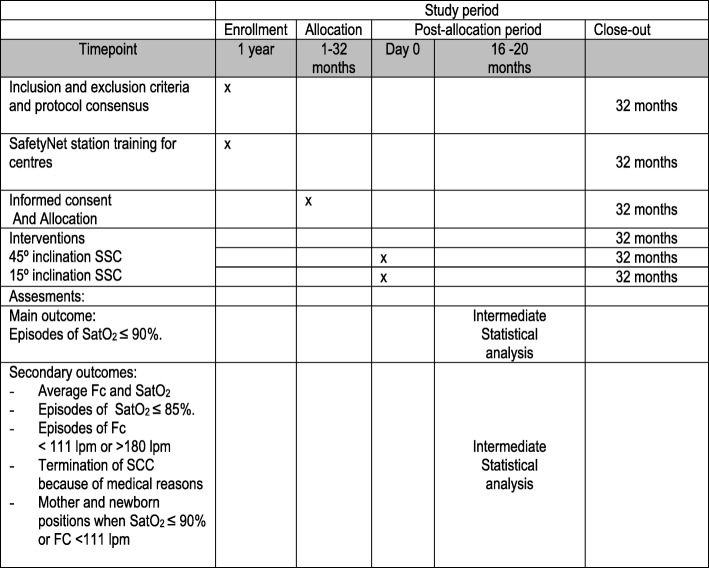
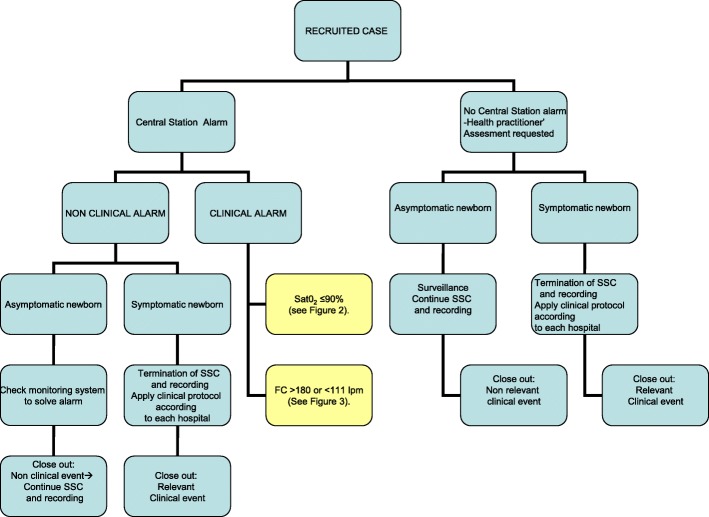
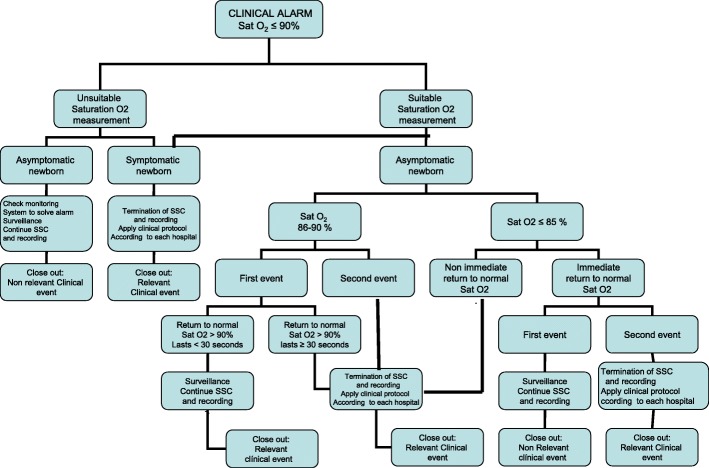
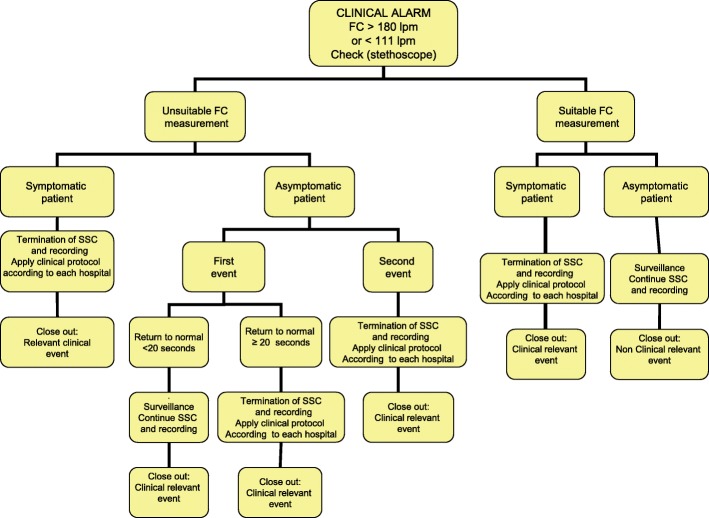
The study participants will be full-term healthy mother-newborn dyads from ten hospitals in Spain. Participants will be randomly assigned to one of two study arms defined by mother's bed inclination (45° or 15°). The planned sample size is 5866. Centralized permuted blocks randomization and assessor blinding will be implemented. The newborns will be monitored remotely with pulse oximetry, from 10 min to 2 h after delivery. We established SO and heart rate (HR) limit alarms, as well as an action protocol in the event of alarm activation. The primary outcome is the number of healthy newborns who undergo episodes of SO ≤ 90%. Secondary outcomes are the mean SO level, the number of newborns who experience episodes of SO ≤ 85%, the time to SSC discontinuation due to abnormal SO or HR, and episodes of HR < 111 beats per minute (bpm) or > 180 bpm. Subgroups and pooled analysis will be performed to identify if breast-feeding and mother and child positions favor the occurrence of desaturation or bradycardia episodes.
A simple intervention such as modifying mother's bed angle of inclination while in SSC with her child during the first 2 h postpartum could favor newborn's hemodynamic and respiratory stabilization and thus contribute to reducing the onset of ALTEs.
ClinicalTrials.gov, NCT02585492 . Registered on 22nd October 2015.
2 (30th June 2015).
产后2小时内尽早进行母婴皮肤接触(SSC)对母婴双方都极为有益。然而,已有报道称新生儿在此过程中发生了明显危及生命的事件(ALTEs)或猝死。这些事件的原因尚不清楚。新生儿的俯卧位可能会影响这些事件的发生,但几乎没有证据支持任何相关建议。我们推测,随着母亲躺得更平,新生儿呼吸阻塞发作会增加。本研究的主要目的是比较因母亲病床倾斜度不同而导致的血氧饱和度降低和心动过缓发作的发生率。该研究设计为一项随机、对照、评估者盲法、多中心、优效性试验,分为两个平行组,分配比例为1:1。
研究参与者将来自西班牙十家医院的足月健康母婴对。参与者将被随机分配到由母亲病床倾斜度(45°或15°)定义的两个研究组之一。计划样本量为5866。将实施集中的置换块随机化和评估者盲法。产后10分钟至2小时,将通过脉搏血氧饱和度仪对新生儿进行远程监测。我们设定了血氧饱和度(SO)和心率(HR)限制警报,以及警报激活时的行动方案。主要结局是经历SO≤90%发作的健康新生儿数量。次要结局包括平均SO水平、经历SO≤85%发作的新生儿数量、因SO或HR异常而停止SSC的时间,以及HR<111次/分钟(bpm)或>180 bpm的发作情况。将进行亚组分析和汇总分析,以确定母乳喂养以及母婴体位是否会增加血氧饱和度降低或心动过缓发作的发生率。
一种简单的干预措施,如在产后2小时内母婴进行SSC时改变母亲病床的倾斜角度,可能有助于新生儿的血流动力学和呼吸稳定,从而有助于减少ALTEs的发生。
ClinicalTrials.gov,NCT02585492。于2015年10月22日注册。
2(2015年6月30日)。