Giuriato Umberto, Krstulovic Giorgio
Université Côte d'Azur, Observatoire de la Côte d'Azur, CNRS, Laboratoire Lagrange, Bd de l'Observatoire, CS 34229, 06304 Cedex 4, Nice, France.
Sci Rep. 2019 Mar 20;9(1):4839. doi: 10.1038/s41598-019-39877-w.
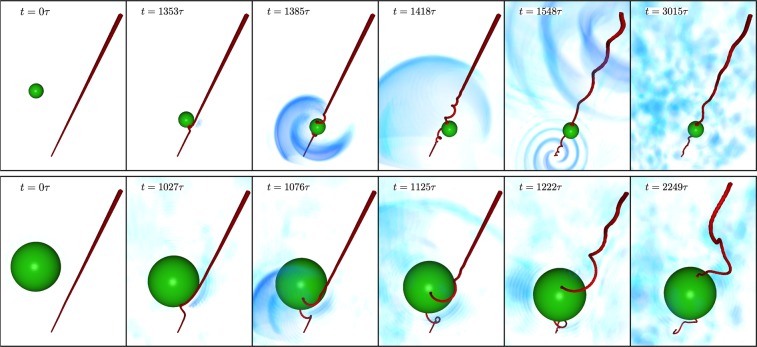
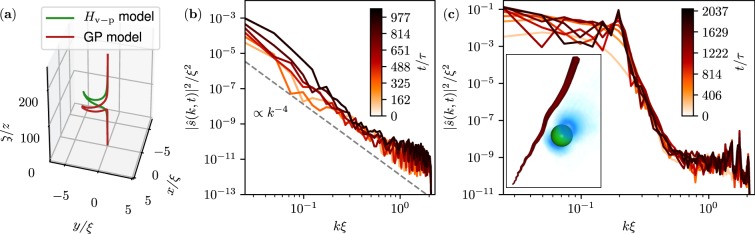
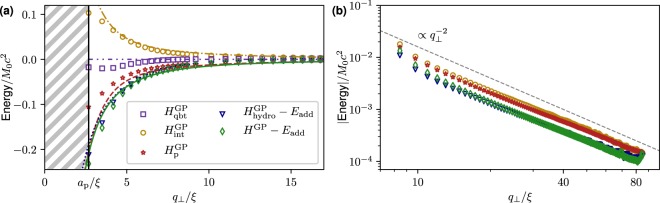
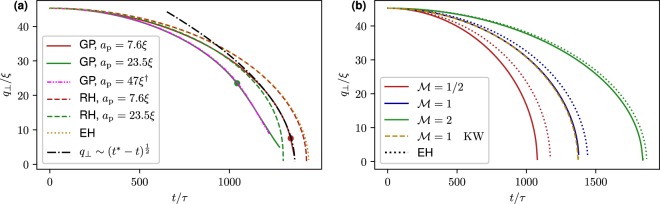
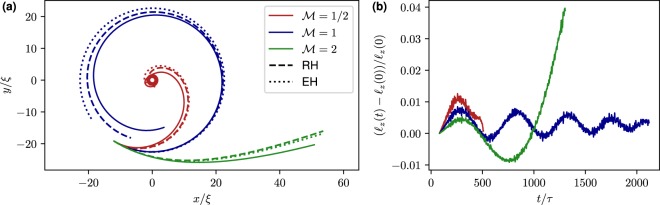
One of the main features of superfluids is the presence of topological defects with quantised circulation. These objects are known as quantum vortices and exhibit a hydrodynamic behaviour. Nowadays, particles are the main experimental tool used to visualise quantum vortices and to study their dynamics. We use a self-consistent model based on the three-dimensional Gross-Pitaevskii (GP) equation to explore theoretically and numerically the attractive interaction between particles and quantized vortices at very low temperature. Particles are described as localised potentials depleting the superfluid and following Newtonian dynamics. We are able to derive analytically a reduced central-force model that only depends on the classical degrees of freedom of the particle. Such model is found to be consistent with the GP simulations. We then generalised the model to include deformations of the vortex filament. The resulting long-range mutual interaction qualitatively reproduces the observed generation of a cusp on the vortex filament during the particle approach. Moreover, we show that particles can excite Kelvin waves on the vortex filament through a resonance mechanism even if they are still far from it.
超流体的主要特征之一是存在具有量子化环流的拓扑缺陷。这些物体被称为量子涡旋,并表现出流体动力学行为。如今,粒子是用于可视化量子涡旋并研究其动力学的主要实验工具。我们使用基于三维格罗斯 - 皮塔耶夫斯基(GP)方程的自洽模型,在理论和数值上探索极低温下粒子与量子化涡旋之间的吸引相互作用。粒子被描述为使超流体耗尽并遵循牛顿动力学的局域势。我们能够解析推导一个仅依赖于粒子经典自由度的简化中心力模型。发现该模型与GP模拟一致。然后我们将该模型推广到包括涡旋丝的变形。由此产生的长程相互作用定性地再现了在粒子靠近过程中涡旋丝上观察到的尖点的产生。此外,我们表明即使粒子离涡旋丝还很远,它们也可以通过共振机制在涡旋丝上激发开尔文波。