Li Jonathan Z, Sax Paul E, Marconi Vincent C, Fajnzylber Jesse, Berzins Baiba, Nyaku Amesika N, Fichtenbaum Carl J, Wilkin Timothy, Benson Constance A, Koletar Susan L, Lorenzo-Redondo Ramon, Taiwo Babafemi O
Division of Infectious Diseases, Brigham and Women's Hospital, Harvard Medical School, Boston, Massachussetts.
Division of Infectious Diseases, Emory University School of Medicine and Rollins School of Public Health, Atlanta, Georgia.
Open Forum Infect Dis. 2019 Feb 11;6(3):ofz056. doi: 10.1093/ofid/ofz056. eCollection 2019 Mar.
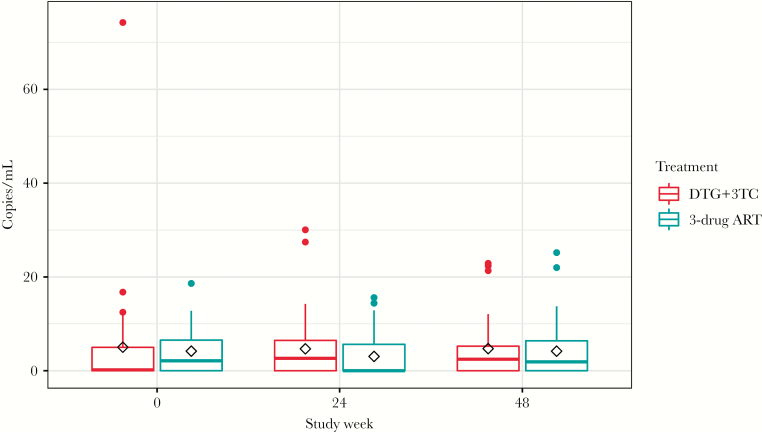
In the ASPIRE trial, antiretroviral therapy (ART) switch to dolutegravir plus lamivudine (DTG+3TC) was comparable to 3-drug ART in maintaining viral suppression by standard viral load assays. We used an ultrasensitive assay to assess whether this switch led to increased residual viremia. At entry, levels of residual viremia did not differ significantly between arms (DTG+3TC vs 3-drug ART: mean, 5.0 vs 4.2 HIV-1 RNA copies/mL; = .64). After randomization, no significant between-group differences were found at either week 24 or 48. These results show no evidence for increased viral replication on DTG+3TC and support its further investigation as a dual ART strategy.
在ASPIRE试验中,通过标准病毒载量检测,抗逆转录病毒疗法(ART)转换为多替拉韦加拉米夫定(DTG+3TC)在维持病毒抑制方面与三联ART相当。我们使用超灵敏检测法来评估这种转换是否会导致残余病毒血症增加。入组时,两组之间的残余病毒血症水平无显著差异(DTG+3TC组与三联ART组:均值分别为5.0和4.2 HIV-1 RNA拷贝/毫升;P = 0.64)。随机分组后,在第24周和第48周均未发现组间有显著差异。这些结果表明没有证据表明DTG+3TC会增加病毒复制,并支持将其作为一种双联ART策略进行进一步研究。