Department of Epidemiology, Gillings School of Public Health, University of North Carolina at Chapel Hill.
Department of Microbiology and Immunology, School of Medicine, University of North Carolina at Chapel Hill.
J Infect Dis. 2019 Jun 19;220(2):219-227. doi: 10.1093/infdis/jiz109.
Dengue virus is an emerging mosquito-borne flavivirus responsible for considerable morbidity and mortality worldwide. The Division of Intramural Research, National Institute of Allergy and Infectious Diseases of the US National Institutes of Health (NIH) has developed live attenuated vaccines to each of the 4 serotypes of dengue virus (DENV1-4). While overall levels of DENV neutralizing antibodies (nAbs) in humans have been correlated with protection, these correlations vary depending on DENV serotype, prevaccination immunostatus, age, and study site. By combining both the level and molecular specificity of nAbs to each serotype, it may be possible to develop more robust correlates that predict long-term outcome.
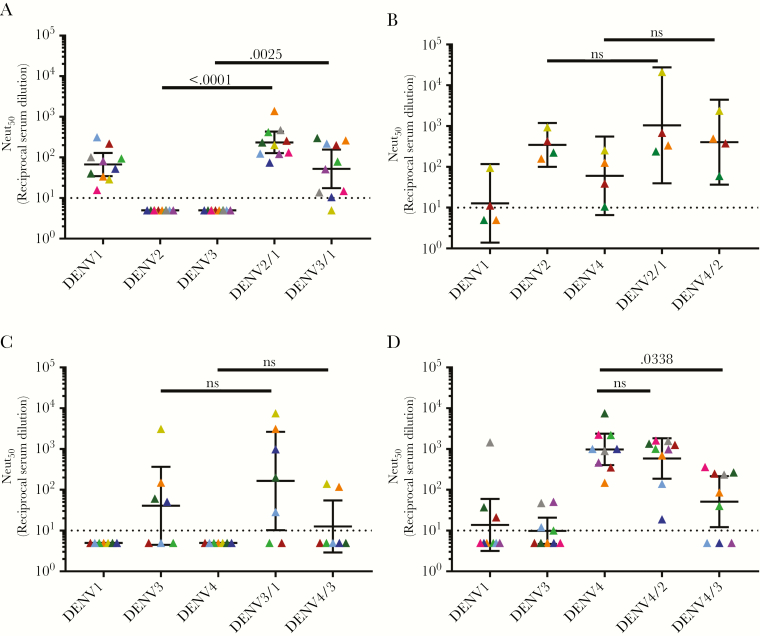
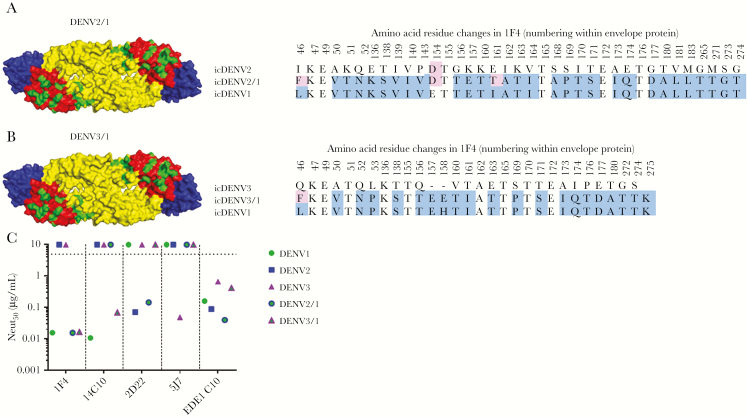
Using depletions and recombinant chimeric epitope transplant DENVs, we evaluate the molecular specificity and mapped specific epitopes and antigenic regions targeted by vaccine-induced nAbs in volunteers who received the NIH monovalent vaccines against each DENV serotype.
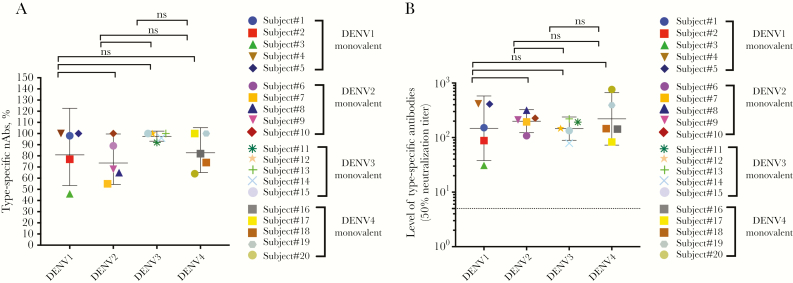
After monovalent vaccination, subjects developed high levels of nAbs that mainly targeted epitopes that are unique (type-specific) to each DENV serotype. The DENV1, 2, and 4 monovalent vaccines induced type-specific nAbs directed to quaternary structure envelope epitopes known to be targets of strongly neutralizing antibodies induced by wild-type DENV infections.
Our results reported here on the molecular specificity of NIH vaccine-induced antibodies enable new strategies, beyond the absolute levels of nAbs, for determining correlates and mechanisms of protective immunity.
登革热病毒是一种新兴的蚊媒黄病毒,在全球范围内造成了相当大的发病率和死亡率。美国国立卫生研究院(NIH)下属的国立过敏和传染病研究所(NIAID)的内部研究部门已经开发出针对登革热病毒(DENV1-4)的 4 种血清型的减毒活疫苗。虽然人类对登革热病毒的中和抗体(nAbs)总体水平与保护作用相关,但这些相关性因 DENV 血清型、接种前免疫状态、年龄和研究地点而异。通过结合每种血清型 nAbs 的水平和分子特异性,可能开发出更能预测长期结果的稳健相关指标。
使用耗尽和重组嵌合表位移植 DENVs,我们评估了接受 NIH 单价疫苗接种的志愿者中疫苗诱导的 nAbs 的分子特异性和针对的特定表位和抗原区域,这些志愿者分别针对每种 DENV 血清型接受了 NIH 单价疫苗接种。
单价疫苗接种后,受试者产生了高水平的 nAbs,主要针对每种 DENV 血清型特有的(血清型特异性)表位。DENV1、2 和 4 单价疫苗诱导的 nAbs 针对已知是野生型 DENV 感染诱导的强中和抗体靶标的四级结构包膜表位,具有血清型特异性。
我们在此报告的 NIH 疫苗诱导抗体的分子特异性的结果,为确定相关性和保护性免疫的机制提供了新策略,超越了 nAbs 的绝对水平。