Department of Veterans Affairs, Palo Alto Health Care System, Palo Alto, CA 94304, USA.
Department of Pharmacology and Toxicology, School of Pharmacy, Rutgers University, Piscataway, NJ 08854, USA.
Int J Mol Med. 2019 May;43(5):1927-1938. doi: 10.3892/ijmm.2019.4136. Epub 2019 Mar 18.
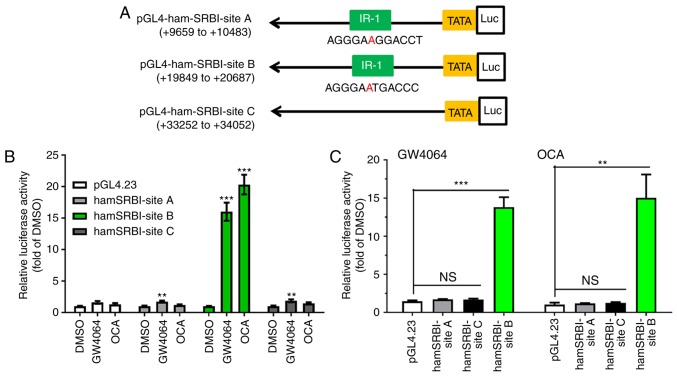
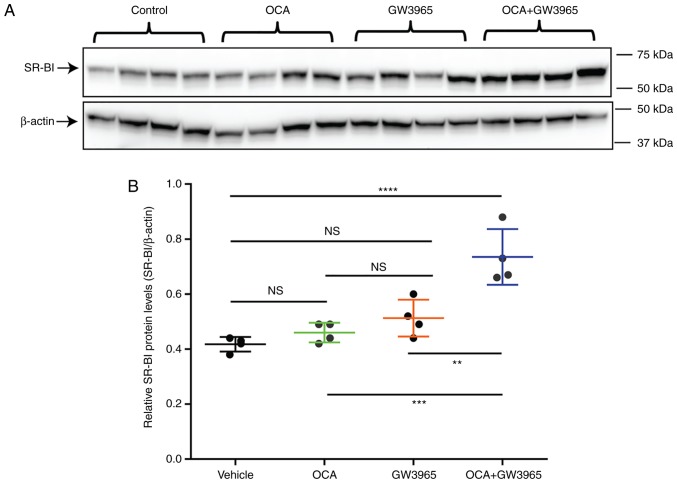
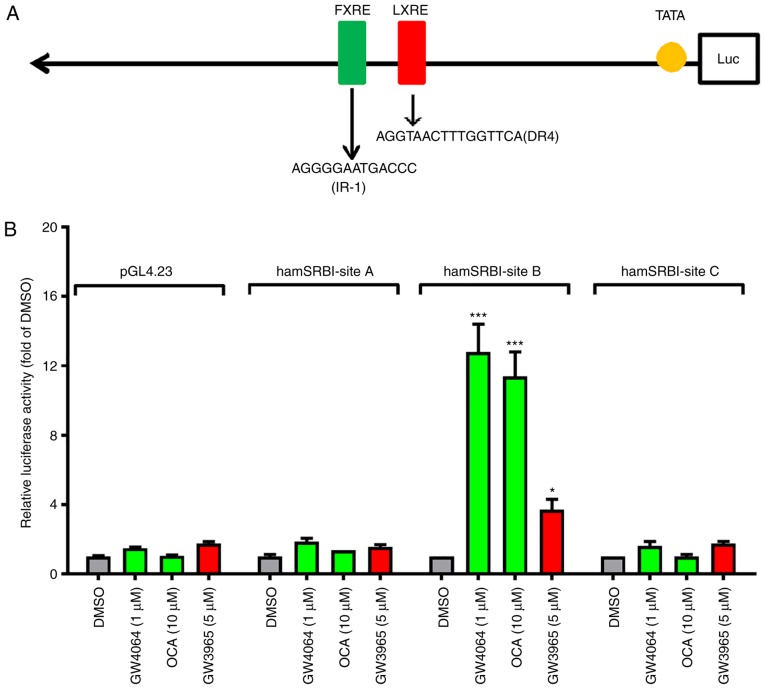
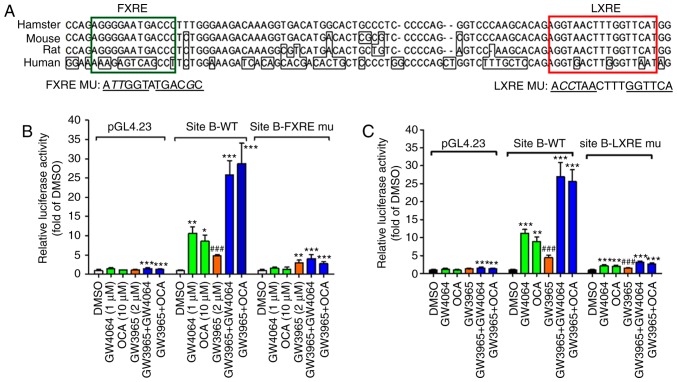
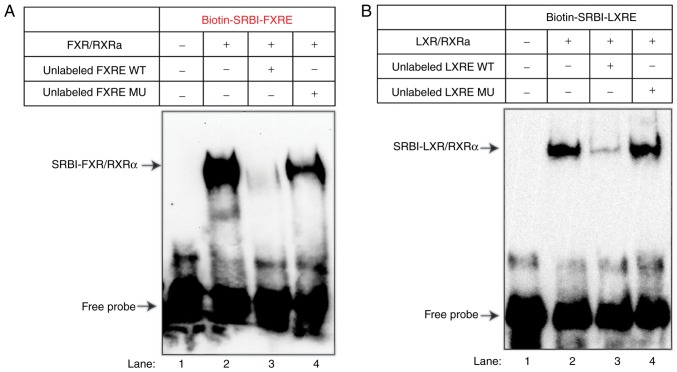
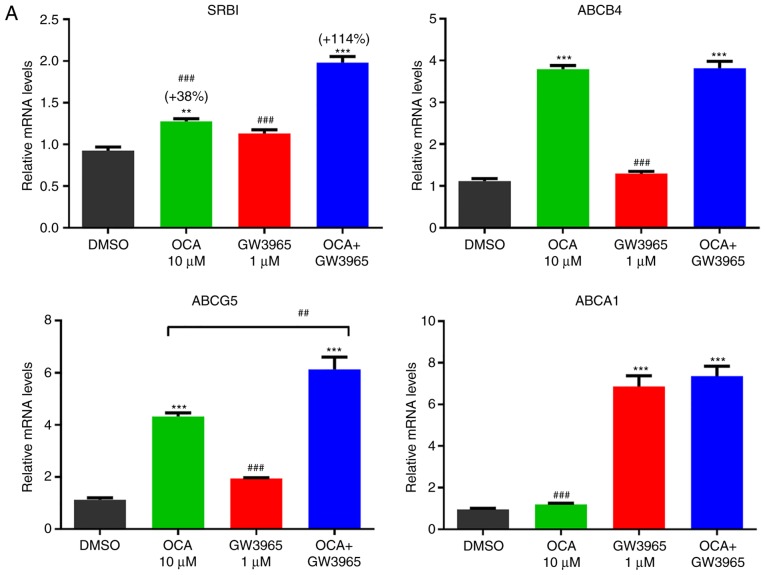
The farnesoid X receptor (FXR) is known to regulate the gene expression of SR‑BI, which mediates plasma high‑density lipoprotein (HDL)‑cholesterol uptake. Our previous study demonstrated that the activation of FXR by obeticholic acid (OCA) lowered plasma HDL‑cholesterol levels and increased the hepatic mRNA and protein expression levels of SR‑BI in hypercholesterolemic hamsters, but not in normolipidemic hamsters, suggesting that dietary cholesterol may be involved in the OCA‑induced transcription of SR‑BI. In the present study, a functional 90‑base‑pair regulatory region was identified in the first intron of the SR‑BI gene of hamster and mouse that contains a FXR response element (IR‑1) and an adjacent liver X receptor (LXR) response element (LXRE). By in vitro DNA binding and luciferase reporter gene assays, it was demonstrated that FXR and LXR bind to their recognition sequences within this intronic region and transactivate the SR‑BI reporter gene in a synergistic manner. It was also shown that mutations at either the IR‑1 site or the LXRE site eliminated OCA‑mediated gene transcription. Utilizing chow‑fed hamsters as an in vivo model, it was demonstrated that treating normolipidemic hamsters with OCA or GW3965 alone did not effectively induce levels of SR‑BI, whereas their combined treatment significantly increased the mRNA and protein levels of SR‑BI in the liver. The study further investigated effects of FXR and LXR coactivation on the gene expression of SR‑BI in human liver cells. The intronic FXRE and LXRE regulatory region was not conserved in the human SR‑BI genomic sequence, however, higher mRNA expression levels of SR‑BI were observed in human primary hepatocytes and HepG2 cells exposed to combined treatments of FXR and LXR agonists, compared with those in cells exposed to individual ligand treatment. Therefore, these results suggest that human SR‑BI gene transcription may also be subject to concerted activation by FXR and LXR, mediated via currently unidentified regulatory sequences.
法尼醇 X 受体 (FXR) 已知可调节介导血浆高密度脂蛋白 (HDL) -胆固醇摄取的清道夫受体 BI (SR-BI) 的基因表达。我们之前的研究表明,法尼醇 X 受体激动剂奥贝胆酸 (OCA) 的激活可降低血浆 HDL-胆固醇水平,并增加高脂血症仓鼠的肝脏 mRNA 和 SR-BI 蛋白表达水平,但在正常血脂仓鼠中则没有,这表明膳食胆固醇可能参与了 OCA 诱导的 SR-BI 转录。在本研究中,在仓鼠和小鼠的 SR-BI 基因的第一个内含子中鉴定出一个具有 90 个碱基对的功能调节区,该区域包含一个法尼醇 X 受体反应元件 (IR-1) 和一个相邻的肝 X 受体 (LXR) 反应元件 (LXRE)。通过体外 DNA 结合和荧光素酶报告基因检测,证实 FXR 和 LXR 结合到该内含子区域内的识别序列,并以协同方式反式激活 SR-BI 报告基因。还表明,IR-1 位点或 LXRE 位点的突变消除了 OCA 介导的基因转录。利用普通饮食喂养的仓鼠作为体内模型,结果表明,单独用 OCA 或 GW3965 处理正常血脂仓鼠并不能有效诱导 SR-BI 水平,而两者联合处理则显著增加了肝脏中 SR-BI 的 mRNA 和蛋白水平。该研究进一步研究了 FXR 和 LXR 共同激活对人肝源细胞中 SR-BI 基因表达的影响。FXRE 和 LXRE 调节区在人 SR-BI 基因组序列中并不保守,然而,与单独用配体处理的细胞相比,在人原代肝细胞和 HepG2 细胞中,同时暴露于 FXR 和 LXR 激动剂时,SR-BI 的 mRNA 表达水平更高。因此,这些结果表明,人 SR-BI 基因转录也可能受到 FXR 和 LXR 的协同激活,通过目前尚未确定的调节序列介导。