Department of Emerging and Infectious Diseases (DEID), United States Army Medical Research Directorate-Africa (USAMRD-A), Kenya Medical Research Institute (KEMRI) Kisumu, Kenya.
Department of Biochemistry, Jomo Kenyatta University of Agriculture and Technology, Nairobi, Kenya.
PLoS Negl Trop Dis. 2019 Mar 21;13(3):e0007223. doi: 10.1371/journal.pntd.0007223. eCollection 2019 Mar.
Cotrimoxazole prevents opportunistic infections including falciparum malaria in HIV-infected individuals but there are concerns of cross-resistance to other antifolate drugs such as sulphadoxine-pyrimethamine (SP). In this study, we investigated the prevalence of antifolate-resistance mutations in Plasmodium falciparum that are associated with SP resistance in HIV-infected individuals on antiretroviral treatment randomized to discontinue (STOP-CTX), or continue (CTX) cotrimoxazole in Western Kenya.
Samples were obtained from an unblinded, non-inferiority randomized controlled trial where participants were recruited on a rolling basis for the first six months of the study, then followed-up for 12 months with samples collected at enrollment, quarterly, and during sick visits.
Plasmodium DNA was extracted from blood specimens. Initial screening to determine the presence of Plasmodium spp. was performed by quantitative reverse transcriptase real-time PCR, followed by genotyping for the presence of SP-resistance associated mutations by Sanger sequencing.
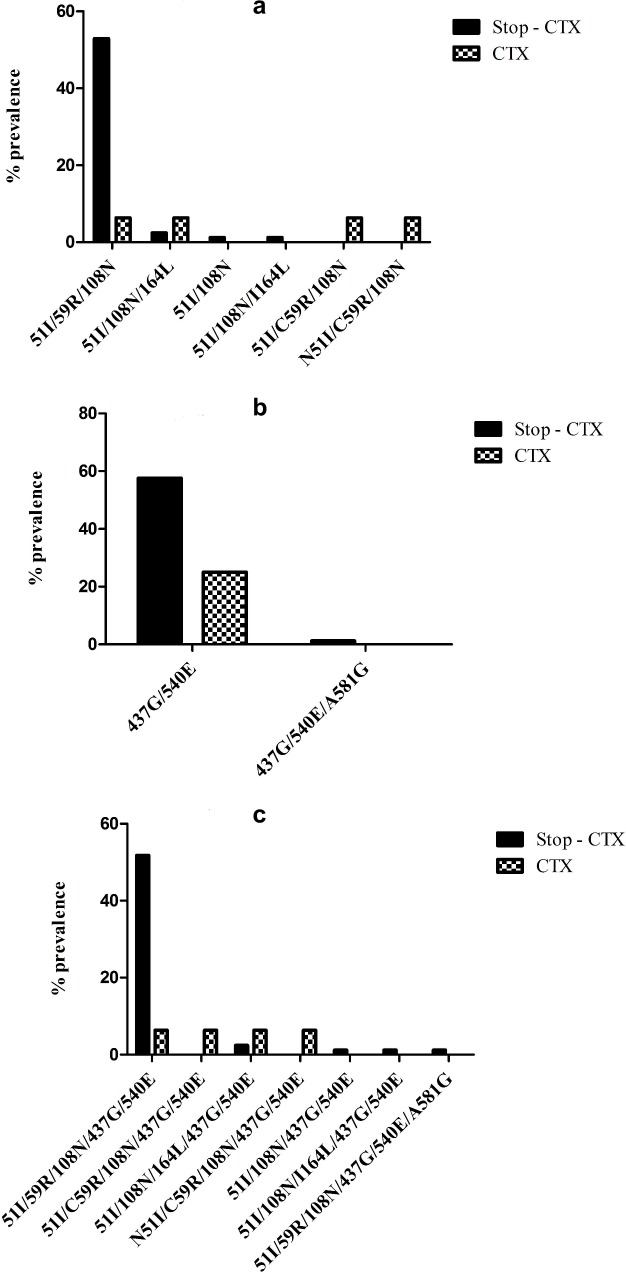
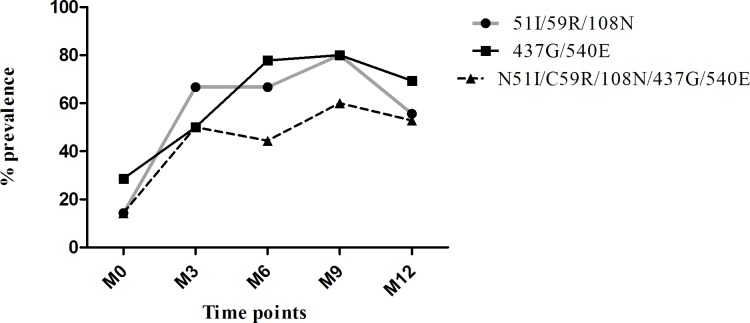
The prevalence of mutant haplotypes associated with SP-resistant parasites in pfdhfr (51I/59R/108N) and pfdhps (437G/540E) genes were significantly higher (P = 0.0006 and P = 0.027, respectively) in STOP-CTX compared to CTX arm. The prevalence of quintuple haplotype (51I/59R/108N/437G/540E) was 51.8% in STOP-CTX vs. 6.3% (P = 0.0007) in CTX arm. There was a steady increase in mutant haplotypes in both genes in STOP-CTX arm overtime through the study period, reaching statistical significance (P < 0.0001).
The frequencies of mutations in pfdhfr and pfdhps genes were higher in STOP-CTX arm compared to CTX arm, suggesting cotrimoxazole effectively controls and selects against SP-resistant parasites.
ClinicalTrials.gov NCT01425073.
复方新诺明可预防机会性感染,包括 HIV 感染者中的恶性疟原虫感染,但人们担心其会对其他叶酸拮抗剂药物(如磺胺多辛-乙胺嘧啶[SP])产生交叉耐药性。在这项研究中,我们调查了在接受抗逆转录病毒治疗的 HIV 感染者中,磺胺多辛-乙胺嘧啶耐药相关的疟原虫叶酸耐药突变的流行情况,这些感染者被随机分配停止(STOP-CTX)或继续(CTX)使用复方新诺明,地点在肯尼亚西部。
本研究样本取自一项非劣效性随机对照试验,参与者在研究的前六个月内按滚动方式招募,然后进行为期 12 个月的随访,在入组时、每季度和就诊时采集样本。
从血液标本中提取疟原虫 DNA。通过定量逆转录实时 PCR 进行初始筛查,以确定是否存在疟原虫属。然后通过 Sanger 测序进行基因分型,以确定 SP 耐药相关突变的存在。
pfdhfr(51I/59R/108N)和 pfdhps(437G/540E)基因中与 SP 耐药寄生虫相关的突变单体型的流行率在 STOP-CTX 组中明显高于 CTX 组(分别为 P = 0.0006 和 P = 0.027)。51I/59R/108N/437G/540E 五联单体型的流行率在 STOP-CTX 组中为 51.8%,CTX 组中为 6.3%(P = 0.0007)。在整个研究期间,STOP-CTX 组中这两个基因的突变单体型数量持续增加,具有统计学意义(P < 0.0001)。
与 CTX 组相比,pfdhfr 和 pfdhps 基因中的突变频率在 STOP-CTX 组中更高,这表明复方新诺明有效控制和选择了 SP 耐药寄生虫。
ClinicalTrials.gov NCT01425073。