Institute of Evolutionary Genetics, Heinrich-Heine University Dusseldorf, Düsseldorf, Germany.
School of Life Sciences, Arizona State University, Phoenix, Arizona, United States of America.
PLoS Biol. 2019 Mar 21;17(3):e3000171. doi: 10.1371/journal.pbio.3000171. eCollection 2019 Mar.
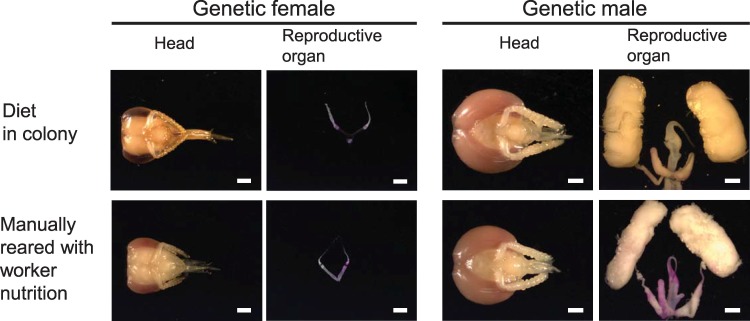
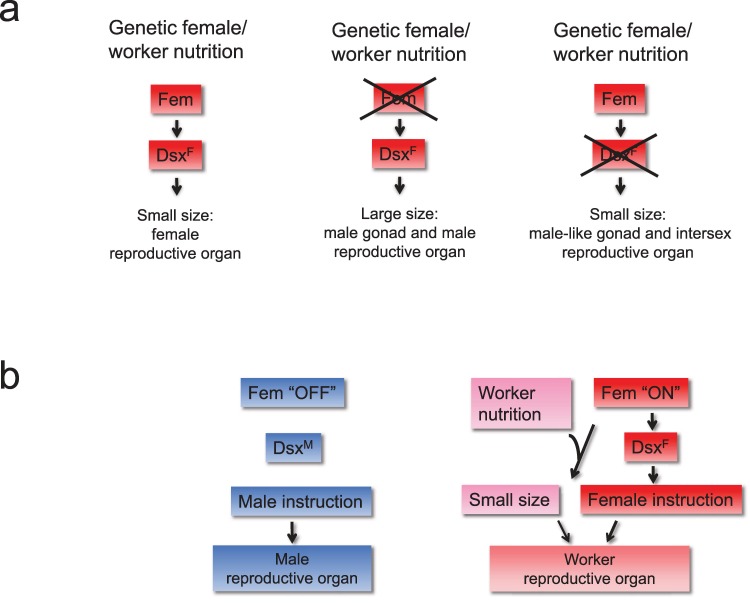
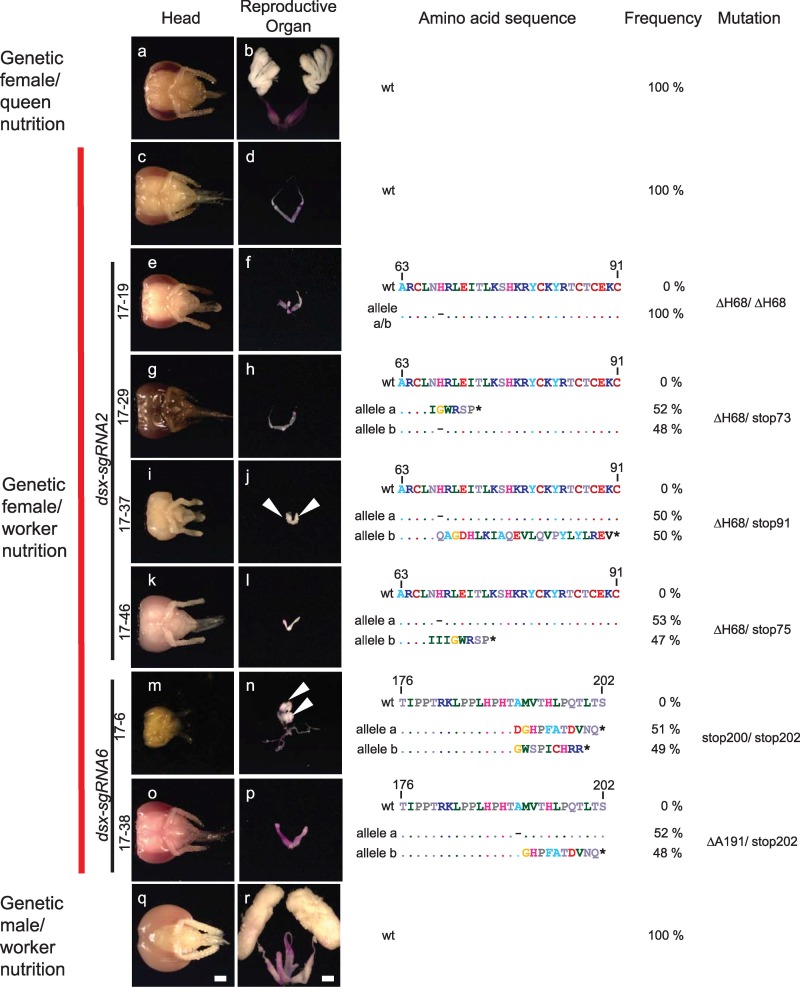
Highly social insects are characterized by caste dimorphism, with distinct size differences of reproductive organs between fertile queens and the more or less sterile workers. An abundance of nutrition or instruction via diet-specific compounds has been proposed as explanations for the nutrition-driven queen and worker polyphenism. Here, we further explored these models in the honeybee (Apis mellifera) using worker nutrition rearing and a novel mutational screening approach using the clustered regularly interspaced short palindromic repeats/CRISPR-associated protein 9 (CRISPR/Cas9) method. The worker nutrition-driven size reduction of reproductive organs was restricted to the female sex, suggesting input from the sex determination pathway. Genetic screens on the sex determination genes in genetic females for size polyphenism revealed that doublesex (dsx) mutants display size-reduced reproductive organs irrespective of the sexual morphology of the organ tissue. In contrast, feminizer (fem) mutants lost the response to worker nutrition-driven size control. The first morphological worker mutants in honeybees demonstrate that the response to nutrition relies on a genetic program that is switched "ON" by the fem gene. Thus, the genetic instruction provided by the fem gene provides an entry point to genetically dissect the underlying processes that implement the size polyphenism.
高度社会化的昆虫的特征是性别二态性,生殖器官在有生殖能力的蜂王和或多或少不育的工蜂之间存在明显的大小差异。人们提出,通过特定饮食化合物提供丰富的营养或指导,可以解释营养驱动的蜂王和工蜂多态性。在这里,我们使用工蜂营养饲养和一种使用成簇规律间隔短回文重复/CRISPR 相关蛋白 9(CRISPR/Cas9)方法的新型突变筛选方法,进一步探索了蜜蜂(Apis mellifera)中的这些模型。生殖器官大小的这种由工蜂营养驱动的减小仅限于雌性,表明这是由性别决定途径输入的。对雌性遗传性别决定基因的大小多态性遗传筛选表明, doublesex(dsx)突变体显示出生殖器官减小,而与器官组织的性别形态无关。相比之下, feminizer(fem)突变体失去了对工蜂营养驱动大小控制的反应。在蜜蜂中首次出现的形态学工蜂突变体表明,对营养的反应依赖于一个遗传程序,该程序由 fem 基因“开启”。因此,fem 基因提供的遗传指令为从遗传上剖析实现大小多态性的潜在过程提供了一个切入点。