Academic Unit of Palliative Care, Leeds Institute of Health Sciences (LIHS), School of Medicine, University of Leeds, Room 10.39, Level 10, Worsley Building, Clarendon Way, Leeds, LS2 9NL, UK.
Academic Unit of Public Health, Leeds Institute of Health Sciences, University of Leeds, Leeds, UK.
BMC Med. 2019 Mar 22;17(1):50. doi: 10.1186/s12916-019-1287-8.
Studies have shown that more than half of patients with advanced progressive diseases approaching the end-of-life report pain and that pain relief for these patients is poorest at home compared to other care settings such as acute care facilities and hospice. Although home is the most common preferred place of death, the majority of deaths occur outside the home. Specialist palliative care is associated with improved quality of life, but systematic reviews of RCTs have failed to show a consistent association with better pain relief. The aim of this study was to examine the factors associated with good pain relief at home in the last 3 months of life for people with advanced progressive disease.
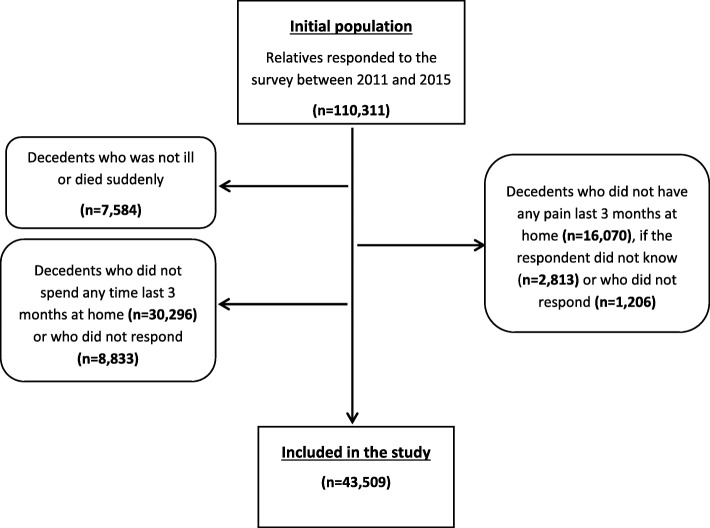
Data were obtained from the National Bereavement Survey in England, a cross-sectional post-bereavement survey of a stratified random sample of 246,763 deaths which were registered in England from 2011 to 2015. From 110,311 completed surveys (45% response rate), the analysis was based on individual-level data from 43,509 decedents who were cared for at home before death.
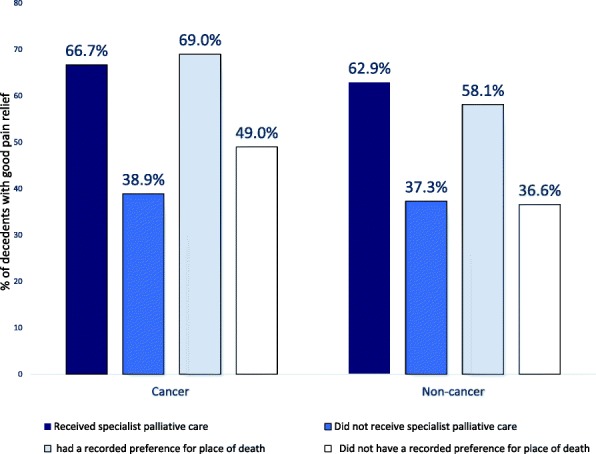
Decedents who experienced good pain relief at home before death were significantly more likely to have received specialist palliative care (adjusted OR = 2.67; 95% CI, 2.62 to 2.72) and to have a recorded preferred place of death (adjusted OR = 1.87; 95% CI, 1.84 to 1.90) compared to those who did not. Good pain relief was more likely to be reported by a spouse or partner of the decedents compared to reports from their son or daughter (adjusted OR = 1.50, 95% CI, 1.47 to 1.53).
This study indicates that patients at home who are approaching the end-of-life experience substantially better pain relief if they receive specialist palliative care and their preferred place of death is recorded regardless of their disease aetiology.
研究表明,超过一半的晚期进展性疾病患者在接近生命终点时会报告疼痛,与急性护理机构和临终关怀等其他护理环境相比,这些患者在家中缓解疼痛的效果最差。尽管家是最常见的首选死亡地点,但大多数死亡发生在家庭之外。专科姑息治疗与提高生活质量相关,但 RCT 的系统评价未能显示与更好的疼痛缓解有一致的关联。本研究旨在探讨晚期进展性疾病患者在生命的最后 3 个月内在家中获得良好疼痛缓解的相关因素。
数据来自英格兰全国丧亲调查,这是一项针对英格兰 2011 年至 2015 年期间注册的分层随机样本 246763 例死亡的横断面事后调查。在完成的 110311 份调查(45%的回复率)中,分析基于 43509 名在家中接受护理后死亡的死者的个人水平数据。
在家中死亡前经历良好疼痛缓解的死者,明显更有可能接受专科姑息治疗(调整后的 OR=2.67;95%CI,2.62 至 2.72),并且有记录的首选死亡地点(调整后的 OR=1.87;95%CI,1.84 至 1.90),而不是没有记录的。与子女的报告相比,死者的配偶或伴侣更有可能报告良好的疼痛缓解(调整后的 OR=1.50;95%CI,1.47 至 1.53)。
本研究表明,如果在家中接受专科姑息治疗并记录其首选死亡地点,无论其疾病病因如何,接近生命终点的患者在家中经历的疼痛缓解效果会显著更好。