Institute for Global Health, University College London, London, UK.
Department of Epidemiology, Harvard T. H. Chan School of Public Health, Boston, Massachusetts, USA.
BMJ Open. 2019 Mar 20;9(3):e023272. doi: 10.1136/bmjopen-2018-023272.
Female bar workers (FBW) in East Africa often conduct sex work to supplement their incomes, and may be vulnerable to HIV acquisition. Pre-exposure prophylaxis (PrEP) offers protection against HIV acquisition. However, there is little research on FBW's sexual health. Our objective was to determine HIV risk behaviours and interest in PrEP among FBW in the largest city in East Africa.
Cross-sectional survey covering respondents' work and personal lives, including social and behavioural risk factors for HIV. The survey aimed to determine the feasibility of working with FBW and HIV prevalence estimates. Those who did not report being HIV positive were asked about their knowledge of and interest in PrEP. All women were offered free on-site HIV testing and counselling (HTC).
Eight randomly selected workplaces, that is, bars, in Kinondoni district, Dar es Salaam (DSM).
66 FBW (≥18 years) selected at random from all women working in selected bars on the day of visit.
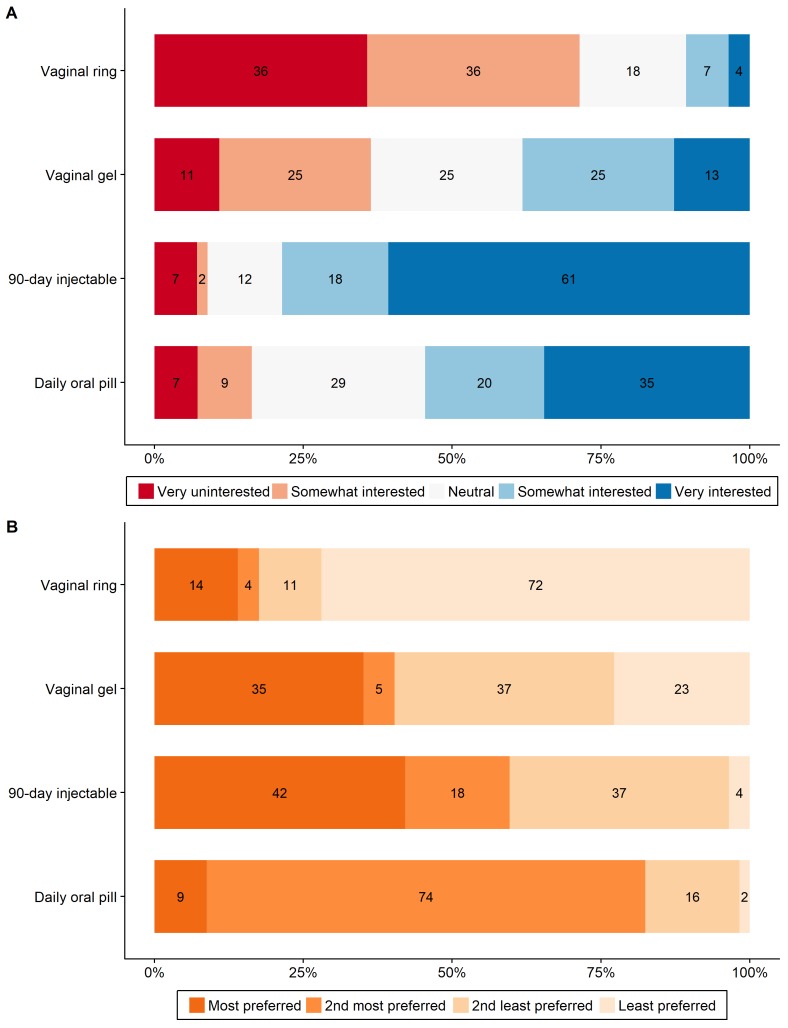
Half of respondents reported having had sex for money: 20% with bar clients only, 15% with other men only and 15% with both. Almost all (98%) reported ≥1 non-commercial partners in the past 12 months; only 30% reported using condoms with these partners. 85% of respondents had ever been pregnant; 44% had had an unintended pregnancy. Only 5% of respondents had ever heard of PrEP. However, 54% were somewhat/very interested in daily-pill PrEP and 79% were somewhat/very interested in long-acting injectable PrEP. When asked to rank modalities, long-acting injectable PrEP was the most preferred. Seven per cent of the 56 respondents who completed HTC tested HIV positive.
FBW in DSM have elevated risk factors for HIV acquisition, and PrEP appears highly acceptable. Studies developing PrEP delivery models and assessing PrEP initiation and adherence in FBW appear warranted.
东非的女性酒吧工作者(FBW)通常从事性工作以补充收入,并且可能容易感染艾滋病毒。暴露前预防(PrEP)可提供预防艾滋病毒感染的保护。然而,针对 FBW 的性健康研究甚少。我们的目的是确定东非最大城市中 FBW 的艾滋病毒风险行为和对 PrEP 的兴趣。
横断面调查涵盖了受访者的工作和个人生活,包括艾滋病毒感染的社会和行为风险因素。该调查旨在确定与 FBW 合作的可行性和 HIV 流行率估计。那些未报告 HIV 阳性的人被询问他们对 PrEP 的了解程度和兴趣。所有女性都获得了现场免费艾滋病毒检测和咨询(HTC)。
坦桑尼亚达累斯萨拉姆市基隆多尼区的 8 个随机选定的工作场所,即酒吧。
从当天访问的选定酒吧中随机挑选的 66 名(≥18 岁)FBW。
一半的受访者报告有过卖淫行为:20%只与酒吧顾客发生性关系,15%只与其他男性发生性关系,15%两者都有。几乎所有(98%)受访者报告在过去 12 个月中有≥1 个非商业性伴侣;只有 30%的人在与这些伴侣发生性关系时使用了避孕套。85%的受访者曾怀孕;44%曾意外怀孕。只有 5%的受访者听说过 PrEP。然而,54%的人对每日药丸 PrEP 有些/非常感兴趣,79%的人对长效注射型 PrEP 有些/非常感兴趣。当被要求对各种方案进行排序时,长效注射型 PrEP 是最受欢迎的。在完成 HTC 的 56 名受访者中,有 7%的人 HIV 检测呈阳性。
DSM 的 FBW 具有较高的艾滋病毒感染风险因素,并且 PrEP 似乎非常受欢迎。开展 PrEP 提供模式的研究并评估 FBW 中 PrEP 的启动和坚持情况似乎是合理的。