Division of Learning and Knowledge Systems, Department of Learning Health Sciences and.
Division of Nephrology, Department of Internal Medicine, University of Michigan Medical School, Ann Arbor, Michigan.
Clin J Am Soc Nephrol. 2019 Apr 5;14(4):523-529. doi: 10.2215/CJN.10370818. Epub 2019 Mar 21.
Many aspects of CKD management rely heavily on patient self-care, including medication and dietary adherence, self-monitoring of BP, and daily physical activity. Growing evidence suggests that incorporating smartphone-based applications can support self-care in CKD and chronic disease more generally.
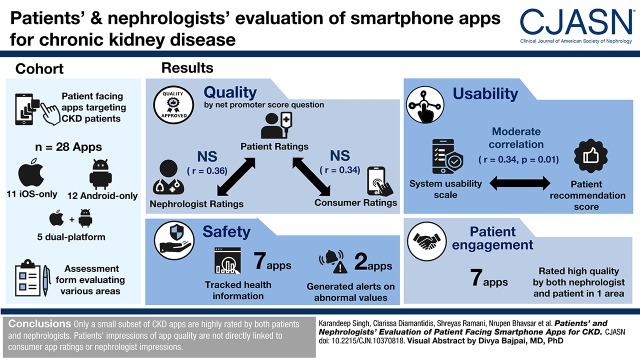
DESIGN, SETTING, PARTICIPANTS, & MEASUREMENTS: We identified applications targeting patients with CKD by conducting a search of the US Apple App Store (iOS) and Google Play Store (Android) using the following four phrases: "kidney disease," "renal," "dialysis," and "kidney transplant." We considered the first 50 applications for each search term on each application store. We adapted a previously described framework for assessment of mobile health applications to account for kidney disease-specific content areas and evaluated applications on their types of patient engagement, quality, usability, and safety. Engagement and quality were assessed by both a patient and a nephrologist, usability was assessed by a patient, and safety was assessed by a nephrologist. Overall, two patients with CKD and three nephrologists performed the evaluations. We examined pairwise correlations between patient, nephrologist, and consumer ratings of application quality.
Our search strategy identified 174 unique applications on Android and 165 unique applications on iOS. After excluding applications that were not related to kidney disease, were not patient facing, or were last updated before 2014, 12 Android-only applications, 11 iOS-only applications, and five dual-platform applications remained. Patient and nephrologist application quality ratings, assessed by the net promoter score, were not correlated (=0.36; =0.06). Consumer ratings on the application stores did not correlate with patient ratings of application quality (=0.34; =0.18).
Only a small subset of CKD applications was highly rated by both patients and nephrologists. Patients' impressions of application quality are not directly linked to consumer application ratings or nephrologist impressions.
CKD 管理的许多方面都严重依赖于患者的自我护理,包括药物和饮食依从性、血压自我监测以及日常体育活动。越来越多的证据表明,基于智能手机的应用程序可以支持 CKD 患者乃至更广泛的慢性疾病患者的自我护理。
设计、地点、参与者和测量:我们通过在美国苹果应用商店(iOS)和谷歌应用商店(Android)上使用以下四个短语搜索针对 CKD 患者的应用程序,从而确定了针对 CKD 患者的应用程序:“肾病”、“肾脏”、“透析”和“肾脏移植”。我们考虑了每个应用商店每个搜索词的前 50 个应用程序。我们采用了一个以前描述的用于评估移动健康应用程序的框架,以考虑肾脏疾病的特定内容领域,并根据患者参与度、质量、可用性和安全性对应用程序进行评估。参与度和质量由患者和肾病医生进行评估,可用性由患者评估,安全性由肾病医生评估。总的来说,两名 CKD 患者和三名肾病医生进行了评估。我们检查了患者、肾病医生和消费者对应用程序质量的评价之间的两两相关性。
我们的搜索策略在 Android 上确定了 174 个独特的应用程序,在 iOS 上确定了 165 个独特的应用程序。排除与肾脏疾病无关、不是面向患者的、或最后更新时间在 2014 年之前的应用程序后,剩下 12 个仅在 Android 上的应用程序、11 个仅在 iOS 上的应用程序和 5 个双平台应用程序。通过净推荐值评估的患者和肾病医生的应用程序质量评分不相关(=0.36;=0.06)。应用程序商店上的消费者评分与患者对应用程序质量的评分不相关(=0.34;=0.18)。
只有一小部分 CKD 应用程序得到了患者和肾病医生的高度评价。患者对应用程序质量的印象与消费者应用程序评分或肾病医生的印象没有直接联系。