Humboldt-Universität zu Berlin, Institute of Biology, Theoretical Biophysics, Berlin, 10099, Germany.
Bioinformatics Center, Institute for Chemical Research, Kyoto University, Kyoto, 611-0011, Japan.
Nat Commun. 2019 Mar 21;10(1):1308. doi: 10.1038/s41467-019-08903-w.
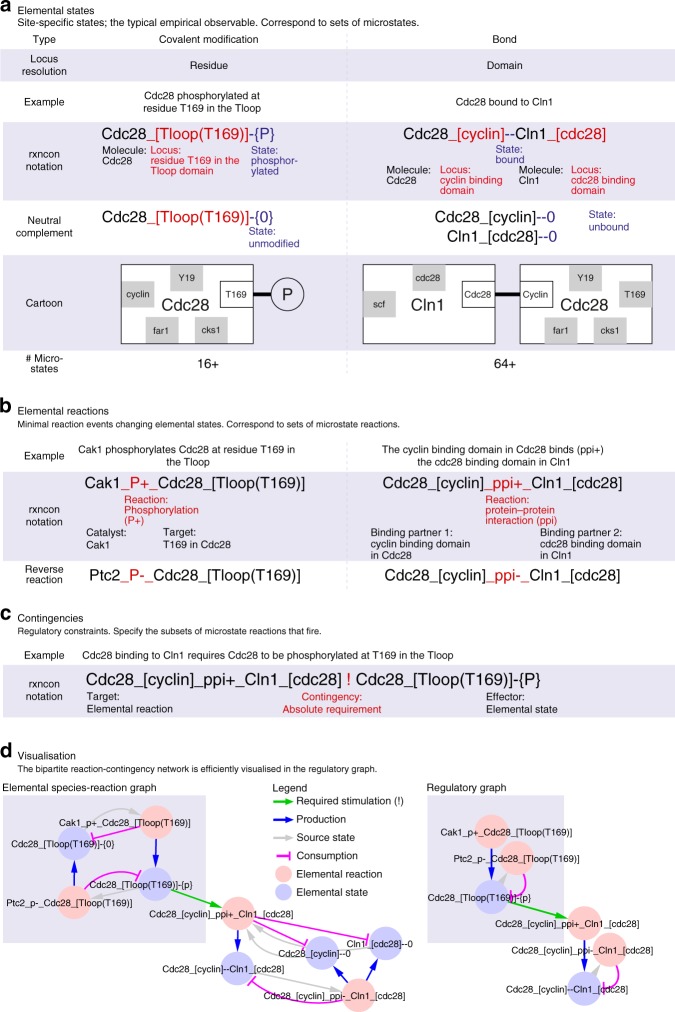
Understanding how cellular functions emerge from the underlying molecular mechanisms is a key challenge in biology. This will require computational models, whose predictive power is expected to increase with coverage and precision of formulation. Genome-scale models revolutionised the metabolic field and made the first whole-cell model possible. However, the lack of genome-scale models of signalling networks blocks the development of eukaryotic whole-cell models. Here, we present a comprehensive mechanistic model of the molecular network that controls the cell division cycle in Saccharomyces cerevisiae. We use rxncon, the reaction-contingency language, to neutralise the scalability issues preventing formulation, visualisation and simulation of signalling networks at the genome-scale. We use parameter-free modelling to validate the network and to predict genotype-to-phenotype relationships down to residue resolution. This mechanistic genome-scale model offers a new perspective on eukaryotic cell cycle control, and opens up for similar models-and eventually whole-cell models-of human cells.
理解细胞功能如何从基础的分子机制中涌现出来是生物学面临的一个关键挑战。这将需要计算模型,其预测能力预计将随着表述的涵盖范围和精度的提高而提高。基因组规模模型彻底改变了代谢领域,并使得构建第一个全细胞模型成为可能。然而,由于缺乏信号网络的基因组规模模型,真核生物全细胞模型的发展受到了阻碍。在这里,我们提出了一个控制酿酒酵母细胞分裂周期的分子网络的综合机制模型。我们使用 rxncon(反应依赖语言)来消除可表达性、可视化和模拟基因组规模信号网络所面临的扩展性问题。我们使用无参数建模来验证网络,并预测到残基分辨率的基因型到表型关系。这个基于机制的基因组规模模型为真核细胞周期控制提供了一个新的视角,并为人类细胞的类似模型——最终是全细胞模型——开辟了道路。