Department of Biotechnology and Biosciences, University of Milano-Bicocca, Milan, Italy.
Harvard Medical School and Division of Gastroenterology, Boston Children's Hospital, Boston, Massachusetts, USA.
J Leukoc Biol. 2019 Jul;106(1):147-160. doi: 10.1002/JLB.3MIR1218-483RR. Epub 2019 Mar 22.
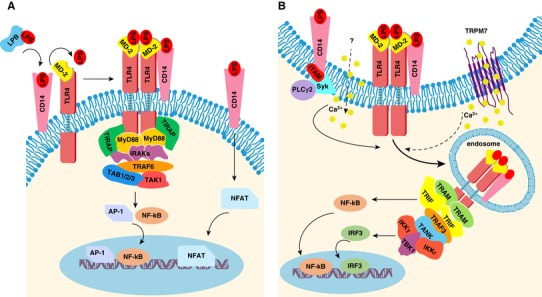
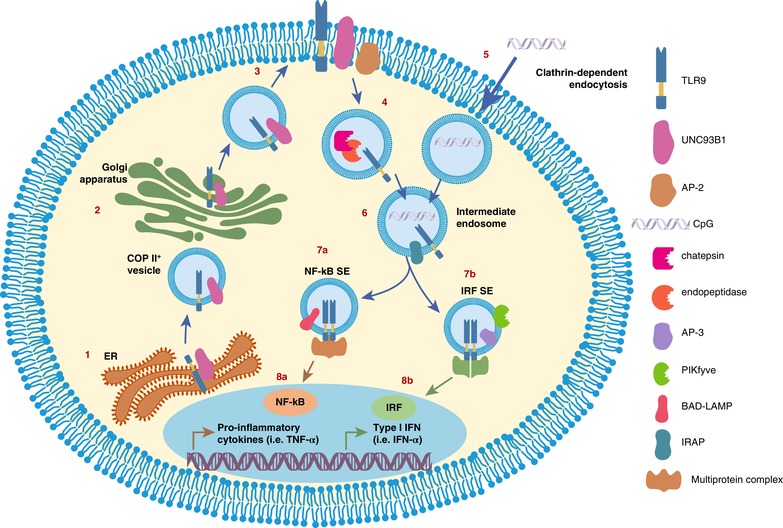
TLRs are a class of pattern recognition receptors (PRRs) that detect invading microbes by recognizing pathogen-associated molecular patterns (PAMPs). Upon PAMP engagement, TLRs activate a signaling cascade that leads to the production of inflammatory mediators. The localization of TLRs, either on the plasma membrane or in the endolysosomal compartment, has been considered to be a fundamental aspect to determine to which ligands the receptors bind, and which transduction pathways are induced. However, new observations have challenged this view by identifying complex trafficking events that occur upon TLR-ligand binding. These findings have highlighted the central role that endocytosis and receptor trafficking play in the regulation of the innate immune response. Here, we review the TLR4 and TLR9 transduction pathways and the importance of their different subcellular localization during the inflammatory response. Finally, we discuss the implications of TLR9 subcellular localization in autoimmunity.
TLRs 是一类模式识别受体 (PRRs),通过识别病原体相关分子模式 (PAMPs) 来检测入侵的微生物。在 PAMP 结合后,TLRs 激活信号级联反应,导致炎症介质的产生。TLRs 的定位,无论是在质膜上还是在内体溶酶体区室中,被认为是决定受体结合哪些配体以及诱导哪些转导途径的基本方面。然而,新的观察结果通过识别 TLR-配体结合时发生的复杂运输事件对这一观点提出了挑战。这些发现强调了胞吞作用和受体运输在调节先天免疫反应中的核心作用。在这里,我们回顾了 TLR4 和 TLR9 的转导途径以及它们在炎症反应过程中不同亚细胞定位的重要性。最后,我们讨论了 TLR9 亚细胞定位在自身免疫中的意义。