Collaboration for Evidence, Research and Impact in Public Health, School of Public Health, Curtin University, Kent Street, Bentley, WA 6102, Australia.
Communicable Disease Control Branch, Public Health and Clinical Systems, Department for Health and Wellbeing, Government of South Australia, Adelaide, SA 5000, Australia.
Int J Environ Res Public Health. 2019 Mar 21;16(6):1034. doi: 10.3390/ijerph16061034.
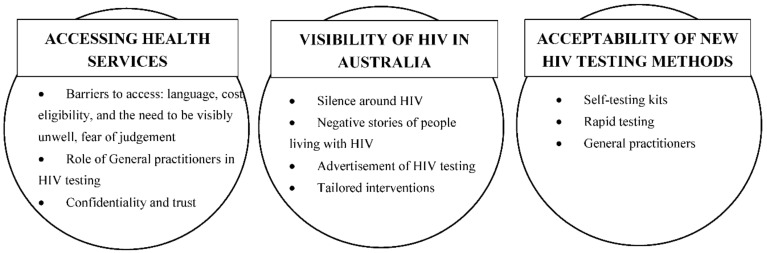
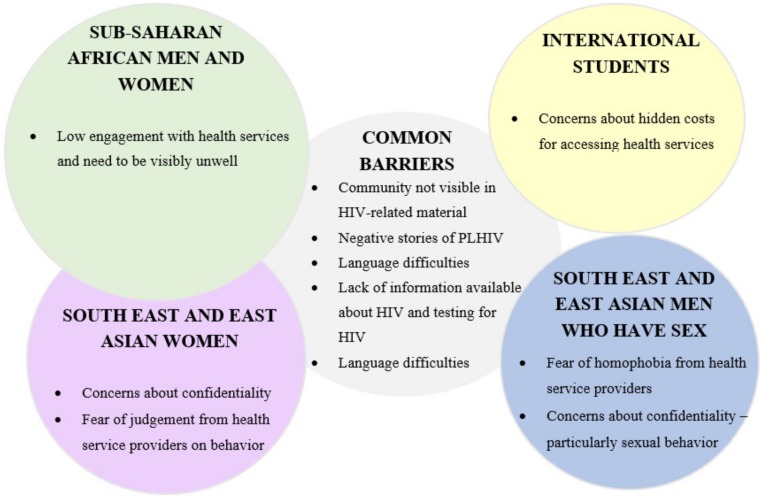
People born in sub-Saharan Africa and Southeast Asia are overrepresented in HIV notifications in Australia. Just under half of all notifications among people from sub-Saharan Africa and Southeast Asia are diagnosed late. Increased HIV testing among these communities is necessary to ensure early diagnosis, better care and reduce likelihood of HIV onward transmission. Recently, Australia has made new HIV testing methods available: rapid HIV testing and self-testing kits. We conducted 11 focus groups with 77 participants with people from sub-Saharan Africa, Southeast Asia and Northeast Asia in four jurisdictions in Australia. Focus groups discussed barriers to HIV testing and the acceptability of new testing methods. Barriers to HIV testing included: cost and eligibility of health services, low visibility of HIV in Australia, HIV-related stigma, and missed opportunities by general practitioners (GPs) for early diagnosis of HIV and linkage into care. Participants had low levels of knowledge on where to test for HIV and the different methods available. Diverse opportunities for testing were considered important. Interventions to increase HIV testing rates among sub-Saharan African, Southeast Asia and Northeast Asian migrants in Australia need to be multi-strategic and aimed at individual, community and policy levels. New methods of HIV testing, including rapid HIV testing and self-testing, present an opportunity to engage with migrants outside of traditional health care settings.
在澳大利亚,感染艾滋病毒的通报病例中,撒哈拉以南非洲和东南亚的人数比例过高。在撒哈拉以南非洲和东南亚的所有通报病例中,几乎有一半的人被诊断为晚期。需要在这些社区中增加艾滋病毒检测,以确保早期诊断、更好的护理,并降低艾滋病毒传播的可能性。最近,澳大利亚提供了新的艾滋病毒检测方法:快速艾滋病毒检测和自我检测试剂盒。我们在澳大利亚的四个司法管辖区进行了 11 次焦点小组讨论,共有来自撒哈拉以南非洲、东南亚和东北亚的 77 名参与者参加。焦点小组讨论了艾滋病毒检测的障碍以及新检测方法的可接受性。艾滋病毒检测的障碍包括:卫生服务的费用和资格、澳大利亚对艾滋病毒的低可见度、与艾滋病毒相关的耻辱感、以及全科医生(GP)错过早期诊断艾滋病毒和将患者纳入护理的机会。参与者对在哪里进行艾滋病毒检测以及可用的不同方法知之甚少。人们认为有多样化的检测机会很重要。为了提高澳大利亚撒哈拉以南非洲、东南亚和东北亚移民的艾滋病毒检测率,需要采取多方面的策略,针对个人、社区和政策层面。艾滋病毒新的检测方法,包括快速艾滋病毒检测和自我检测,为在传统医疗保健环境之外与移民接触提供了机会。