Institute for Diabetes and Obesity, Helmholtz Diabetes Center at Helmholtz Zentrum München, German Research Center for Environmental Health (GmbH), 85764 Neuherberg, Germany; Division of Metabolic Diseases, Department of Medicine, Technische Universität München, 80333 Munich, Germany; German Center for Diabetes Research (DZD), 85764 Neuherberg, Germany.
Institute for Diabetes and Obesity, Helmholtz Diabetes Center at Helmholtz Zentrum München, German Research Center for Environmental Health (GmbH), 85764 Neuherberg, Germany; German Center for Diabetes Research (DZD), 85764 Neuherberg, Germany.
Mol Metab. 2019 May;23:75-81. doi: 10.1016/j.molmet.2019.02.011. Epub 2019 Mar 7.
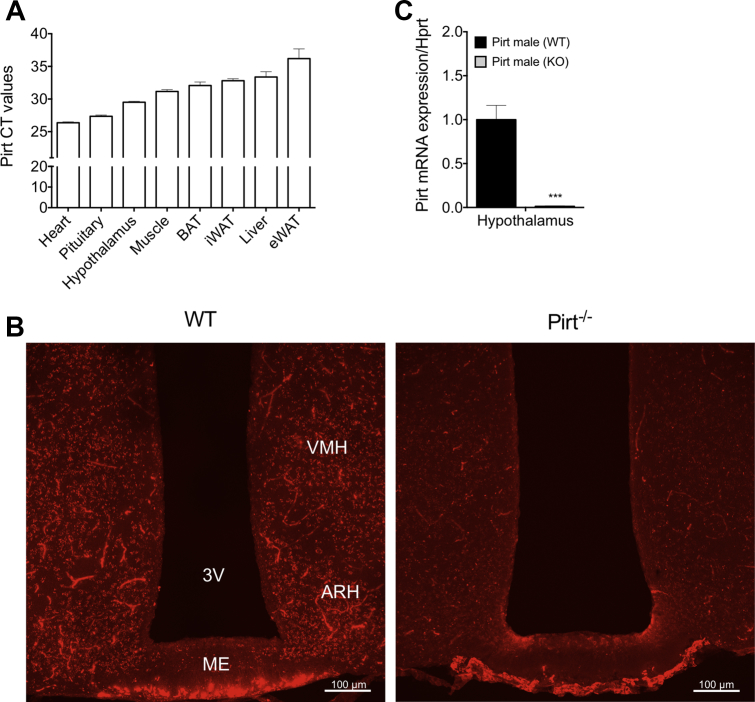
The contribution of brown adipose tissue (BAT) to adult human metabolic control is a topic of ongoing investigation. In context, understanding the cellular events leading to BAT uncoupling, heat production, and energy expenditure is anticipated to produce significant insight into this endeavor. The phosphoinositide interacting regulator of transient receptor potentials (Pirt) was recently put forward as a key protein regulating cold sensing downstream of the transient receptor potential melastatin 8 (TRPM8). Notably, TRPM8 has been identified as a non-canonical regulator of BAT thermogenesis. The aim of this investigation was to delineate the role of Pirt in energy homeostasis and glucose metabolism - and the possible involvement of Pirt in TRPM8-elicited energy expenditure.
To this end, we metabolically phenotyped male and female Pirt deficient (Pirt) mice exposed to a low-fat chow diet or to a high-fat, high-sugar (HFHS) diet.
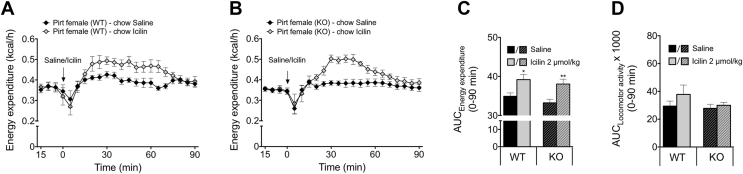
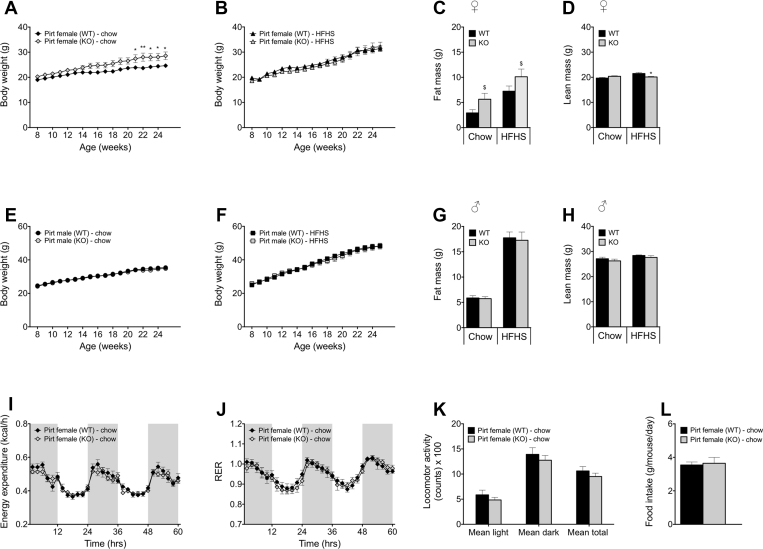
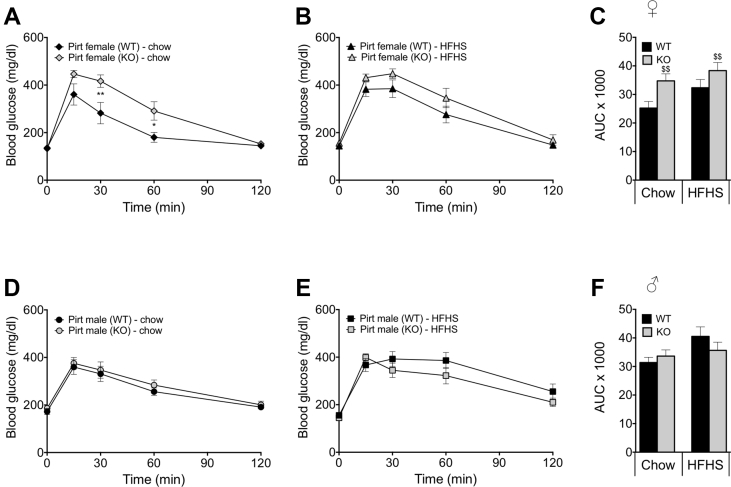
We identified that chow-fed female Pirt mice have an increased susceptibility to develop obesity and glucose intolerance. This effect is abrogated when the mice are exposed to a HFHS diet. Conversely, Pirt male mice display no metabolic phenotype on either diet relative to wild-type (WT) control mice. Finally, we observed that Pirt is dispensable for TRPM8-evoked energy expenditure.
We here report subtle metabolic abnormalities in female, but not male, Pirt mice. Future studies are required to tease out if metabolic stressors beyond dietary interventions, e.g. temperature fluctuations, are interacting with Pirt-signaling and metabolic control in a sex-specific fashion.
棕色脂肪组织(BAT)对成人代谢控制的贡献是当前研究的一个课题。在此背景下,了解导致 BAT 解偶联、产热和能量消耗的细胞事件,预计将为这一研究提供重要的见解。磷酸肌醇相互作用的瞬时受体电位调节剂(Pirt)最近被提出是调节瞬时受体电位 melastatin 8(TRPM8)下游冷感受的关键蛋白。值得注意的是,TRPM8 已被确定为 BAT 产热的非经典调节剂。本研究旨在阐明 Pirt 在能量平衡和葡萄糖代谢中的作用,以及 Pirt 可能在 TRPM8 引发的能量消耗中的作用。
为此,我们对暴露于低脂饲料或高脂肪、高糖(HFHS)饮食的雄性和雌性 Pirt 缺陷(Pirt)小鼠进行代谢表型分析。
我们发现,喂食低脂饲料的雌性 Pirt 小鼠更容易肥胖和出现葡萄糖不耐受。当这些小鼠暴露于 HFHS 饮食时,这种影响会被消除。相反,雄性 Pirt 小鼠在两种饮食条件下与野生型(WT)对照小鼠相比,没有表现出代谢表型。最后,我们观察到 Pirt 对于 TRPM8 引发的能量消耗是可有可无的。
我们在此报告了雌性 Pirt 小鼠存在微妙的代谢异常,但雄性 Pirt 小鼠则没有。需要进一步的研究来梳理除了饮食干预之外的代谢应激源,例如温度波动,是否以性别特异性的方式与 Pirt 信号和代谢控制相互作用。