Institute of Cancer and Genomic Sciences, University of Birmingham, Birmingham, UK.
Department of Complex Genetics, Nutrition and Translational Research in Metabolism (School NUTRIM), Maastricht University, PO Box 616, 6200 MD, Maastricht, The Netherlands.
World J Urol. 2019 Dec;37(12):2747-2753. doi: 10.1007/s00345-019-02728-4. Epub 2019 Mar 23.
Due to the high risk of recurrence of non-muscle invasive bladder cancer, all patients undergo regular cystoscopic surveillance for early detection. As cystoscopy is invasive, costly and increases the burden of the disease considerably, there is significant ongoing research and development into non-invasive urinary biomarker substitutes. This study aims to assess the level of sensitivity required before patients accept a new urinary biomarker.
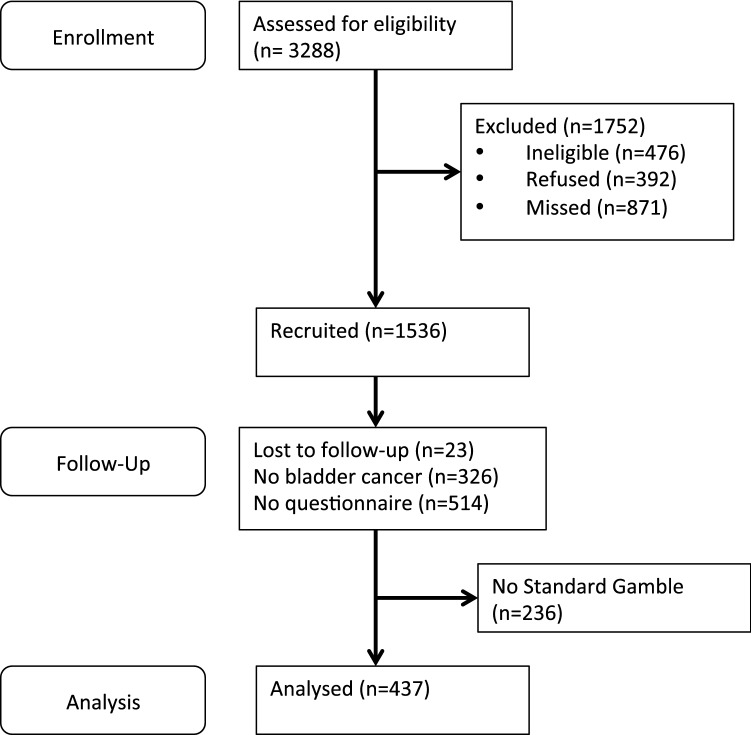
We studied the preferences for a hypothetical diagnostic urinary biomarker and compared this to usual care (cystoscopy) at different levels of sensitivity among 437 patients with bladder cancer (354 men and 83 women) from the UK Bladder Cancer Prognosis Programme. A standard gamble approach was used to estimate the minimally acceptable sensitivity (MAS) of the new biomarker. Additionally, non-parametric statistical analyses were performed to investigate the association between surveillance preference and various patient characteristics.
Almost half of patients (183, 43%) would not replace cystoscopy with a urinary biomarker unless it was 100% sensitive. The median MAS was 99.9999%, and nearly 85% of patients demanded a sensitivity of at least 99% before preferring a urinary biomarker test over cystoscopy. These results were consistent across all patient characteristics and demographic categories.
Our results indicate that patients demand urinary biomarkers as sensitive as cystoscopy before they would be willing to forego cystoscopy for bladder cancer surveillance.
由于非肌肉浸润性膀胱癌复发的风险较高,所有患者都需要定期进行膀胱镜检查以进行早期检测。由于膀胱镜检查具有侵入性、成本高且会显著增加疾病负担,因此目前正在进行大量研究和开发非侵入性尿液生物标志物替代物。本研究旨在评估患者接受新的尿液生物标志物之前所需的敏感性水平。
我们研究了 437 名膀胱癌患者(354 名男性和 83 名女性)对假设的诊断性尿液生物标志物的偏好,并将其与常规护理(膀胱镜检查)进行了比较,比较了不同敏感性水平下的偏好。使用标准博弈方法估计新生物标志物的最小可接受敏感性(MAS)。此外,还进行了非参数统计分析,以研究监测偏好与各种患者特征之间的关系。
近一半的患者(183 名,43%)表示,如果尿液生物标志物的敏感性不是 100%,他们不会用其替代膀胱镜检查。中位数 MAS 为 99.9999%,近 85%的患者要求生物标志物的敏感性至少达到 99%,才会优先选择尿液生物标志物检测而不是膀胱镜检查。这些结果在所有患者特征和人口统计学类别中都是一致的。
我们的结果表明,患者要求尿液生物标志物的敏感性与膀胱镜检查一样高,才会愿意放弃膀胱镜检查来进行膀胱癌监测。