Bolu Abdullah, Aydın Mehmet Sinan, Akgün Abdullah, Coşkun Ali, Garip Beyazıt, Öznur Taner, Çelik Cemil, Uzun Özcan
Department of Psychiatry, Gülhane Medical Faculty, Health Sciences University.
Clin Psychopharmacol Neurosci. 2019 May 31;17(2):244-249. doi: 10.9758/cpn.2019.17.2.244.
Findings about inflammatory processes in schizophrenia are increasing day by day. Inflammatory processes in schizophrenia are associated with both its etiology and clinical symptoms. Serum high-sensitivity C-reactive protein (hsCRP) is also one of these inflammatory processes. Particularly, it is thought to be closely related to clinical findings of patients with schizophrenia.
In this study, the relationship between clinical findings of hsCRP levels of patients with drug-naÏve first-episode psychosis (FEP) and patients with schizophrenia in acute exacerbation phase is investigated. Clinical findings, psychometric properties (the Scale for the Assessment of Positive Symptoms, the Scale for the Assessment of Negative Symptoms, Brief Psychiatric Rating Scale), and hsCRP levels of patients were compared.
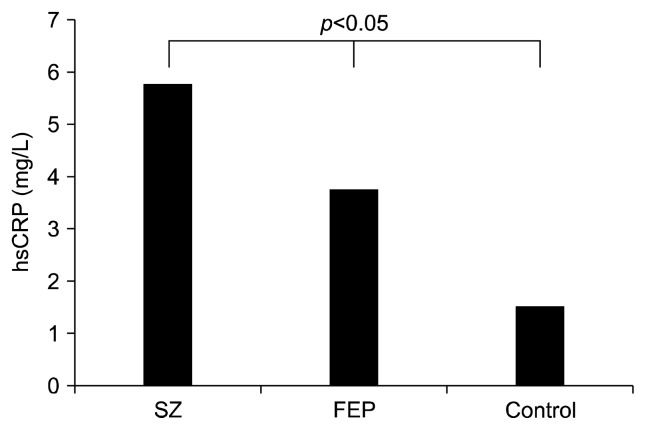
Forty-eight patients with FEP, 74 patients with schizophrenia in acute exacerbation phase and 54 healthy controlled volunteers are included in the study. The most substantial finding in the study is that there is a positive correlation between hsCRP levels and severity of positive symptoms of both patient groups, with FEP and with schizophrenia. The second most substantial finding is there is no significant difference between patients with FEP and schizophrenia, in terms of hsCRP.
The relationship between hsCRP and positive symptom severity in two groups of patients supports the inflammatory hypothesis in the etiopathogenesis of schizophrenia. This finding is supportive of close relation between inflammatory processes and clinical findings of patient with schizophrenia.
关于精神分裂症炎症过程的研究发现日益增多。精神分裂症中的炎症过程与其病因及临床症状均相关。血清高敏C反应蛋白(hsCRP)也是这些炎症过程之一。尤其,人们认为它与精神分裂症患者的临床症状密切相关。
在本研究中,调查了首次发作未用药的精神病患者(FEP)和急性加重期精神分裂症患者的hsCRP水平与临床症状之间的关系。比较了患者的临床症状、心理测量指标(阳性症状评定量表、阴性症状评定量表、简明精神病评定量表)以及hsCRP水平。
本研究纳入了48例FEP患者、74例急性加重期精神分裂症患者和54名健康对照志愿者。该研究中最显著的发现是,hsCRP水平与两组患者(FEP患者和精神分裂症患者)的阳性症状严重程度呈正相关。第二显著的发现是,就hsCRP而言,FEP患者和精神分裂症患者之间无显著差异。
两组患者中hsCRP与阳性症状严重程度之间的关系支持了精神分裂症病因学中的炎症假说。这一发现支持了炎症过程与精神分裂症患者临床症状之间的密切关系。