Parmentier Fabrice B R, García-Toro Mauro, García-Campayo Javier, Yañez Aina M, Andrés Pilar, Gili Margalida
Department of Psychology and Institute of Health Sciences (iUNICS), University of the Balearic Islands, Palma, Spain.
Balearic Islands Health Research Institute (IdISBa), Palma, Spain.
Front Psychol. 2019 Mar 8;10:506. doi: 10.3389/fpsyg.2019.00506. eCollection 2019.
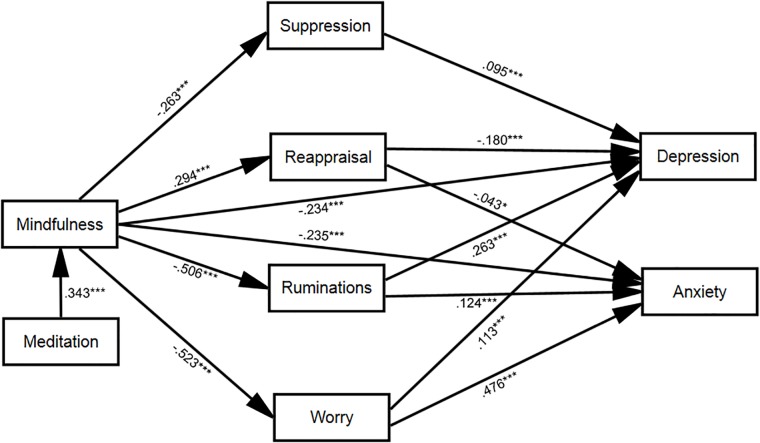
The present study examined the effects of mindfulness on depression and anxiety, both direct and indirect through the mediation of four mechanisms of emotional regulation: worry, rumination, reappraisal and suppression. Path analysis was applied to data collected from an international and non-clinical sample of 1151 adults, including both meditators and non-meditators, who completed an online questionnaire battery. Our results show that mindfulness are related to lower levels of depression and anxiety both directly and indirectly. Suppression, reappraisal, worry and rumination all acted as significant mediators of the relationship between mindfulness and depression. A similar picture emerged for the relationship between mindfulness and anxiety, with the difference that suppression was not a mediator. Our data also revealed that the estimated number of hours of mindfulness meditation practice did not affect depression or anxiety directly but did reduce these indirectly by increasing mindfulness. Worry and rumination proved to be the most potent mediating variables. Altogether, our results confirm that emotional regulation plays a significant mediating role between mindfulness and symptoms of depression and anxiety in the general population and suggest that meditation focusing on reducing worry and rumination may be especially useful in reducing the risk of developing clinical depression.
本研究考察了正念对抑郁和焦虑的影响,包括直接影响以及通过四种情绪调节机制(担忧、沉思、重新评价和抑制)的中介作用产生的间接影响。路径分析应用于从1151名成年人的国际非临床样本收集的数据,样本包括冥想者和非冥想者,他们完成了一套在线问卷。我们的结果表明,正念与较低水平的抑郁和焦虑直接和间接相关。抑制、重新评价、担忧和沉思均在正念与抑郁的关系中起到显著的中介作用。正念与焦虑的关系也呈现出类似情况,不同之处在于抑制不是中介因素。我们的数据还显示,估计的正念冥想练习时长并未直接影响抑郁或焦虑,但通过提高正念间接降低了这些症状。事实证明,担忧和沉思是最有力的中介变量。总体而言,我们的结果证实情绪调节在一般人群的正念与抑郁和焦虑症状之间起到显著的中介作用,并表明专注于减少担忧和沉思的冥想可能对降低临床抑郁的风险特别有用。