Yellowstone Center for Resources, Mammoth Hot Springs, Yellowstone National Park, WY 82190, USA.
Wyoming Natural Diversity Database, University of Wyoming, Laramie, WY 82071, USA.
Sci Adv. 2019 Mar 20;5(3):eaav1139. doi: 10.1126/sciadv.aav1139. eCollection 2019 Mar.
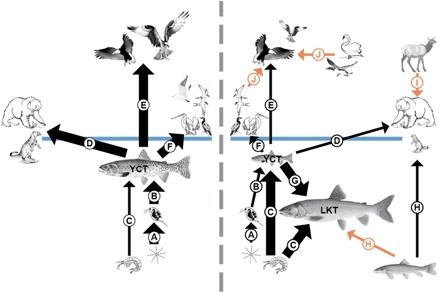
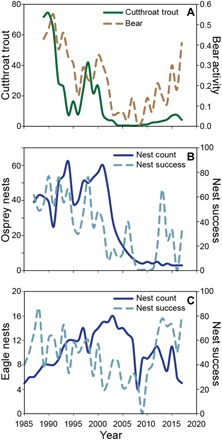
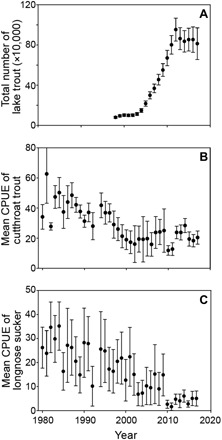
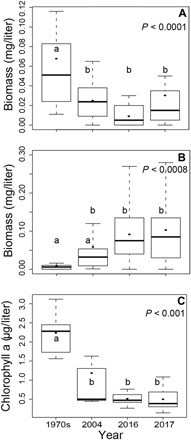
Predatory fish introduction can cause cascading changes within recipient freshwater ecosystems. Linkages to avian and terrestrial food webs may occur, but effects are thought to attenuate across ecosystem boundaries. Using data spanning more than four decades (1972-2017), we demonstrate that lake trout invasion of Yellowstone Lake added a novel, piscivorous trophic level resulting in a precipitous decline of prey fish, including Yellowstone cutthroat trout. Plankton assemblages within the lake were altered, and nutrient transport to tributary streams was reduced. Effects across the aquatic-terrestrial ecosystem boundary remained strong (log response ratio ≤ 1.07) as grizzly bears and black bears necessarily sought alternative foods. Nest density and success of ospreys greatly declined. Bald eagles shifted their diet to compensate for the cutthroat trout loss. These interactions across multiple trophic levels both within and outside of the invaded lake highlight the potential substantial influence of an introduced predatory fish on otherwise pristine ecosystems.
掠食性鱼类的引入会在受纳淡水生态系统中引发级联变化。可能与鸟类和陆地食物网发生联系,但这些影响被认为会在生态系统边界处减弱。本研究利用跨越四十多年(1972-2017 年)的数据,证明了湖鳟鱼对黄石湖的入侵增加了一个新的、以鱼类为食的营养级,导致猎物鱼类,包括黄石河鳟鱼,数量急剧下降。湖中浮游生物群落发生了变化,营养物质向支流的输送减少。水生-陆地生态系统边界的影响仍然很强(对数响应比≤1.07),因为灰熊和黑熊必然会寻找替代食物。巢密度和鱼鹰的繁殖成功率大大下降。白头海雕则通过改变饮食来弥补鳟鱼的减少。这些发生在入侵湖泊内外多个营养级的相互作用,突出了引入的掠食性鱼类对原本原始生态系统的潜在重大影响。