Department of Traditional Chinese Medicine, Putuo People's Hospital Affiliated to Tongji University, Shanghai, China.
Department of Traditional Chinese Medicine, Wuliqiao Community Health Center of Huangpu District, Shanghai, China.
J Cell Mol Med. 2019 May;23(5):3151-3165. doi: 10.1111/jcmm.14148. Epub 2019 Mar 25.
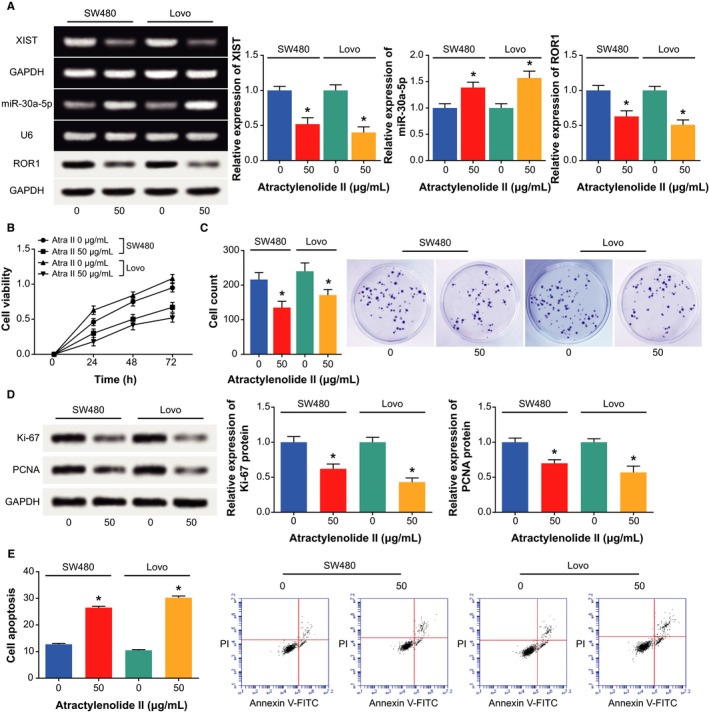
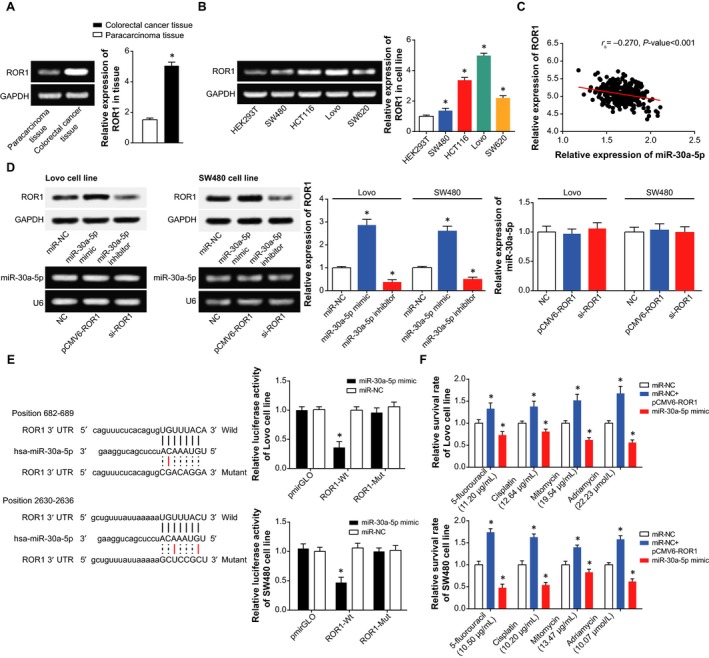
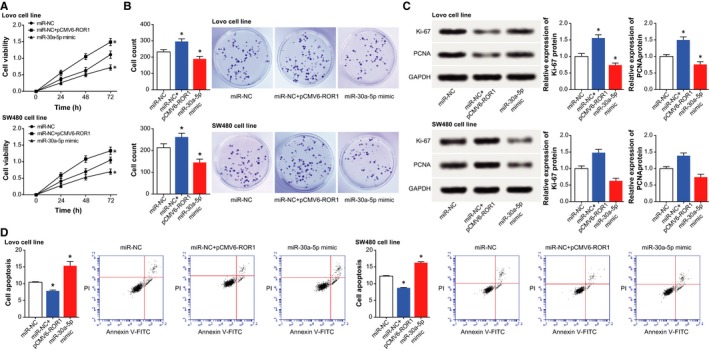
This investigation was conducted to elucidate whether atractylenolide II could reverse the role of lncRNA XIST/miR-30a-5p/ROR1 axis in modulating chemosensitivity of colorectal cancer cells. We totally collected 294 pairs of colorectal cancer tissues and adjacent normal tissues and also purchased colorectal cancer cell lines and human embryonic kidney cell line. 5-fluorouracil, cisplatin, mitomycin and adriamycin were designated as the chemotherapies for colorectal cell lines, and atractylenolides were arranged as the Chinese drug. The expressions of XIST, miR-30a-5p and ROR1 were quantified with aid of qRT-PCR or Western blot, and luciferase reporter gene assay was implemented to determine the relationships among XIST, miR-30a-5p and ROR1. Our results demonstrated that XIST and ROR1 expressions were dramatically up-regulated, yet miR-30a-5p expression was down-regulated within colorectal cancer tissues (P < 0.05). The overexpressed XIST and ROR1, as well as under-expressed miR-30a-5p, were inclined to promote viability and proliferation of colorectal cells under the influence of chemo drugs (P < 0.05). In addition, XIST could directly target miR-30a-5p, and ROR1 acted as the targeted molecule of miR-30a-5p. Interestingly, atractylenolides not only switched the expressions of XIST, miR-30a-5p and ROR1 within colorectal cancer cells but also significantly intensified the chemosensitivity of colorectal cancer cells (P < 0.05). Finally, atractylenolide II was discovered to slow down the viability and proliferation of colorectal cancer cells (P < 0.05). In conclusion, the XIST/miR-30a-5p/ROR1 axis could be deemed as pivotal markers underlying colorectal cancer, and administration of atractylenolide II might improve the chemotherapeutic efficacy for colorectal cancer.
本研究旨在探讨苍术内酯 II 是否可以逆转长链非编码 RNA XIST/miR-30a-5p/ROR1 轴在调节结直肠癌细胞化疗敏感性中的作用。我们共收集了 294 对结直肠癌组织及其相应的癌旁正常组织,还购买了结直肠癌细胞系和人胚肾细胞系。5-氟尿嘧啶、顺铂、丝裂霉素和阿霉素被指定为结直肠细胞系的化疗药物,苍术内酯被安排为中药。通过 qRT-PCR 或 Western blot 定量检测 XIST、miR-30a-5p 和 ROR1 的表达,并通过荧光素酶报告基因检测确定 XIST、miR-30a-5p 和 ROR1 之间的关系。我们的研究结果表明,在结直肠癌组织中,XIST 和 ROR1 的表达显著上调,而 miR-30a-5p 的表达下调(P<0.05)。过表达的 XIST 和 ROR1 以及低表达的 miR-30a-5p 都倾向于在化疗药物的影响下促进结直肠细胞的活力和增殖(P<0.05)。此外,XIST 可以直接靶向 miR-30a-5p,而 ROR1 是 miR-30a-5p 的靶向分子。有趣的是,苍术内酯不仅可以改变结直肠癌细胞中 XIST、miR-30a-5p 和 ROR1 的表达,而且还可以显著增强结直肠癌细胞的化疗敏感性(P<0.05)。最后,我们发现苍术内酯 II 可以减缓结直肠癌细胞的活力和增殖(P<0.05)。综上所述,XIST/miR-30a-5p/ROR1 轴可以作为结直肠癌的关键标志物,苍术内酯 II 的应用可能会提高结直肠癌的化疗疗效。