Department of Population and Public Health Sciences, Center for Interventions, Treatment, and Addictions Research, Boonshoft School of Medicine, Wright State University, 3171 Research Blvd, Kettering, OH, 45420, USA.
Montgomery County Coroner's Office/Miami Valley Regional Crime Lab (MCCO/MVRCL), 361 W Third ST., Dayton, OH, 45402, USA.
Drug Alcohol Depend. 2019 May 1;198:116-120. doi: 10.1016/j.drugalcdep.2019.01.045. Epub 2019 Mar 18.
There is a lack of information on illicitly manufactured fentanyl and fentanyl analogue-related (IMF) unintentional overdose death trends over time. The study analyzes IMF-related unintentional overdose fatalities that occurred between July 2015 and June 2017 in Montgomery County, Ohio, an area with the highest rates of unintentional overdose mortality in Ohio.
LC-MS/MS-based method was used to identify fentanyl analogs and metabolites in 724 unintentional overdose death cases. The Chi-square statistic was used to assess differences over time in demographic and drug-related characteristics.
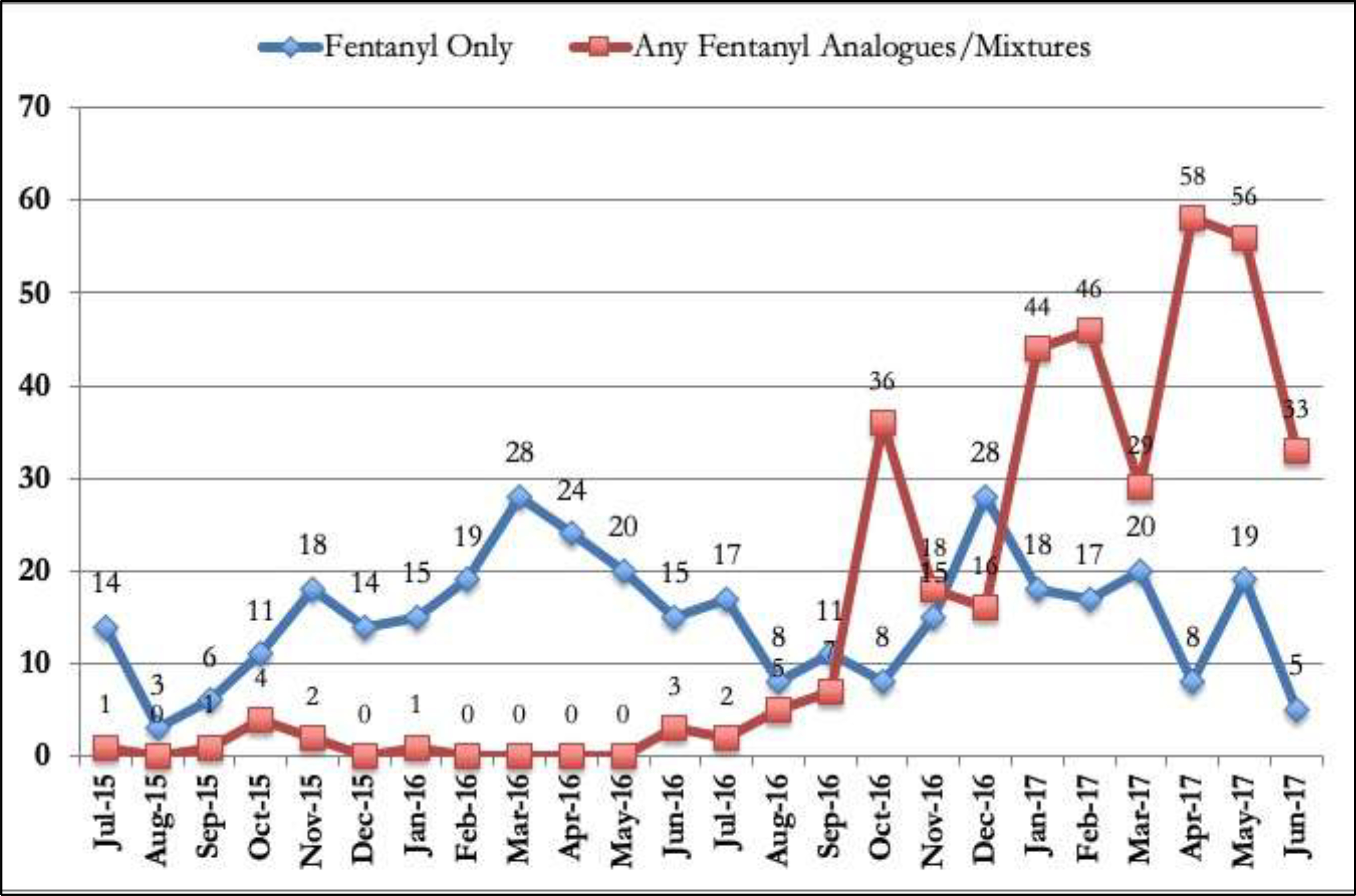
The number of unintentional overdose death cases testing positive for IMFs increased by 377% between second half of 2015 and first half of 2017. The majority of decedents were white (82.5%) and male (67.8%). The proportion of fentanyl-only (no other analogs) cases declined from 89.2%-24.6% (p < 0.001), while proportion of fentanyl analogue-containing cases increased from 9.8%-70.3% (p < 0.001) between the second half of 2015 and first half of 2017. The most commonly identified fentanyl analogs were carfentanil (29.7%), furanyl fentanyl (14.1%) and acryl fentanyl (10.2%). Proportion of IMF cases also testing positive for heroin declined from 21.6% to 5.4% (p < 0.001), while methamphetamine positive cases increased from 1.4%-17.8% (p < 0.001) over the same time period.
Emergence of fentanyl analogs contributed to substantial increases in unintentional overdose deaths. The data indicate a growing overlap between the IMF and methamphetamine outbreaks. Continuous monitoring of local IMF trends and rapid information dissemination to active users are needed to reduce the risks associated with IMF use.
关于非法制造的芬太尼和芬太尼类似物相关(IMF)非故意过量用药死亡趋势随时间的变化,目前信息匮乏。本研究分析了 2015 年 7 月至 2017 年 6 月期间在俄亥俄州蒙哥马利县发生的与 IMF 相关的非故意过量用药致死案例,该县是俄亥俄州非故意过量用药死亡率最高的地区。
采用 LC-MS/MS 方法检测 724 例非故意过量用药死亡案例中的芬太尼类似物和代谢物。采用卡方检验评估不同时间段在人口统计学和药物相关特征方面的差异。
2015 年下半年至 2017 年上半年期间,IMF 检测呈阳性的非故意过量用药死亡案例数量增加了 377%。死者大多数为白人(82.5%)和男性(67.8%)。芬太尼单一用药(无其他类似物)案例的比例从 89.2%降至 24.6%(p<0.001),而芬太尼类似物用药案例的比例从 9.8%增至 70.3%(p<0.001)。最常见的芬太尼类似物为卡芬太尼(29.7%)、呋喃芬太尼(14.1%)和丙烯基芬太尼(10.2%)。IMF 案例中同时检测出海洛因阳性的比例从 21.6%降至 5.4%(p<0.001),而同时检测出甲基苯丙胺阳性的比例从 1.4%增至 17.8%(p<0.001)。
芬太尼类似物的出现导致非故意过量用药死亡人数大幅增加。数据表明,IMF 和甲基苯丙胺的爆发之间存在越来越多的重叠。需要对当地 IMF 趋势进行持续监测,并向活跃使用者快速传播信息,以降低与 IMF 使用相关的风险。