Delcher Chris, Harris Daniel R, Anthony Nicholas, Mir Mojde
Institute for Pharmaceutical Outcomes and Policy, UK College of Pharmacy, University of Kentucky, Lexington, Kentucky.
Department of Pharmacy Practice and Science, UK College of Pharmacy, University of Kentucky, Lexington, Kentucky.
AJPM Focus. 2022 Sep;1(1):100007. doi: 10.1016/j.focus.2022.100007. Epub 2022 Jun 16.
Stay-at-home orders during the COVID-19 pandemic decreased population mobility to reduce SARS-CoV-2 infection rates. We empirically tested the hypothesis that this public health measure was associated with a higher likelihood of opioid- and stimulant-involved deaths occurring in homes located in Cook County, Illinois.
The stay-at-home period was from March 21, 2020 to May 30, 2020. We analyzed overdose data from the Cook County Medical Examiner's Office using a death location description from case investigations categorized as home, medical, motel, scene, and other. Two groups of decedents were defined as either having an opioid or stimulant listed in the primary cause of death field. We modeled a weekly time series to detect changes in deaths (number) and trends during segmented time periods. Chi-square or Fisher's exact and adjusted logistic regression was used for testing the differences between the stay-at-home and a 13-week preceding period.
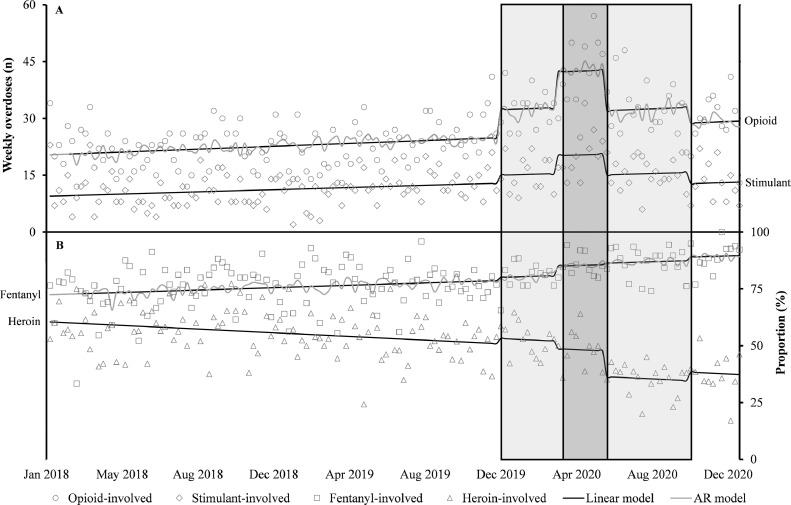
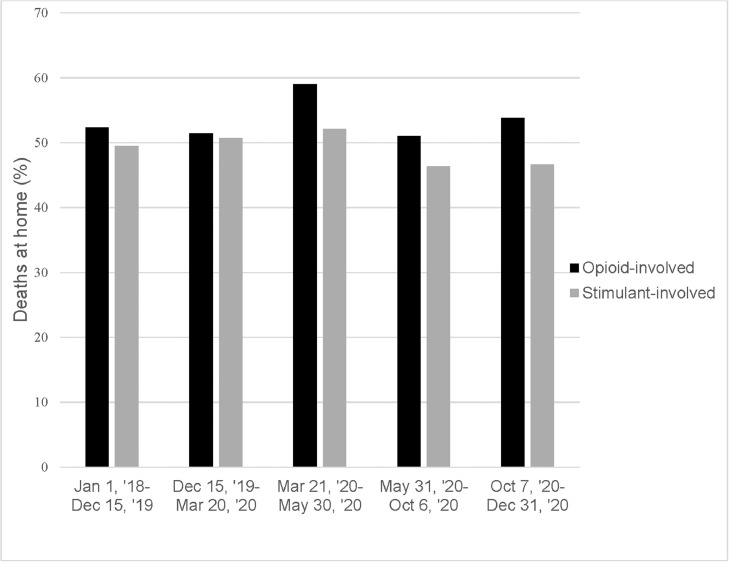
There were 4,169 and 2,012 opioid- and stimulant-involved deaths, respectively, from 2018 to 2020. Both groups were demographically similar: 75% male, 52% White, and aged 45 years (mean). In the 13 weeks before stay-at-home orders, 51% of opioid-involved deaths occurred in homes, which increased to 59% (<0.0001) during the 10 weeks of the order and decreased back to 51% in the 18 weeks after the order expired. For stimulant-involved deaths, 51% were residential immediately before the orders, with a nonsignificant increase to 52% during the stay-at-home period. Before the pandemic, there were 20 deaths/week, increasing to 37 deaths/week (<0.0001) during stay-at-home enactment. Deaths involving fentanyl among the opioid-involved group increased from 76% to 89%, whereas those involving heroin decreased from 55% to 37%. The adjusted OR for opioid-involved fatal overdoses occurring at home during this period compared with that occurring the 13 weeks before was 1.37 (95% CI=1.05, 1.79).
The likelihood of a death occurring at home, especially for people using opioids, increased during the stay-at-home order period. Findings have implications for mitigating overdose risks during social isolation.
在新冠疫情期间实施的居家令降低了人口流动性,以减少严重急性呼吸综合征冠状病毒2(SARS-CoV-2)的感染率。我们通过实证检验了这样一个假设,即这一公共卫生措施与伊利诺伊州库克县家庭中发生的涉及阿片类药物和兴奋剂的死亡可能性增加有关。
居家期为2020年3月21日至2020年5月30日。我们分析了库克县法医办公室的过量用药数据,使用的是病例调查中的死亡地点描述,分为家中、医疗机构、汽车旅馆、现场和其他。两组死者被定义为在主要死因字段中列出了阿片类药物或兴奋剂。我们建立了一个每周时间序列模型,以检测分段时间段内死亡人数的变化和趋势。使用卡方检验或费舍尔精确检验以及调整后的逻辑回归来检验居家期与前13周之间的差异。
2018年至2020年,分别有4169例和2012例涉及阿片类药物和兴奋剂的死亡。两组在人口统计学上相似:75%为男性,52%为白人,平均年龄45岁。在居家令发布前的13周内,51%的涉及阿片类药物的死亡发生在家中,在居家令实施的10周内这一比例增至59%(<0.0001),在居家令到期后的18周内又降至51%。对于涉及兴奋剂的死亡,在居家令发布前,51%发生在住所,在居家期内略有增加至52%,无显著差异。在疫情之前,每周有20例死亡,在居家令实施期间增至每周37例(<0.0001)。在涉及阿片类药物的死亡群体中,涉及芬太尼的死亡比例从76%增至89%,而涉及海洛因的死亡比例从55%降至37%。与居家令发布前的13周相比,在此期间在家中发生的涉及阿片类药物的致命过量用药的调整后比值比为1.37(95%置信区间=1.05,1.79)。
在居家令实施期间,在家中发生死亡的可能性增加,尤其是对于使用阿片类药物的人。这些发现对于减轻社会隔离期间的过量用药风险具有启示意义。