Folegatti Pedro M, Bellamy Duncan, Flaxman Amy, Mair Catherine, Ellis Chris, Ramon Raquel L, Ramos Lopez Fernando, Mitton Celia, Baker Megan, Poulton Ian, Lawrie Alison, Roberts Rachel, Minassian Angela, Ewer Katie J, Evans Thomas G, Hill Adrian V S, Gilbert Sarah C
The Jenner Institute, University of Oxford, ORCRB, Roosevelt Drive, Oxford, OX3 7DQ, UK.
Vaccitech Ltd, The Schrodinger Building, 2nd Floor, Oxford Science Park, Heatley Road, Oxford, OX4 4GE, UK.
Vaccines (Basel). 2019 Mar 22;7(1):33. doi: 10.3390/vaccines7010033.
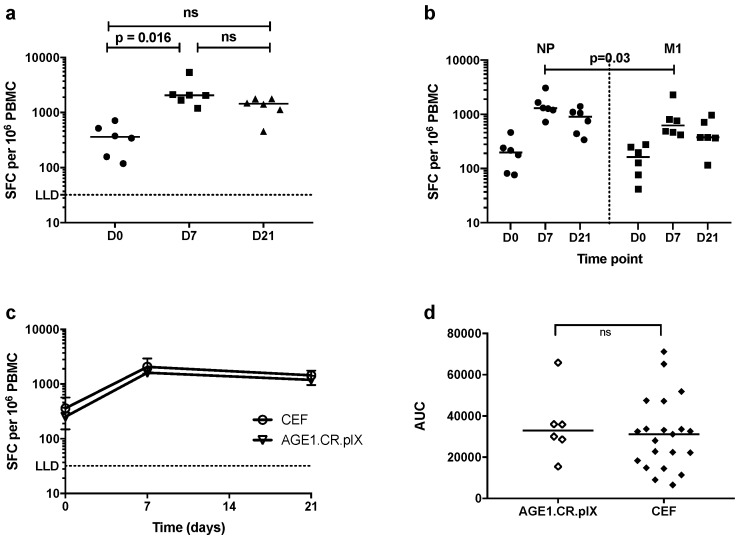
Seasonal influenza infections have a significant global impact leading to increased health and economic burden. The efficacy of currently available seasonal influenza vaccines targeting polymorphic surface antigens has historically been suboptimal. Cellular immune responses against highly conserved Influenza A virus antigens, such as nucleoprotein (NP) and matrix protein-1 (M1), have previously been shown to be associated with protection from disease, whilst viral-vectored vaccines are an effective strategy to boost cell-mediated immunity. We have previously demonstrated that MVA encoding NP and M1 can induce potent and persistent T cell responses against influenza. In this Phase I study, we evaluated the safety and immunogenicity of MVA-NP+M1, which was newly manufactured on an immortalized cell line, in six healthy adult participants. The vaccine was well-tolerated with only mild to moderate adverse events that resolved spontaneously and were comparable to previous studies with the same vaccine manufactured in chick embryo fibroblasts. A significant increase in vaccine-specific T cell responses was detected seven days after immunization and was directed against both antigens in the vector insert. This small Phase I study supports progression of this vaccine to a Phase IIb study to assess immunogenicity and additional protective efficacy in older adults receiving licensed seasonal influenza vaccines.
季节性流感感染对全球具有重大影响,导致健康和经济负担加重。历史上,针对多态性表面抗原的现有季节性流感疫苗的效力一直不尽人意。先前研究表明,针对甲型流感病毒高度保守抗原(如核蛋白(NP)和基质蛋白1(M1))的细胞免疫反应与预防疾病有关,而病毒载体疫苗是增强细胞介导免疫的有效策略。我们之前已证明,编码NP和M1的痘苗病毒安卡拉株(MVA)可诱导针对流感的强效且持久的T细胞反应。在这项I期研究中,我们评估了在永生化细胞系上新生产的MVA-NP+M1在六名健康成年参与者中的安全性和免疫原性。该疫苗耐受性良好,仅出现轻度至中度不良事件,这些不良事件可自发缓解,且与先前在鸡胚成纤维细胞中生产的相同疫苗的研究结果相当。免疫后七天检测到疫苗特异性T细胞反应显著增加,且针对载体插入片段中的两种抗原。这项小型I期研究支持将该疫苗推进至IIb期研究,以评估其在接种已获许可的季节性流感疫苗的老年人中的免疫原性和额外的保护效力。