Setyowibowo Hari, Iskandarsyah Aulia, Sadarjoen Sawitri S, Badudu Dharmayanti F, Suardi Drajat R, Passchier Jan, Hunfeld Joke A M, Sijbrandij Marit
Department of Educational Psychology, Faculty of Psychology, Universitas Padjadjaran, Jatinangor, Indonesia. Email:
Department of Clinical, Neuro-and Developmental Psychology, Faculty of Behavioural and Movement Sciences, VU University, Amsterdam, Netherlands.
Asian Pac J Cancer Prev. 2019 Mar 26;20(3):711-722. doi: 10.31557/APJCP.2019.20.3.711.
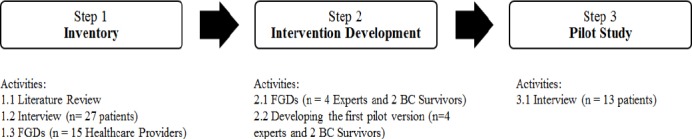
Background: Delay in the diagnosis of breast cancer (BC) may lead to an advanced stage of the disease and a poor prognosis. A psychoeducational intervention can be crucial in helping women with BC symptoms complete the examination procedures and reduce diagnosis delay of BC. Objective: To develop a psychoeducational intervention to reduce the delay of BC diagnosis among Indonesian women with BC symptoms. Methods: The development of the intervention included an inventory of crucial elements in developing psychoeducation through literature review as well as consultation with BC patients and healthcare providers. Additionally, we developed PERANTARA as the first pilot version of the self-help guided psychoeducational intervention. PERANTARA is an abbreviation for “Pengantar Perawatan Kesehatan Payadura”, which means an introduction to breast health treatment. The pilot feasibility study combined an expert review and a pilot testing in hospital settings. A semi-structured interview and the client satisfaction inventory were utilized to measure feasibility and acceptability of the intervention for Indonesian women with BC symptoms. Results: PERANTARA contained an oncologist’s explanation about BC and the BC survivors’ testimony to reduce the time to diagnosis. The pilot study results showed that most patients were satisfied with and trusted on PERANTARA. Conclusion: PERANTARA was feasible and acceptable for Indonesian patients with BC symptoms. The development framework suggested in this study can be applied to develop psychoeducational packages for other patients group, in particular, those interventional packages aimed at reducing diagnosis and treatment delays and nonadherence.
乳腺癌(BC)诊断延迟可能导致疾病进展至晚期并预后不良。心理教育干预对于帮助有BC症状的女性完成检查程序并减少BC诊断延迟可能至关重要。目的:开发一种心理教育干预措施,以减少有BC症状的印度尼西亚女性的BC诊断延迟。方法:干预措施的开发包括通过文献综述以及与BC患者和医疗服务提供者协商,列出心理教育开发中的关键要素清单。此外,我们开发了PERANTARA作为自助式心理教育干预的首个试点版本。PERANTARA是“Pengantar Perawatan Kesehatan Payadura”的缩写,意为乳腺健康治疗入门。试点可行性研究结合了专家评审和在医院环境中的试点测试。采用半结构化访谈和客户满意度清单来衡量该干预措施对有BC症状的印度尼西亚女性的可行性和可接受性。结果:PERANTARA包含肿瘤学家对BC的解释以及BC幸存者关于缩短诊断时间的证词。试点研究结果表明,大多数患者对PERANTARA感到满意并信任它。结论:PERANTARA对有BC症状的印度尼西亚患者是可行且可接受的。本研究中提出的开发框架可应用于为其他患者群体开发心理教育套餐,特别是那些旨在减少诊断和治疗延迟以及不依从性的干预套餐。