Di Mingyi, Zhang Li
Department of Respiratory Medicine, Peking Union Medical College Hospital, Beijing 100730, China.
Zhongguo Fei Ai Za Zhi. 2019 Mar 20;22(3):132-136. doi: 10.3779/j.issn.1009-3419.2019.03.02.
The aim of this study was to investigate the clinical features of paraneoplastic limbic encephalitis (PLE) with small cell lung cancer (SCLC) and improve clinical diagnosis and treatment.
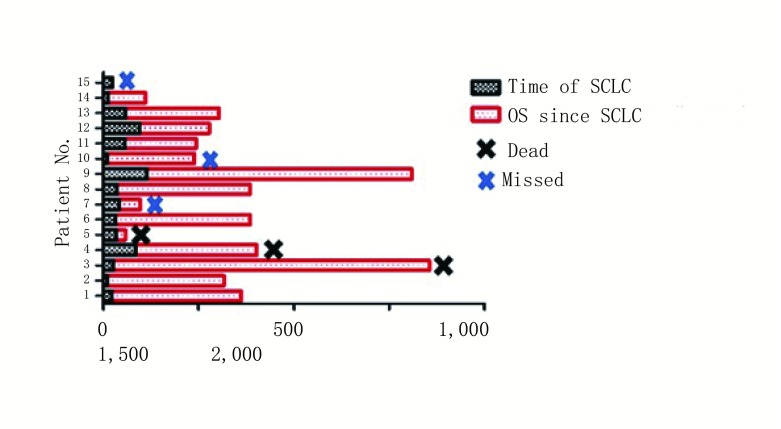
The clinical data of 15 patients with SCLC combined with PLE from January 1980 to May 2017 were collected from Beijing Union Hospital. Their symptoms and laboratory data were analyzed and the prognosis of the patients was followed.
PLE is a rare disease, the incidence rate in SCLC is about 0.842%. The data may be underestimated because of misdiagnose or missed diagnosis; High incidence crowd of the disease is the middle-aged male smoker, the tumor-node-metastasis (TNM) stages of them are later than others; Typical neurological symptoms include varying degrees of short-term memory loss, seizures and varying degrees of mental disorders; neurological symptoms usually occur before the onset of cancer or respiratory symptoms appear, an average of about 2 months be taken from onset to diagnosis; Serum antibody (anti-Hu, GABA-R-Ab), cerebrospinal fluid, head magnetic resonance imaging (MRI) and electroencephalogram (EEG) of the patients has abnormalities; Videography, especially computed tomography (CT) is a good means of screening the primary tumor, pathology diagnosis mainly rely on bronchoscopy; The treatment of primary tumors can be more effective in alleviating the nervous system symptoms than immunotherapy.
Paraneoplastic limbic encephalitis is a rare paraneoplastic syndrome in nervous system caused by malignant neoplasms often characterized by facial neurological symptoms. The disease are usually associated with lung cancer (especially SCLC). Its nervous system symptoms occur earlier than the tumor diagnosis. Early diagnosis and treatment for primary tumors will increase the benefit.
本研究旨在探讨小细胞肺癌(SCLC)合并副肿瘤性边缘叶脑炎(PLE)的临床特征,以提高临床诊断与治疗水平。
收集1980年1月至2017年5月在北京协和医院就诊的15例SCLC合并PLE患者的临床资料,分析其症状及实验室检查数据,并对患者预后进行随访。
PLE是一种罕见病,在SCLC中的发病率约为0.842%。由于误诊或漏诊,该数据可能被低估;该病高发人群为中年男性吸烟者,其肿瘤分期晚于其他患者;典型神经症状包括不同程度的短期记忆丧失、癫痫发作及不同程度的精神障碍;神经症状通常在癌症发病前或呼吸道症状出现前出现,从发病到诊断平均约2个月;患者血清抗体(抗Hu、GABA-R-Ab)、脑脊液、头部磁共振成像(MRI)及脑电图(EEG)均有异常;影像学检查,尤其是计算机断层扫描(CT)是筛查原发肿瘤的良好手段,病理诊断主要依靠支气管镜检查;原发肿瘤的治疗比免疫治疗更能有效缓解神经系统症状。
副肿瘤性边缘叶脑炎是一种罕见的由恶性肿瘤引起的神经系统副肿瘤综合征,常以神经症状为特征。该病通常与肺癌(尤其是SCLC)相关。其神经系统症状早于肿瘤诊断出现。早期诊断并治疗原发肿瘤将增加获益。