Luo Xiaolin, Liu Jing, Zheng Peitao, Li Meng, Zhou Yang, Huang Liulian, Chen Lihui, Shuai Li
1College of Materials Engineering, Fujian Agriculture and Forestry University, Fuzhou, 350002 China.
2College of Energy, Xiamen University, Xiamen, 361102 China.
Biotechnol Biofuels. 2019 Mar 13;12:51. doi: 10.1186/s13068-019-1387-x. eCollection 2019.
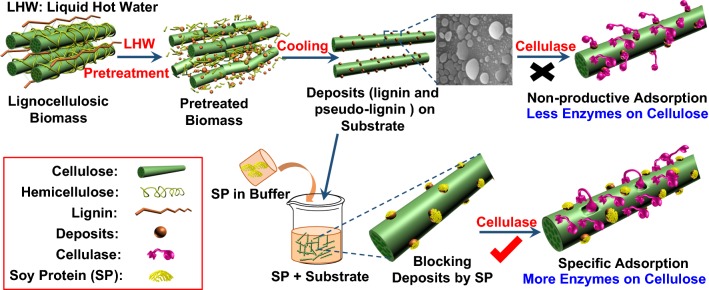
Liquid hot water (LHW) pretreatment has been considered as one of the most industrially viable and environment-friendly methods for facilitating the transformation of lignocelluloses into biofuels through biological conversion. However, lignin fragments in pretreatment hydrolysates are preferential to condense with each other and then deposit back onto cellulose surface under severe conditions. Particularly, lignin tends to relocate or redistribute under high-temperature LHW pretreatment conditions. The lignin residues on the cellulose surface would result in significant nonproductive binding of cellulolytic enzymes, and therefore negatively affect the enzymatic conversion (EC) of glucan in pretreated substrates. Although additives such as bovine serum albumin (BSA) and Tween series have been used to reduce nonproductive binding of enzymes through blocking the lignin, the high cost or non-biocompatibility of these additives limits their potential in industrial applications.
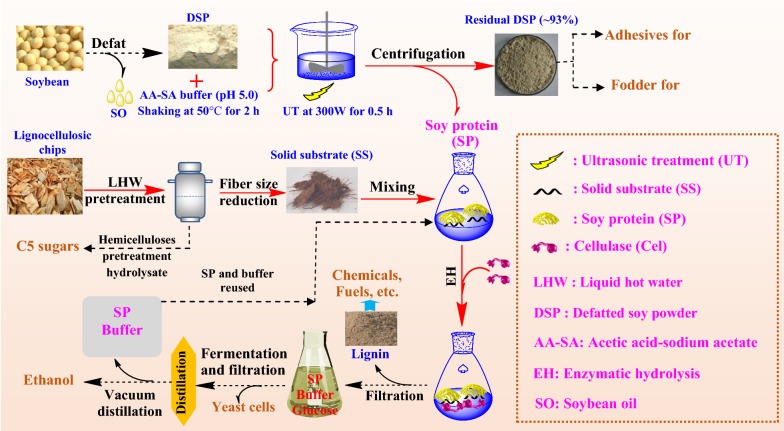
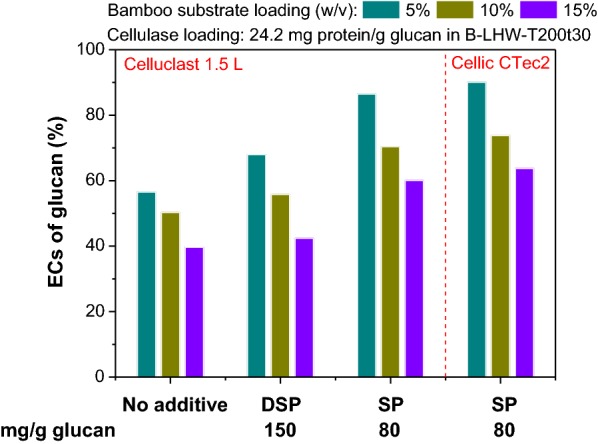
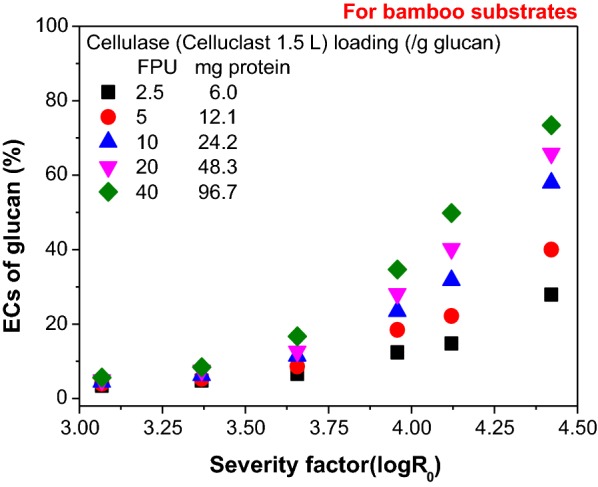
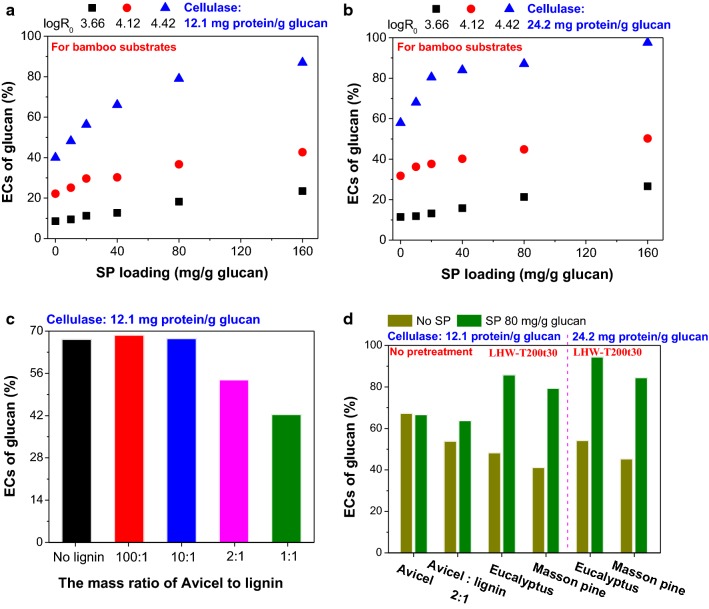
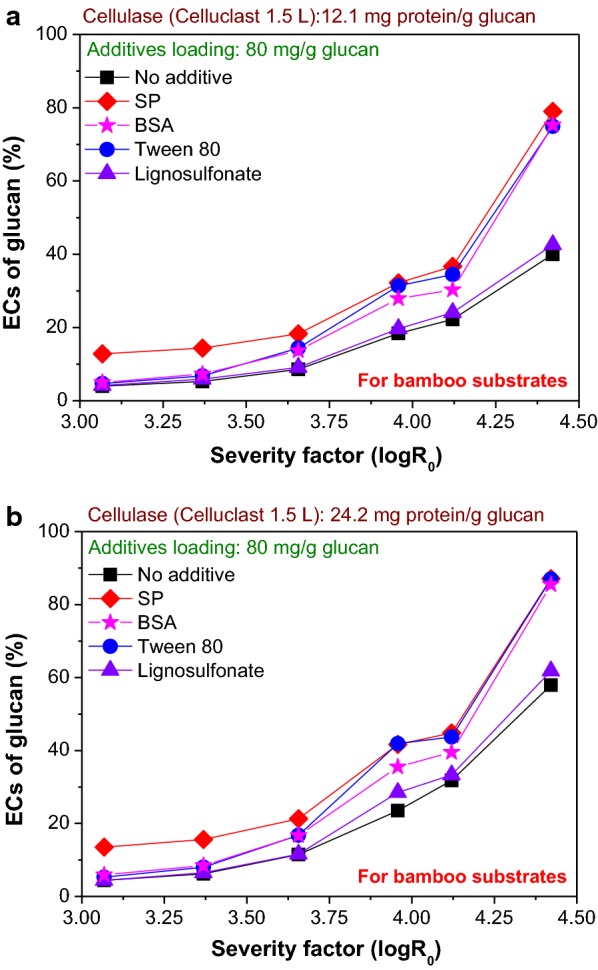
Here, we firstly report that a soluble soy protein (SP) extracted from inexpensive defatted soy powder (DSP) showed excellent performance in promoting the EC of glucan in LHW-pretreated lignocellulosic substrates. The addition of the SP (80 mg/g glucan) could readily reduce the cellulase (Celluclast 1.5 L) loading by 8 times from 96.7 to 12.1 mg protein/g glucan and achieve a glucan EC of 80% at a hydrolysis time of 72 h. With the same cellulase (Celluclast 1.5 L) loading (24.2 mg protein/g glucan), the ECs of glucan in LHW-pretreated bamboo, eucalyptus, and Masson pine substrates increased from 57%, 54% and 45% (without SP) to 87%, 94% and 86% (with 80 mg SP/g glucan), respectively. Similar effects were also observed when Cellic CTec2, a newer-generation cellulase preparation, was used. Mechanistic studies indicated that the adsorption of soluble SP onto the surface of lignin residues could reduce the nonproductive binding of cellulolytic enzymes to lignin. The cost of the SP required for effective promotion would be equivalent to the cost of 2.9 mg cellulase (Celluclast 1.5 L) protein (or 1.2 FPU/g glucan), if a proposed semi-simultaneous saccharification and fermentation (semi-SSF) model was used.
Near-complete saccharification of glucan in LHW-pretreated lignocellulosic substrates could be achieved with the addition of the inexpensive and biocompatible SP additive extracted from DSP. This simple but remarkably effective technique could readily contribute to improving the economics of the cellulosic biorefinery industry.
液态热水(LHW)预处理被认为是最具工业可行性和环境友好性的方法之一,可通过生物转化促进木质纤维素转化为生物燃料。然而,预处理水解产物中的木质素片段在苛刻条件下易于相互缩合,然后重新沉积到纤维素表面。特别是,在高温LHW预处理条件下,木质素倾向于重新定位或重新分布。纤维素表面的木质素残留会导致纤维素分解酶大量非生产性结合,从而对预处理底物中葡聚糖的酶促转化(EC)产生负面影响。尽管已使用牛血清白蛋白(BSA)和吐温系列等添加剂通过阻断木质素来减少酶的非生产性结合,但这些添加剂的高成本或非生物相容性限制了它们在工业应用中的潜力。
在此,我们首次报道,从廉价脱脂大豆粉(DSP)中提取的可溶性大豆蛋白(SP)在促进LHW预处理的木质纤维素底物中葡聚糖的酶促转化方面表现出优异性能。添加SP(80 mg/g葡聚糖)可轻松将纤维素酶(Celluclast 1.5 L)负载量从96.7 mg蛋白/g葡聚糖降低8倍至12.1 mg蛋白/g葡聚糖,并在水解72小时时实现80%的葡聚糖酶促转化率。在相同的纤维素酶(Celluclast 1.5 L)负载量(24.2 mg蛋白/g葡聚糖)下,LHW预处理的竹子、桉树和马尾松底物中葡聚糖的酶促转化率分别从57%、54%和45%(无SP)提高到87%、94%和86%(添加80 mg SP/g葡聚糖)。使用新一代纤维素酶制剂Cellic CTec2时也观察到类似效果。机理研究表明,可溶性SP吸附到木质素残留表面可减少纤维素分解酶与木质素的非生产性结合。如果采用拟议的半同步糖化发酵(半SSF)模型,有效促进所需的SP成本相当于2.9 mg纤维素酶(Celluclast 1.5 L)蛋白(或1.2 FPU/g葡聚糖)的成本。
添加从DSP中提取的廉价且生物相容的SP添加剂可实现LHW预处理的木质纤维素底物中葡聚糖的近完全糖化。这种简单但非常有效的技术可轻松有助于提高纤维素生物精炼行业的经济性。