US Forest Service, Forest Products Laboratory, Madison, WI, USA.
Biotechnol Biofuels. 2013 Jan 28;6(1):9. doi: 10.1186/1754-6834-6-9.
Nonspecific (nonproductive) binding (adsorption) of cellulase by lignin has been identified as a key barrier to reduce cellulase loading for economical sugar and biofuel production from lignocellulosic biomass. Sulfite Pretreatment to Overcome Recalcitrance of Lignocelluloses (SPORL) is a relatively new process, but demonstrated robust performance for sugar and biofuel production from woody biomass especially softwoods in terms of yields and energy efficiencies. This study demonstrated the role of lignin sulfonation in enhancing enzymatic saccharification of lignocelluloses - lignosulfonate from SPORL can improve enzymatic hydrolysis of lignocelluloses, contrary to the conventional belief that lignin inhibits enzymatic hydrolysis due to nonspecific binding of cellulase.
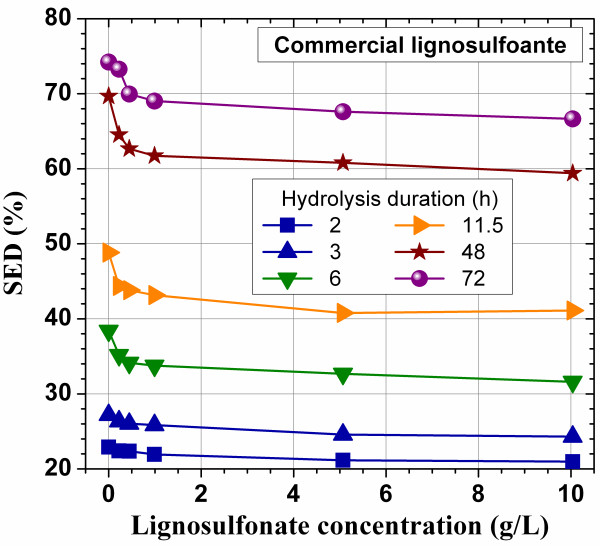
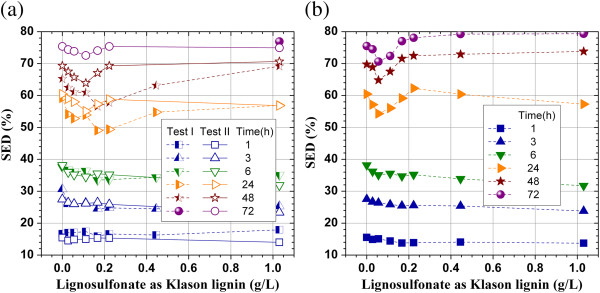
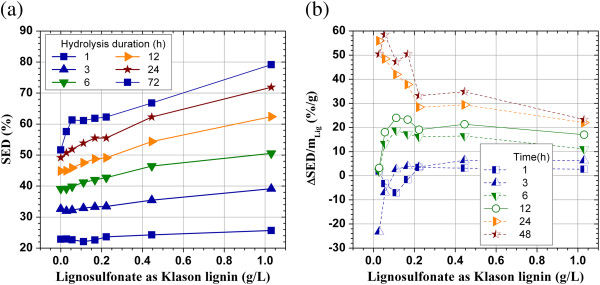
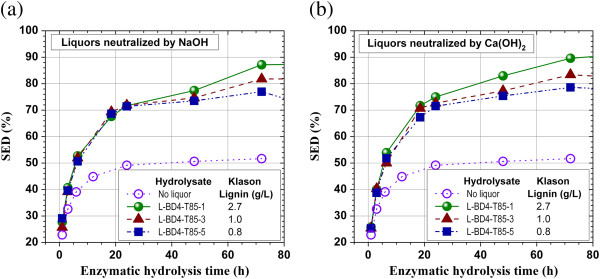
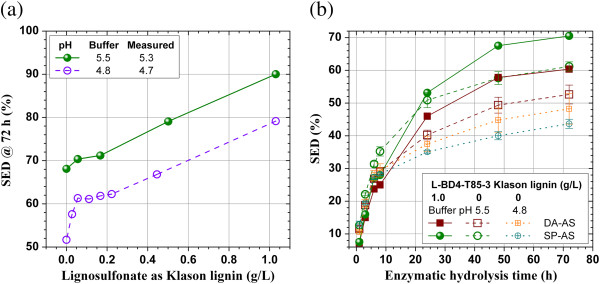
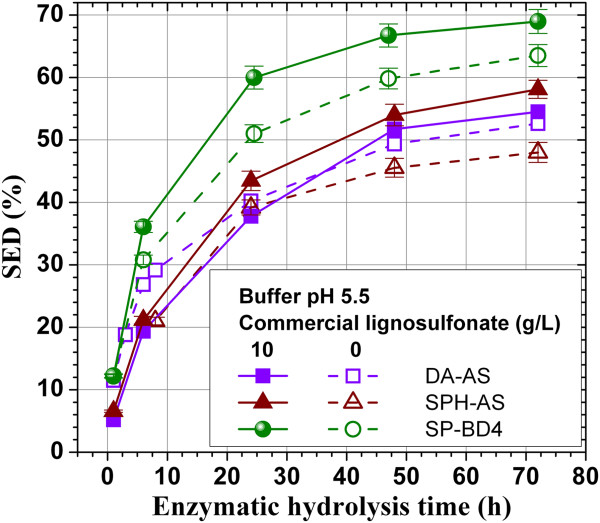
The study found that lignosulfonate from SPORL pretreatment and from a commercial source inhibits enzymatic hydrolysis of pure cellulosic substrates at low concentrations due to nonspecific binding of cellulase. Surprisingly, the reduction in enzymatic saccharification efficiency of a lignocellulosic substrate was fully recovered as the concentrations of these two lignosulfonates increased. We hypothesize that lignosulfonate serves as a surfactant to enhance enzymatic hydrolysis at higher concentrations and that this enhancement offsets its inhibitive effect from nonspecific binding of cellulase, when lignosulfonate is applied to lignocellulosic solid substrates. Lignosulfonate can block nonspecific binding of cellulase by bound lignin on the solid substrates, in the same manner as a nonionic surfactant, to significantly enhance enzymatic saccharification. This enhancement is linearly proportional to the amount of lignosulfonate applied which is very important to practical applications. For a SPORL-pretreated lodgepole pine solid, 90% cellulose saccharification was achieved at cellulase loading of 13 FPU/g glucan with the application of its corresponding pretreatment hydrolysate coupled with increasing hydrolysis pH to above 5.5 compared with only 51% for the control run without lignosulfonate at pH 5.0. The pH-induced lignin surface modification at pH 5.5 further reduced nonspecific binding of cellulase by lignosulfonate.
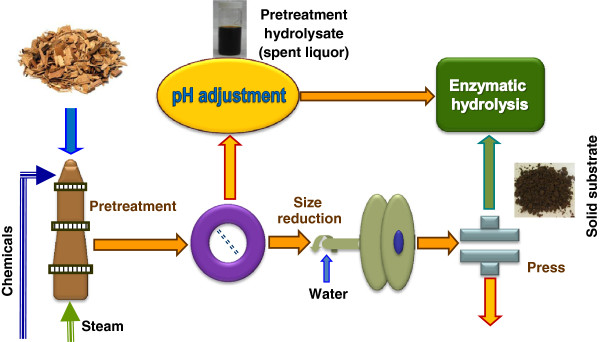
The results reported in this study suggest significant advantages for SPORL-pretreatment in terms of reducing water usage and enzyme dosage, and simplifying process integration, i.e., it should eliminate washing of SPORL solid fraction for direct simultaneous enzymatic saccharification and combined fermentation of enzymatic and pretreatment hydrolysates (SSCombF). Elevated pH 5.5 or higher, rather than the commonly believed optimal and widely practiced pH 4.8-5.0, should be used in conducting enzymatic saccharification of lignocelluloses.
纤维素酶与木质素的非特异性(非生产性)结合(吸附)已被确定为降低纤维素酶负载以从木质纤维素生物质中经济地生产糖和生物燃料的关键障碍。亚硫酸盐预处理克服木质纤维素的顽固性(SPORL)是一种相对较新的工艺,但在木质生物质,尤其是软木的糖和生物燃料生产方面表现出了出色的性能,就产量和能源效率而言。本研究证明了木质素磺化在增强纤维素酶糖化木质纤维素中的作用-来自 SPORL 的木质素磺酸盐可以改善木质纤维素的酶水解,这与由于纤维素酶的非特异性结合而抑制酶水解的传统观念相反。
研究发现,来自 SPORL 预处理和商业来源的木质素磺酸盐在低浓度下会由于纤维素酶的非特异性结合而抑制纯纤维素基质的酶水解。令人惊讶的是,随着这两种木质素磺酸盐浓度的增加,木质纤维素基质的酶糖化效率降低得到完全恢复。我们假设,木质素磺酸盐作为表面活性剂在较高浓度下增强酶水解,并且当木质素磺酸盐应用于木质纤维素固体底物时,这种增强作用抵消了其来自纤维素酶的非特异性结合的抑制作用。木质素磺酸盐可以通过结合在固体底物上的木质素阻止纤维素酶的非特异性结合,以与非离子表面活性剂相同的方式显著增强酶糖化。这种增强与应用的木质素磺酸盐的量成正比,这对于实际应用非常重要。对于 SPORL 预处理的落矶山松固体,在添加其相应的预处理水解液并将水解 pH 提高到 5.5 以上的情况下,在纤维素酶加载量为 13 FPU/g 葡聚糖的情况下可实现 90%的纤维素糖化,而在没有木质素磺酸盐的情况下仅为 51%在 pH 5.0 下运行。在 pH 5.5 下诱导的木质素表面改性进一步降低了木质素磺酸盐对纤维素酶的非特异性结合。
本研究报告的结果表明,SPORL 预处理在减少用水量和酶用量以及简化工艺集成方面具有明显的优势,即它应该消除对 SPORL 固体部分的洗涤,以直接进行同时酶糖化和预处理水解液的组合发酵(SSCombF)。应该使用升高的 pH 5.5 或更高,而不是通常认为的最佳和广泛实践的 pH 4.8-5.0,进行木质纤维素的酶糖化。