Bhargava Madhavi, Bhargava Anurag
Department of Community Medicine, Yenepoya (Deemed to be University), Mangalore, Karnataka, India.
Department of Center for Nutrition Studies, Yenepoya (Deemed to be University), Mangalore, Karnataka, India.
J Family Med Prim Care. 2019 Jan;8(1):115-119. doi: 10.4103/jfmpc.jfmpc_226_18.
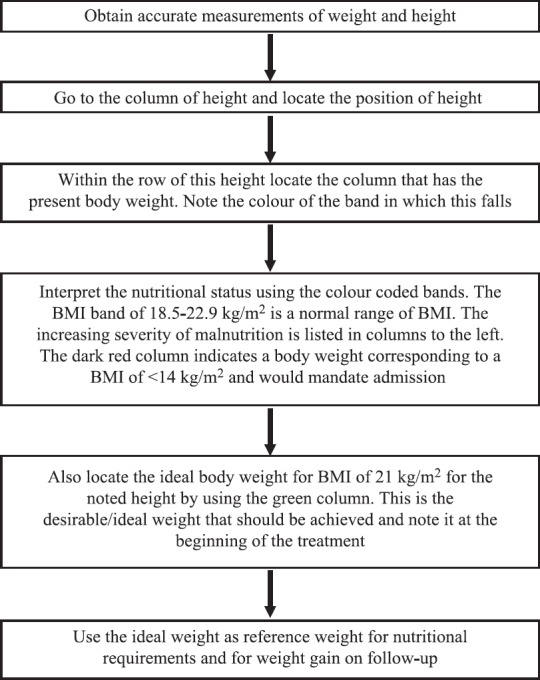
Tuberculosis (TB) is a cause and effect of undernutrition. Patients with active TB in India have a high prevalence of severe undernutrition, an important comorbidity, which increases the risk of mortality, serious adverse effects, relapses after cure and impairs functional status. The World Health Organization and Revised National Tuberculosis Control Programme have now recommended that nutritional assessment, counseling, and support be considered as integral parts of TB care. Nutritional assessment requires calculations of body mass index (BMI) to classify severity of undernutrition at diagnosis and ascertain nutritional recovery at follow-up. We present BMI-based field charts constructed for use by healthcare workers which obviate calculations of BMI and provide weights corresponding to BMI categories, and body weight corresponding to a desirable BMI of 21 kg/m. These simplified BMI-based field charts will enable appropriate assessment, counseling, and monitoring of undernourished patients with active TB by peripheral health workers in programmatic settings.
结核病(TB)是营养不良的一个因果关系。印度的活动性结核病患者中,严重营养不良的患病率很高,这是一种重要的合并症,会增加死亡风险、严重不良反应、治愈后复发的风险,并损害功能状态。世界卫生组织和修订后的国家结核病控制规划现在建议,营养评估、咨询和支持应被视为结核病治疗的组成部分。营养评估需要计算体重指数(BMI),以在诊断时对营养不良的严重程度进行分类,并在随访时确定营养恢复情况。我们展示了为医护人员使用而构建的基于BMI的现场图表,这些图表无需计算BMI,而是提供与BMI类别相对应的体重,以及与理想BMI为21kg/m²相对应的体重。这些简化的基于BMI的现场图表将使基层卫生工作者能够在项目环境中对营养不良的活动性结核病患者进行适当的评估、咨询和监测。