Laboratory of Translational Oncology, School of Medicine, University of Crete, Heraklion, Greece.
Department of Pathology, University General Hospital of Heraklion, Iraklio, Greece.
Cancer Res Treat. 2019 Oct;51(4):1518-1526. doi: 10.4143/crt.2019.008. Epub 2019 Mar 20.
The purpose of this study was to investigate the prognostic significance of liver kinase b1 (LKB1) loss in patients with operable colon cancer (CC).
Two hundred sixty-two specimens from consecutive patients with stage III or high-risk stage II CC, who underwent surgical resection with curative intent and received adjuvant chemotherapy with fluoropyrimidine and oxaliplatin, were analyzed for LKB1 protein expression loss, by immunohistochemistry as well as for KRAS exon 2 and BRAFV600E mutations by Sanger sequencing and TS, ERCC1, MYC, and NEDD9 mRNA expression by real-time quantitative reverse transcription polymerase chain reaction.
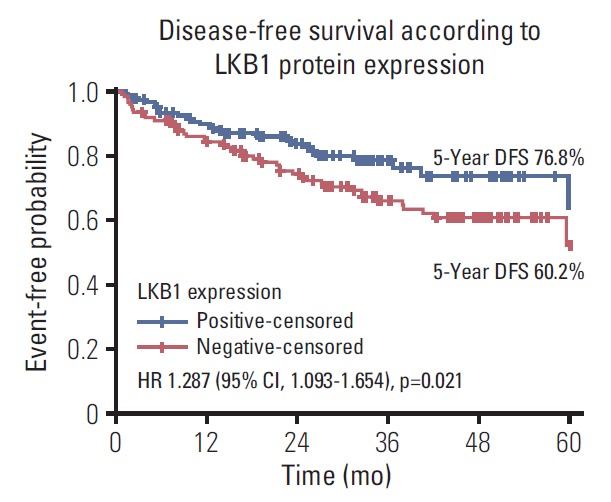
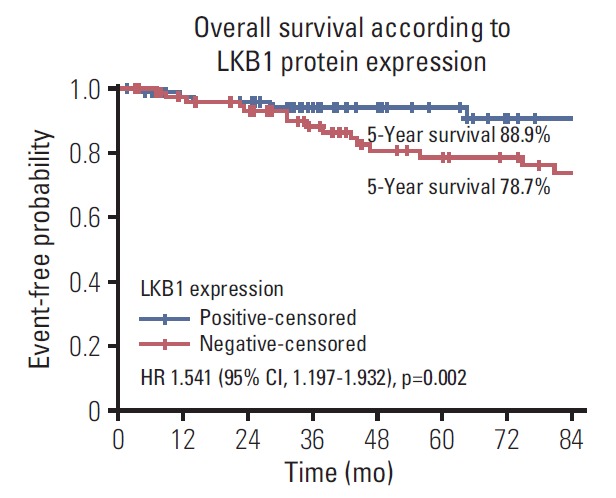
LKB1 expression loss was observed in 117 patients (44.7%) patients and correlated with right-sided located primaries (p=0.032), and pericolic lymph nodes involvement (p=0.003), BRAFV600E mutations (p=0.024), and TS mRNA expression (p=0.041). Patients with LKB1 expression loss experienced significantly lower disease-free survival (DFS) (hazard ratio [HR], 1.287; 95% confidence interval [CI], 1.093 to 1.654; p=0.021) and overall survival (OS) (HR, 1.541; 95% CI, 1.197 to 1.932; p=0.002), compared to patients with LKB1 expressing expressing tumors. Multivariate analysis revealed LKB1 expression loss as independent prognostic factor for both decreased DFS (HR, 1.217; 95% CI, 1.074 to 1.812; p=0.034) and decreased OS (HR, 1.467; 95% CI, 1.226 to 2.122; p=0.019).
Loss of tumoral LKB1 protein expression, constitutes an adverse prognostic factor in patients with operable CC.
本研究旨在探讨肝激酶 B1(LKB1)缺失对可手术结肠癌(CC)患者的预后意义。
对 262 例连续接受根治性手术切除并接受氟嘧啶和奥沙利铂辅助化疗的 III 期或高危 II 期 CC 患者的标本进行 LKB1 蛋白表达缺失分析,采用免疫组织化学方法,对 KRAS 外显子 2 和 BRAFV600E 突变进行 Sanger 测序,对 TS、ERCC1、MYC 和 NEDD9mRNA 表达进行实时定量逆转录聚合酶链反应。
117 例(44.7%)患者存在 LKB1 表达缺失,与右半结肠原发肿瘤(p=0.032)和结肠旁淋巴结受累(p=0.003)、BRAFV600E 突变(p=0.024)和 TS mRNA 表达(p=0.041)相关。LKB1 表达缺失的患者无病生存率(DFS)(风险比 [HR],1.287;95%置信区间 [CI],1.093 至 1.654;p=0.021)和总生存率(OS)(HR,1.541;95% CI,1.197 至 1.932;p=0.002)明显降低,与 LKB1 表达肿瘤的患者相比。多变量分析显示,LKB1 表达缺失是 DFS(HR,1.217;95% CI,1.074 至 1.812;p=0.034)和 OS(HR,1.467;95% CI,1.226 至 2.122;p=0.019)降低的独立预后因素。
肿瘤 LKB1 蛋白表达缺失是可手术 CC 患者的不良预后因素。