Department of Medical Oncology, Centre Léon Bérard, Lyon, France.
Université Claude Bernard, Lyon, France.
Cancer Med. 2019 Apr;8(4):1368-1378. doi: 10.1002/cam4.1931. Epub 2019 Mar 27.
Metastatic soft tissue sarcomas (STS) are a group of rare and heterogeneous mesenchymal tumors with a poor prognosis. The aim of this study was to evaluate the incidence of long-term survivors and describe their presentation and management in a large cohort of patients with metastatic STS.
We collected information of patients with metastatic STS managed in Centre Leon Berard between 1985 and 2015 aiming to compare the group of patients alive 5 years after the diagnosis of metastases vs the others. Prognostic factors of patients and tumors characteristics were investigated by logistic regression analysis. For "long-term survivors," we explored therapeutic strategies at metastatic stage.
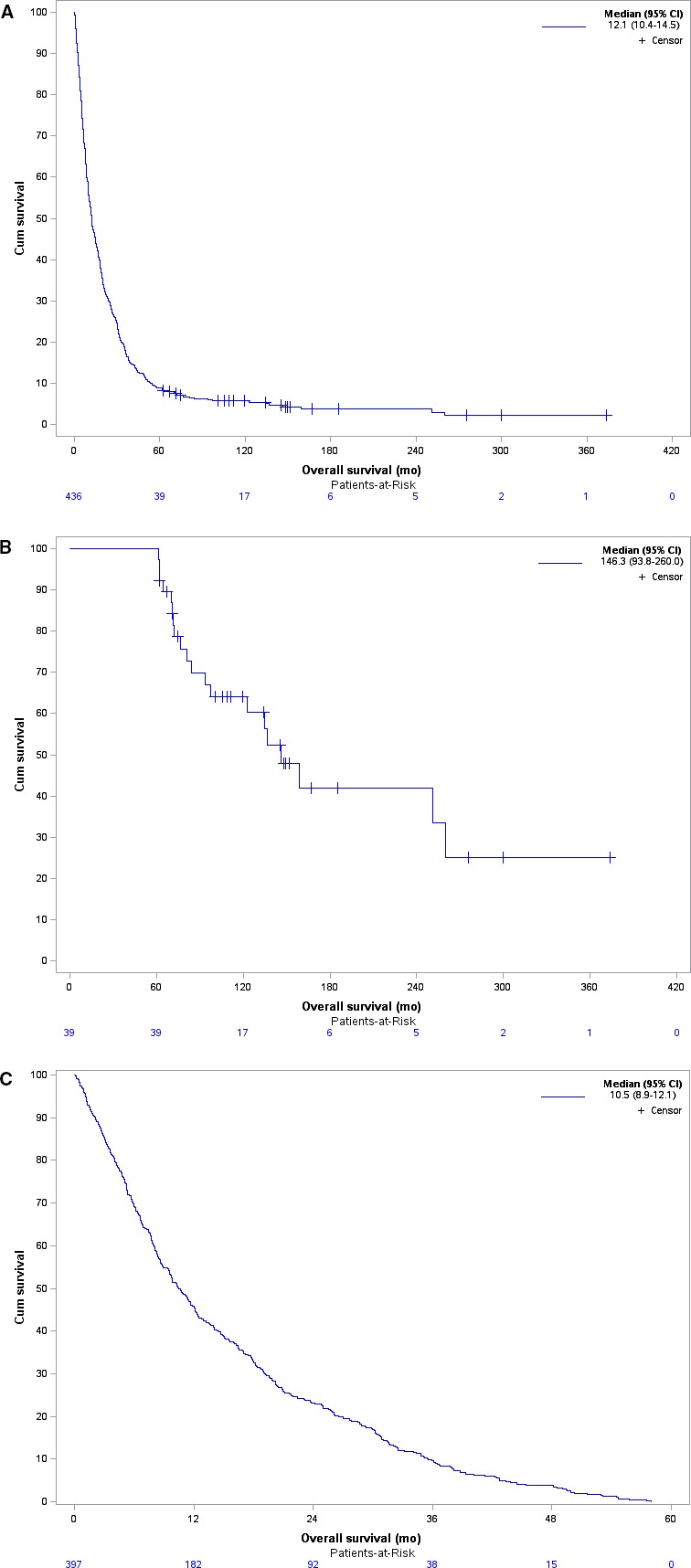
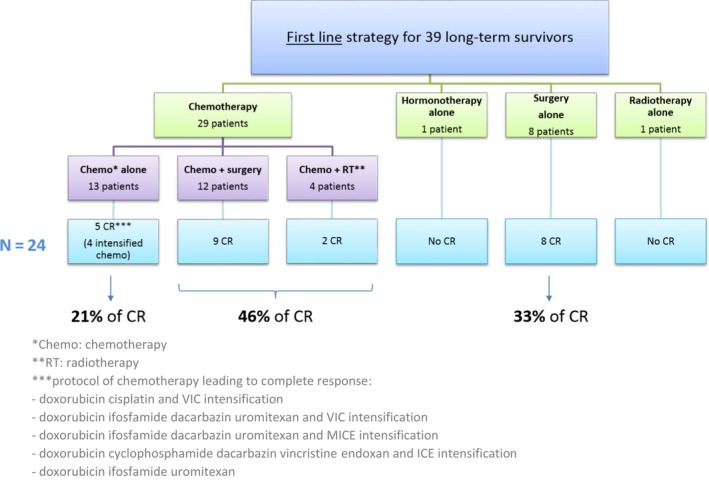
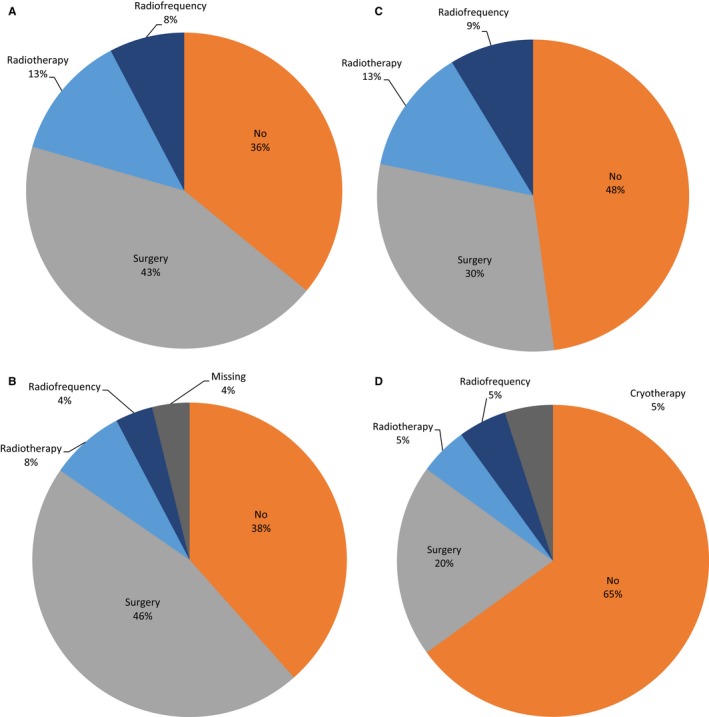
Out of 436 patients enrolled, 39 (9%) were still alive 5 years after diagnostic of metastases with a median survival of 146 months (12 years). This "long-term survivors" group included more female and younger patients, with better performance status, more synovial sarcoma or endometrial stromal sarcoma, more patients with simple genomic sarcomas, lower tumor grade, smaller tumor, and longer disease-free interval. In multivariate analysis, age below 55 at metastatic stage (P = 0.0002) and grade 1 tumor (P < 0.0001) were significantly associated with the "long-term survivors." Their therapeutic management was usually aggressive (intensified or polychemotherapy, repeated local treatment of metastases), leading to 62% of complete response in first-line setting.
Very long-term survivors are observed in metastatic STS. Selection of patients in good condition with less aggressive tumor and administration of intensive treatment may lead to obtain these motivating results in a poor prognosis disease.
转移性软组织肉瘤(STS)是一组罕见且异质性的间叶肿瘤,预后较差。本研究旨在评估长期生存者的发生率,并描述在大量转移性 STS 患者中他们的表现和治疗方法。
我们收集了 1985 年至 2015 年期间在莱昂贝拉德中心治疗的转移性 STS 患者的信息,旨在比较诊断出转移后 5 年仍存活的患者组与其他患者组。通过逻辑回归分析探讨了患者和肿瘤特征的预后因素。对于“长期幸存者”,我们探讨了转移性阶段的治疗策略。
在纳入的 436 名患者中,有 39 名(9%)在诊断出转移后 5 年仍存活,中位生存时间为 146 个月(12 年)。该“长期幸存者”组包括更多的女性和年轻患者,表现状态更好,更多的滑膜肉瘤或子宫内膜间质肉瘤,更多的简单基因组肉瘤患者,更低的肿瘤分级,更小的肿瘤,以及更长的无病间隔。多变量分析显示,转移阶段年龄低于 55 岁(P=0.0002)和肿瘤分级 1(P<0.0001)与“长期幸存者”显著相关。他们的治疗管理通常是积极的(强化或多化疗,重复局部治疗转移灶),导致一线治疗中 62%的完全缓解率。
在转移性 STS 中观察到非常长的生存者。选择身体状况良好、肿瘤侵袭性较低的患者,并给予强化治疗,可能会在预后较差的疾病中获得这些令人鼓舞的结果。