Department of Rehabilitation, Radboud University Medical Center, Donders Centre for Neuroscience, P.O. Box 9101, Nijmegen, HB, 6500, The Netherlands.
Department of Human Movement Sciences, Faculty of Behavioral and Movement Sciences, Vrije Universiteit Amsterdam, Amsterdam Movement Sciences, Amsterdam, The Netherlands.
J Neuroeng Rehabil. 2019 Mar 27;16(1):44. doi: 10.1186/s12984-019-0515-y.
Performing daily activities independently becomes more difficult in time for patients with Duchenne muscular dystrophy (DMD) due to muscle weakness. When performing seated daily activities, the trunk plays an indispensable role besides the upper extremities. However, knowledge is lacking on the interaction between trunk and upper extremities. Therefore the aim was to investigate whether patients with DMD use trunk movement to compensate for reduced arm function when performing seated tasks, and whether this is related to increased muscle activity.
Eighteen boys with DMD and twenty-five healthy controls (HC) performed several tasks when sitting unsupported, like reaching (and placing) forward and sideward, drinking and displacing a dinner plate. Maximum joint torque and maximum surface electromyography (sEMG) were measured during maximum voluntary isometric contractions. Three-dimensional movements and normalized sEMG when performing tasks were analyzed.
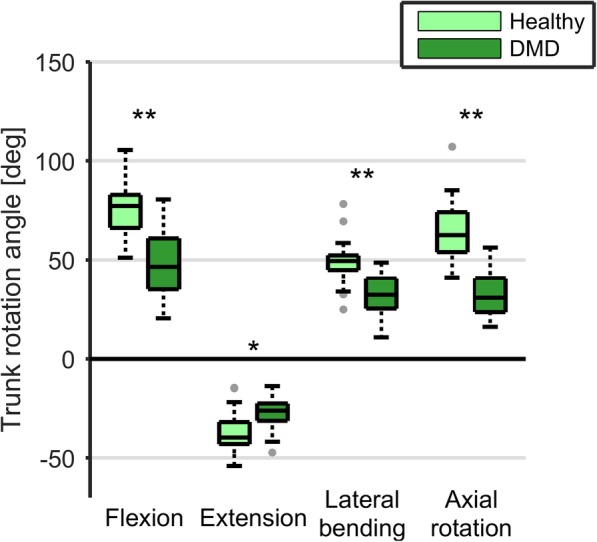
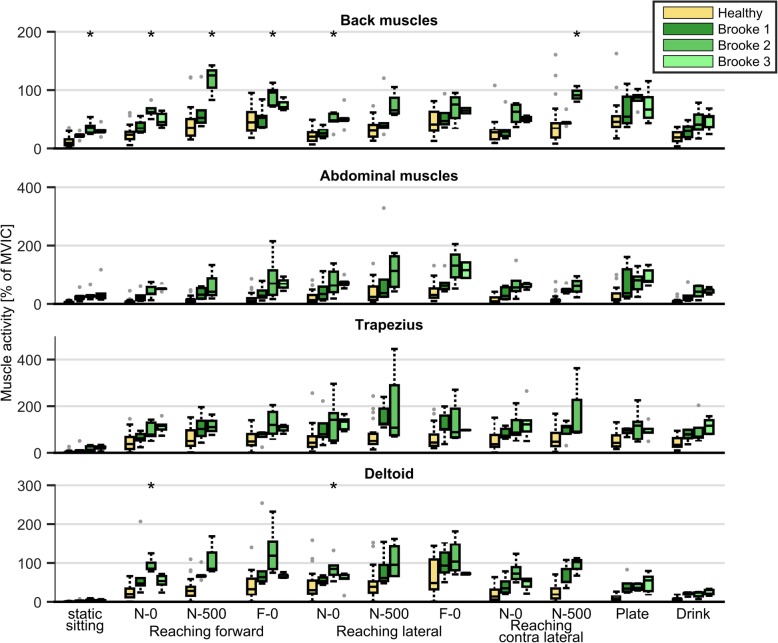
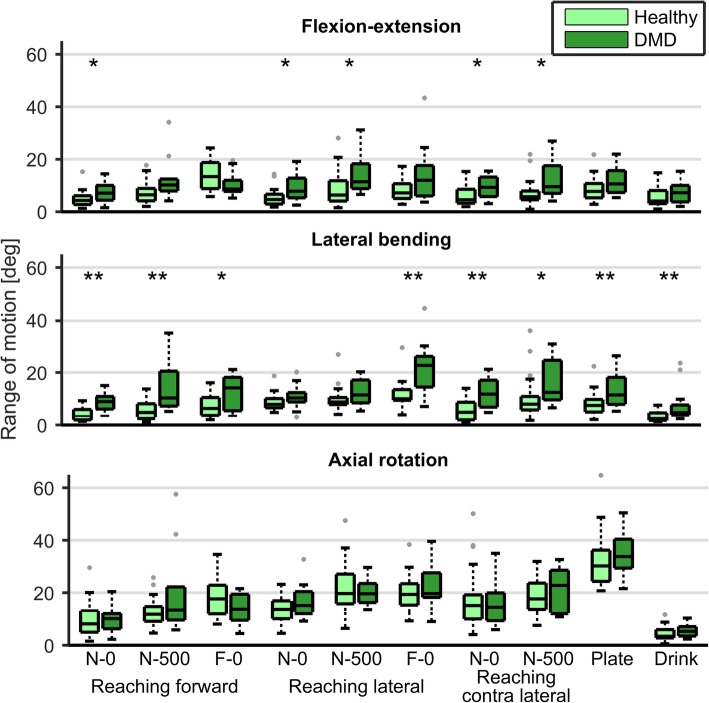
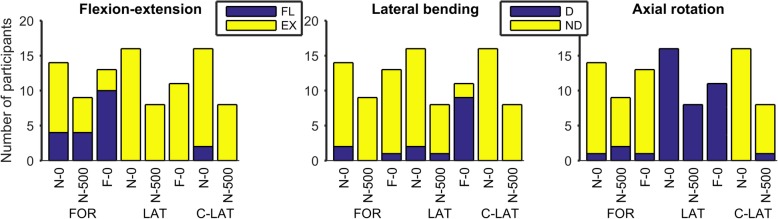
Significantly decreased maximum joint torque was found in DMD patients compared to HC. Trunk and shoulder torques were already decreased in early disease stages. However, only maximum trunk rotation and shoulder abduction torque showed a significant association with Brooke scale. In all reaching and daily tasks, the range of motion in lateral bending and/or flexion-extension was significantly larger in DMD patients compared to HC. The trunk movements did not significantly increase with task difficulty (e.g. increasing object weight) or Brooke scale. Normalized muscle activity was significantly higher in DMD patients for all tasks and muscles.
Boys with DMD use increased trunk movements to compensate for reduced arm function, even when performing relatively simple tasks. This was combined with significantly increased normalized muscle activity. Clinicians should take the trunk into account when assessing function and for intervention development, because DMD patients may appear to have a good trunk function, but percentage of muscle capacity used to perform tasks is increased.
由于肌肉无力,杜氏肌营养不良症(DMD)患者的日常活动能力会随着时间的推移而逐渐下降。在进行坐姿日常活动时,除了上肢外,躯干也起着不可或缺的作用。然而,人们对躯干和上肢之间的相互作用知之甚少。因此,本研究旨在探讨 DMD 患者在进行坐姿任务时是否会利用躯干运动来代偿上肢功能的下降,以及这种代偿是否与肌肉活动增加有关。
18 名 DMD 男孩和 25 名健康对照组(HC)在无支撑坐姿下完成了多项任务,如向前和向侧伸展、喝水和移动餐盘。在最大等长等速收缩时测量最大关节扭矩和最大表面肌电图(sEMG)。分析任务时的三维运动和归一化 sEMG。
与 HC 相比,DMD 患者的最大关节扭矩明显降低。在疾病早期,躯干和肩部扭矩就已经降低。然而,只有最大躯干旋转和肩部外展扭矩与 Brooke 量表有显著相关性。在所有的伸展和日常任务中,DMD 患者的侧向弯曲和/或屈伸活动范围明显大于 HC。随着任务难度(例如增加物体重量)或 Brooke 量表的增加,躯干运动并没有显著增加。与所有任务和肌肉相比,DMD 患者的归一化肌肉活动明显更高。
即使在执行相对简单的任务时,DMD 男孩也会利用增加的躯干运动来代偿上肢功能的下降。这与明显增加的归一化肌肉活动有关。在评估功能和制定干预措施时,临床医生应该考虑到躯干,因为 DMD 患者的躯干功能可能看起来良好,但执行任务所需的肌肉能力百分比增加。