Takata Kazuyuki, Takai Hiroki, Yoshizaki Yuta, Nagata Takuya, Kawahara Keisuke, Yoshida Yasuyuki, Kuzuya Akinori, Ohya Yuichi
Department of Chemistry and Materials Engineering, Faculty of Chemistry, Materials and Bioengineering, 3-3-35 Yamate, Suita, Osaka 564-8680, Japan.
Organization for Research and Development of Innovative Science and Technology (ORDIST), Kansai University, Suita, Osaka 564-8680, Japan.
Gels. 2017 Oct 15;3(4):38. doi: 10.3390/gels3040038.
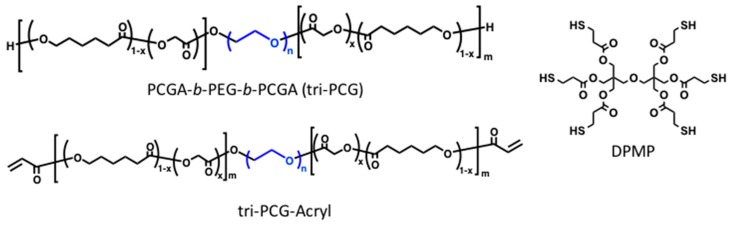
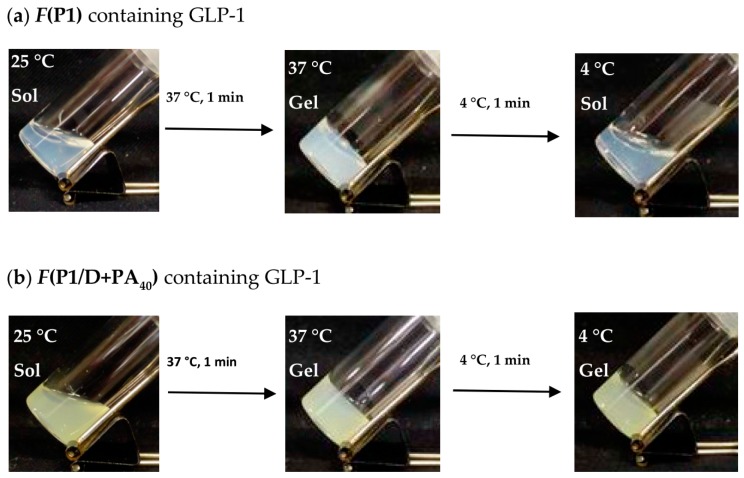
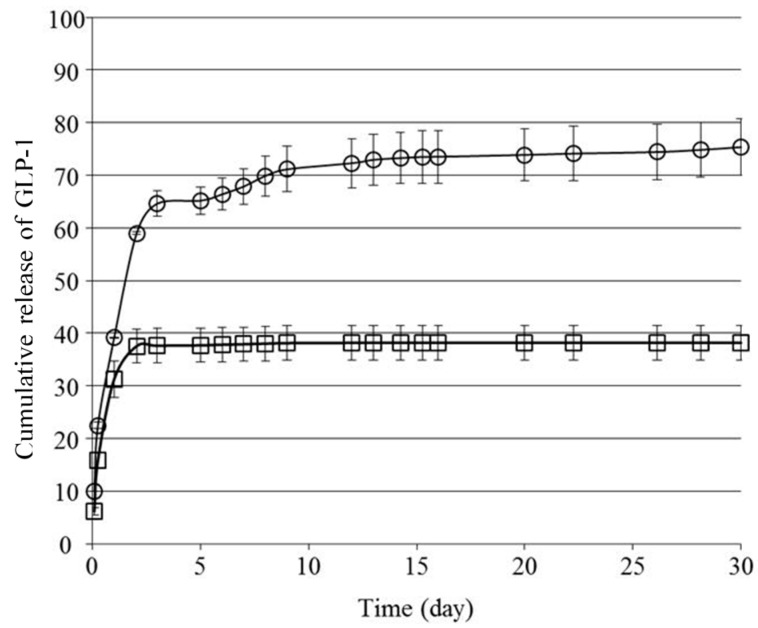
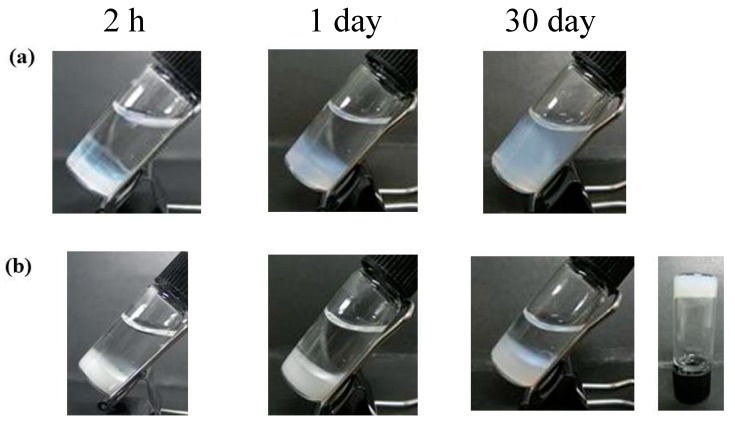
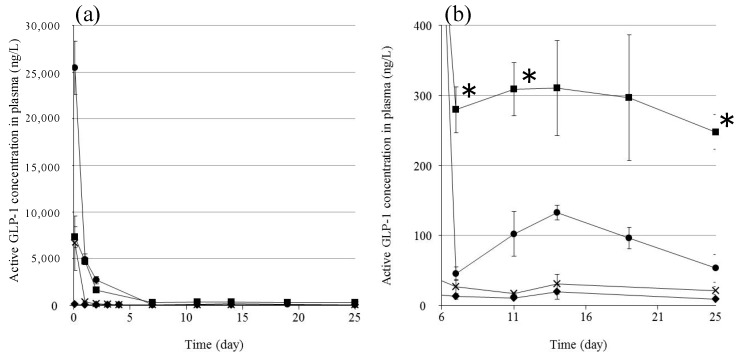
We investigated the release behavior of glucagon-like peptide-1 (GLP-1) from a biodegradable injectable polymer (IP) hydrogel. This hydrogel shows temperature-responsive irreversible gelation due to the covalent bond formation through a thiol-ene reaction. In vitro sustained release of GLP-1 from an irreversible IP formulation () was observed compared with a reversible (physical gelation) IP formulation (). Moreover, pharmaceutically active levels of GLP-1 were maintained in blood after subcutaneous injection of the irreversible IP formulation into rats. This system should be useful for the minimally invasive sustained drug release of peptide drugs and other water-soluble bioactive reagents.
我们研究了胰高血糖素样肽-1(GLP-1)从可生物降解的可注射聚合物(IP)水凝胶中的释放行为。这种水凝胶由于通过硫醇-烯反应形成共价键而表现出温度响应性不可逆凝胶化。与可逆(物理凝胶化)IP制剂()相比,观察到GLP-1从不可逆IP制剂()中的体外持续释放。此外,将不可逆IP制剂皮下注射到大鼠体内后,血液中GLP-1的药物活性水平得以维持。该系统对于肽类药物和其他水溶性生物活性试剂的微创持续药物释放应该是有用的。