Institute for Regenerative Medicine, University of Zurich, Schlieren, Switzerland.
Neuroscience Center Zurich, University of Zurich, Zurich, Switzerland.
Mol Brain. 2019 Mar 29;12(1):27. doi: 10.1186/s13041-019-0447-2.
The amyloid precursor protein (APP) is endoproteolytically processed to generate either the neurotoxic beta-amyloid peptide (Aβ) or the secreted ectodomain APP alpha (sAPPα). While neurotrophic properties of sAPPα were suggested in several studies, it is still unclear if and how sAPPα counteracts pathogenic effects of Aβ. Direct comparisons with sAPPβ, produced in the Aβ-generating pathway, are missing in order to determine the role of sAPPα's carbonyl-terminal end in its possible neuroprotective activity.
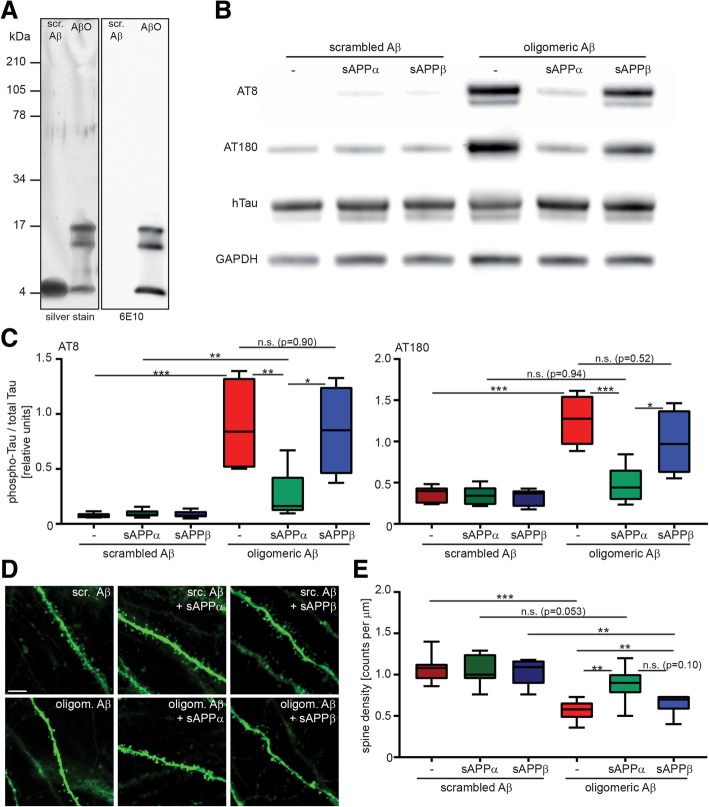
Mouse neuronal primary cultures and hippocampal slices were treated with oligomeric Aβ. The effects on tau phosphorylation and dendritic spine densities were assessed by western blot and confocal imaging, respectively. Co-administration of either sAPPα or sAPPβ was used to determine activity on Aβ-induced toxicity.
RESULTS/DISCUSSION: We found that oligomeric Aβ strongly increased AT8 and AT180 phosphorylation of tau and caused a loss of dendritic spines. SAPPα completely abolished Aβ effects whereas sAPPβ had no such rescue activity. Interestingly, sAPPα or sAPPβ alone neither affected tau phosphorylation nor dendritic spine numbers. Together, our data suggest that sAPPα specifically protects neurons against Aβ-dependent toxicity supporting the strategy of activating α-secretase-dependent endoproteolytic APP processing to increase sAPPα shedding from the neuronal plasma membrane as a therapeutic intervention for the protection of dendritic spines and phospho-tau-dependent toxicity in Alzheimer's disease.
淀粉样前体蛋白(APP)经内肽酶切割生成神经毒性β-淀粉样肽(Aβ)或分泌型 APP 外显子α(sAPPα)。尽管有几项研究表明 sAPPα 具有神经营养作用,但 sAPPα 是否以及如何抵消 Aβ 的致病作用仍不清楚。为了确定 sAPPα 的碳末端在其可能的神经保护活性中的作用,尚缺乏与 Aβ 生成途径中产生的 sAPPβ 的直接比较。
用寡聚 Aβ 处理原代培养的小鼠神经元和海马切片。通过 Western blot 和共聚焦成像分别评估对 tau 磷酸化和树突棘密度的影响。共给予 sAPPα 或 sAPPβ 以确定其对 Aβ 诱导的毒性的作用。
结果/讨论:我们发现,寡聚 Aβ 可强烈增加 tau 的 AT8 和 AT180 磷酸化,并导致树突棘丢失。sAPPα 完全消除了 Aβ 的作用,而 sAPPβ 则没有这种挽救活性。有趣的是,sAPPα 或 sAPPβ 本身既不影响 tau 磷酸化,也不影响树突棘数量。总之,我们的数据表明 sAPPα 特异性保护神经元免受 Aβ 依赖性毒性,支持激活α-分泌酶依赖性 APP 内肽酶切割以增加 sAPPα 从神经元质膜脱落的策略,作为保护树突棘和阿尔茨海默病中磷酸化 tau 依赖性毒性的治疗干预。