Heathcote Lauren C, Pate Joshua W, Park Anna L, Leake Hayley B, Moseley G Lorimer, Kronman Corey A, Fischer Molly, Timmers Inge, Simons Laura E
Anesthesiology, Perioperative, and Pain Medicine, Stanford University School of Medicine, Stanford, CA, United States of America.
Faculty of Medicine and Health Sciences, Macquarie University, Sydney, New South Wales, Australia.
PeerJ. 2019 Mar 22;7:e6603. doi: 10.7717/peerj.6603. eCollection 2019.
The Internet in general, and YouTube in particular, is now one of the most popular sources of health-related information. Pain neuroscience education has become a primary tool for managing persistent pain, based in part on the discovery that information about pain can change pain. Our objective was to examine the availability, characteristics, and content of YouTube videos that address the neuroscience of pain.
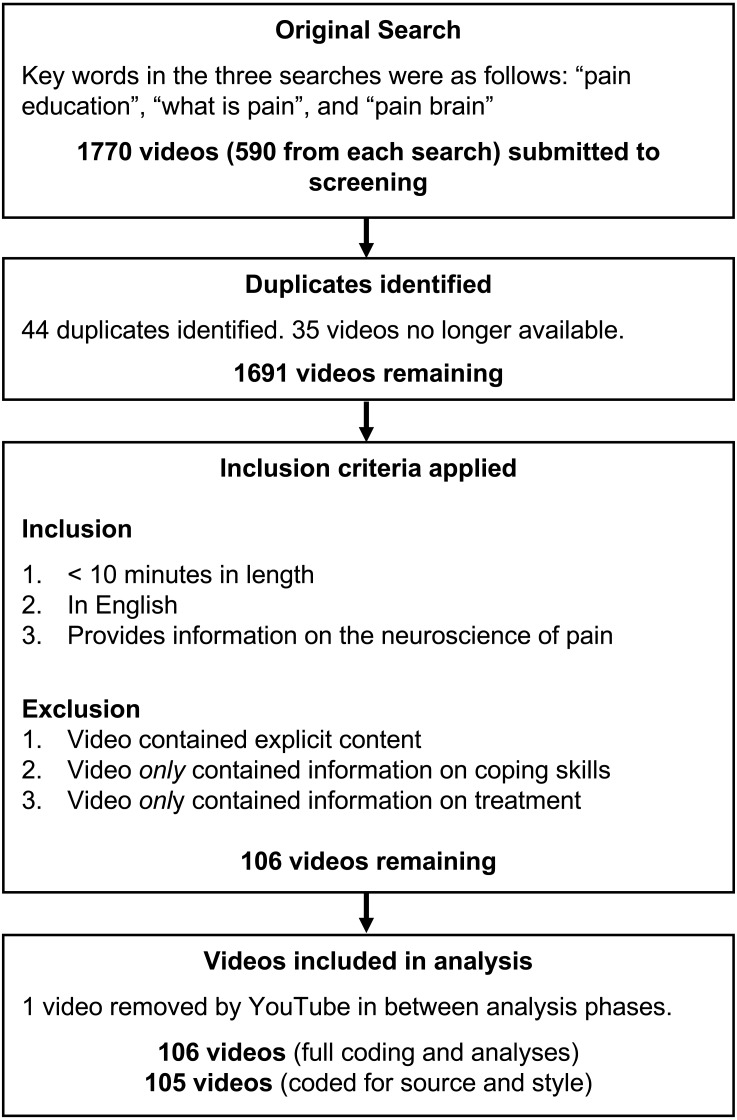
We conducted a systematic review of videos on YouTube using the search terms "pain education", "what is pain", and "pain brain" in January 2018. Videos were included if they were in English, were under 10 minutes long, and included information on the neuroscience of pain. Videos were coded for (i) descriptive characteristics (e.g., number of views, duration on YouTube), (ii) source and style, (iii) whether or not they addressed seven pre-determined target concepts of pain neuroscience education (e.g., 'Pain is not an accurate marker of tissue state'), and (iv) how engaging they were.
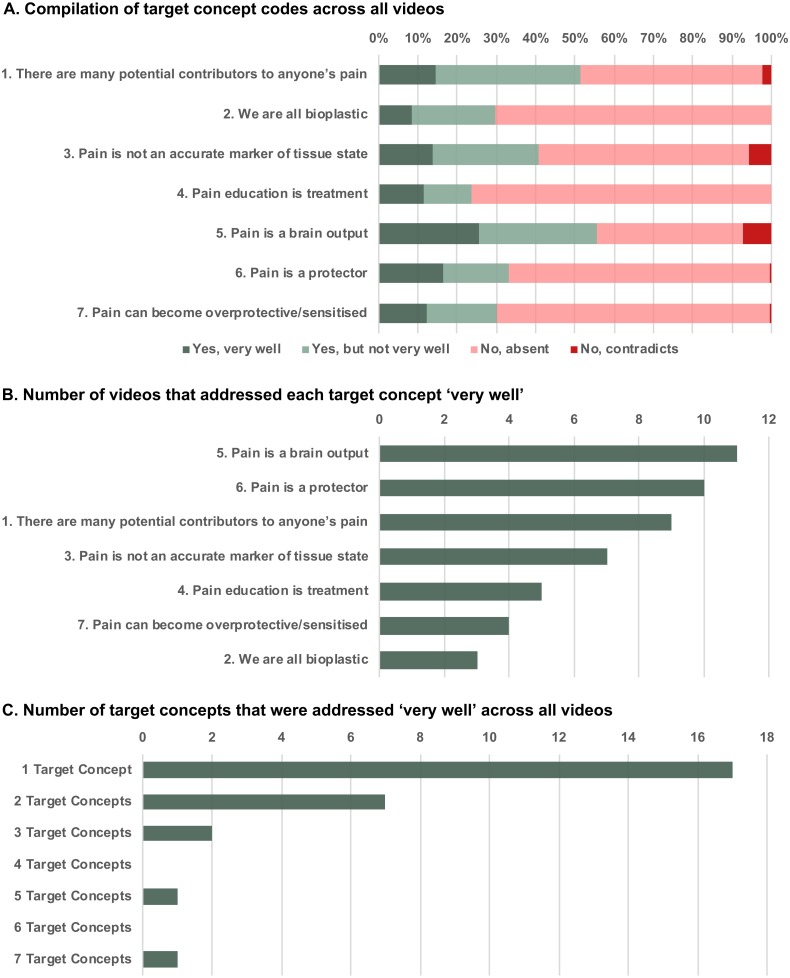
We found 106 unique videos that met the inclusion criteria. The videos ranged from having four views to over five million views ( = 1,163 views), with the three most highly viewed videos accounting for 75% of the total views. Animated videos were much more highly viewed than non-animated videos. Only a small number of videos had been posted by a clearly-identifiable reputable source such as an academic or medical institution (10%), although a number of videos were posted by healthcare professionals and professional medical societies. For a small number of videos (7%), the source was unclear. We found 17 videos that addressed at least one target concept of pain neuroscience science education, only nine of which were considered to be at least somewhat engaging. The target concept 'Pain is a brain output' was considered to be well addressed by the most videos ( = 11), followed by 'Pain is a protector' ( = 10). We found only one video that adequately addressed all seven target concepts of pain neuroscience education.
YouTube contains a variety of videos that practitioners, patients, and families may view to access pain neuroscience education information. A small portion of these videos addressed one or more target concepts of pain neuroscience education in an engaging manner. It is yet to be determined to what extent patients are able to learn information from these videos, to what extent the videos promote behavior change, and thus to what extent the videos may be useful for clinical practice.
一般而言,互联网,尤其是YouTube,如今已成为与健康相关信息最受欢迎的来源之一。疼痛神经科学教育已成为管理持续性疼痛的主要工具,部分原因是发现有关疼痛的信息可以改变疼痛。我们的目的是研究YouTube上有关疼痛神经科学的视频的可获取性、特征和内容。
2018年1月,我们使用搜索词“疼痛教育”、“什么是疼痛”和“疼痛大脑”对YouTube上的视频进行了系统回顾。如果视频为英文、时长在10分钟以内且包含有关疼痛神经科学的信息,则将其纳入。对视频进行编码,内容包括:(i)描述性特征(如观看次数、在YouTube上的时长),(ii)来源和风格,(iii)是否涉及疼痛神经科学教育的七个预先确定的目标概念(如“疼痛不是组织状态的准确指标”),以及(iv)视频的吸引力。
我们发现了106个符合纳入标准的独特视频。这些视频的观看次数从4次到超过500万次不等(平均 = 1163次),观看次数最多的三个视频占总观看次数的75%。动画视频的观看次数远高于非动画视频。只有少数视频由学术或医疗机构等明确可识别的知名来源发布(10%),不过有一些视频是由医疗保健专业人员和专业医学协会发布的。少数视频(7%)的来源不明。我们发现有17个视频涉及疼痛神经科学教育的至少一个目标概念,其中只有9个被认为至少有一定吸引力。大多数视频(n = 11)认为“疼痛是大脑的输出”这一目标概念阐述得较好,其次是“疼痛是一种保护机制”(n = 10)。我们仅发现一个视频充分涵盖了疼痛神经科学教育的所有七个目标概念。
YouTube包含各种从业者、患者和家属可能会观看以获取疼痛神经科学教育信息的视频。这些视频中有一小部分以吸引人的方式涉及了疼痛神经科学教育的一个或多个目标概念。患者能够从这些视频中学到多少信息、这些视频在多大程度上促进行为改变以及因此这些视频在多大程度上可能对临床实践有用,还有待确定。