Birch Eleanor M, Leziak Karolina, Jackson Jenise, Dahl Emma, Niznik Charlotte M, Yee Lynn M
Division of Maternal-Fetal Medicine, Department of Obstetrics & Gynecology, Feinberg School of Medicine, Northwestern University, Chicago, IL, United States.
JMIR Diabetes. 2022 Apr 7;7(2):e30156. doi: 10.2196/30156.
People with gestational diabetes have enhanced learning requirements during pregnancy, and management of their disease often requires the translation of health information into new health behavior changes. Seeking information from the internet to augment learning from health professionals is becoming more common during pregnancy. YouTube is a popular free and accessible web-based resource, which may be particularly useful for individuals with low health literacy or other barriers to receiving high-quality health care; however, the quality and content of YouTube videos varies, and little is known about those covering gestational diabetes.
We aimed to systematically evaluate the quality, content, and reliability of YouTube videos about gestational diabetes.
A systematic search of YouTube videos was conducted over the course of 1 week in April 2020 using the following keywords: "gestational diabetes," "gestational diabetes management," "gestational diabetes treatment," and "pregnancy and diabetes." The search results were displayed by relevance, replicating a default YouTube search attempt. The first 60 results from each keyword were reviewed (n=240). Exclusion criteria were videos unrelated to gestational diabetes, videos not in English, and those for which the full video was not available at the time of review. For each unique video, a gestational diabetes content score was used to rate video comprehensiveness and accuracy, and the DISCERN instrument, a validated metric to assess consumer health information, was used to evaluate the reliability of information presented. Videos were further categorized by quality: videos with DISCERN scores lower than 3 (out of 5) or a content score less than 4 (out of 7) were categorized as low quality, and all others were designated high quality. We performed descriptive analysis and compared video characteristics by source and quality rating.
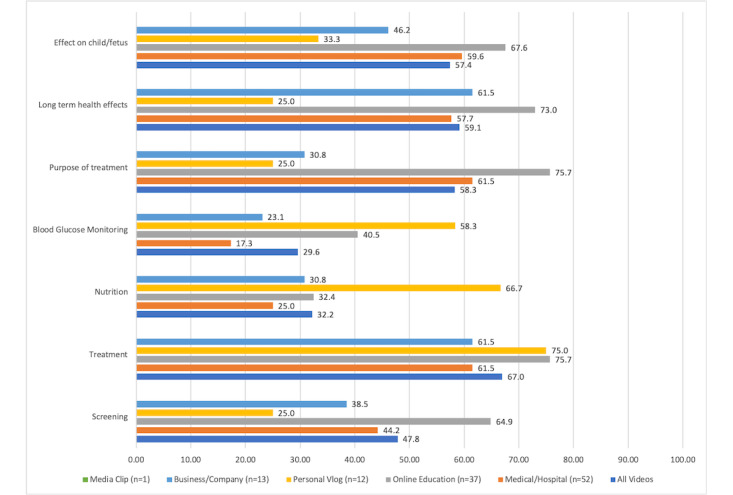
For 115 unique videos, the mean content score (out of 7) was 3.5 (SD 2.0) , and the mean DISCERN score (out of 5) was 2.7 (SD 0.7), representing low to moderate information comprehensiveness and reliability respectively. Video sources were categorized as personal vlog (12/115, 10.4%), web-based education (37/115, 32.2%), medical (52/115, 45.2%), business or company (13/115, 11.3%), and media clip (1/115, 0.9%). DISCERN and content scores trended higher among medical and web-based education videos. The majority of videos (n=88) were categorized as low quality, while 27 videos were categorized as high quality. Video duration was longer for high-quality videos (P<.001); high- and low-quality videos otherwise had similar views and viewer interaction numbers.
Although high-quality videos about gestational diabetes exist, reliability, accuracy, and comprehensiveness were low overall, and higher quality was not associated with increased viewer interaction. It is important to acknowledge the limitations of this platform and to assist patients in accessing high quality content and differentiating the quality of information sources.

妊娠期糖尿病患者在孕期有更高的学习需求,对其疾病的管理通常需要将健康信息转化为新的健康行为改变。孕期通过互联网寻求信息以补充从医疗保健人员处获得的知识变得越来越普遍。YouTube是一个广受欢迎的免费且易于访问的网络资源,对于健康素养较低或在获取高质量医疗保健方面存在其他障碍的个人可能特别有用;然而,YouTube视频的质量和内容参差不齐,对于那些涵盖妊娠期糖尿病的视频了解甚少。
我们旨在系统评估YouTube上关于妊娠期糖尿病的视频的质量、内容和可靠性。
2020年4月,我们使用以下关键词对YouTube视频进行了为期1周的系统搜索:“妊娠期糖尿病”、“妊娠期糖尿病管理”、“妊娠期糖尿病治疗”以及“妊娠与糖尿病”。搜索结果按相关性显示,模拟默认的YouTube搜索尝试。对每个关键词的前60个结果进行了审查(共240个)。排除标准为与妊娠期糖尿病无关的视频、非英语视频以及在审查时无法获取完整视频的视频。对于每个独特的视频,使用妊娠期糖尿病内容评分来评估视频的全面性和准确性,并使用DISCERN工具(一种经过验证的评估消费者健康信息的指标)来评估所呈现信息的可靠性。视频进一步按质量分类:DISCERN评分低于3分(满分5分)或内容评分低于4分(满分7分)的视频被归类为低质量,其他所有视频被指定为高质量。我们进行了描述性分析,并按来源和质量评级比较了视频特征。
对于115个独特的视频,平均内容评分(满分7分)为3.5分(标准差2.0),平均DISCERN评分(满分5分)为2.7分(标准差0.7),分别代表信息全面性和可靠性低至中等。视频来源分为个人博客(12/115,10.4%)、网络教育(37/115,32.2%)、医学(52/115,45.2%)、商业或公司(13/115,11.3%)以及媒体剪辑(1/115,0.9%)。医学和网络教育视频的DISCERN评分和内容评分往往更高。大多数视频(n = 88)被归类为低质量,而27个视频被归类为高质量。高质量视频的时长更长(P <.001);否则,高质量和低质量视频的观看次数和观众互动数量相似。
尽管存在关于妊娠期糖尿病的高质量视频,但总体而言可靠性、准确性和全面性较低,且较高的质量与增加的观众互动无关。认识到这个平台的局限性并协助患者获取高质量内容以及区分信息来源的质量很重要。