Sparks Jeffrey A, Doyle Tracy J, He Xintong, Pan Beatrice, Iannaccone Christine, Frits Michelle L, Dellaripa Paul F, Rosas Ivan O, Lu Bing, Weinblatt Michael E, Shadick Nancy A, Karlson Elizabeth W
Department of Medicine, Division of Rheumatology, Immunology, and Allergy, Brigham and Women's Hospital, Boston, MA.
Harvard Medical School, Boston, MA.
ACR Open Rheumatol. 2019 Mar;1(1):4-15. doi: 10.1002/acr2.1001. Epub 2019 Mar 15.
To investigate the incidence and predictors of dyspnea on exertion among subjects with rheumatoid arthritis (RA).
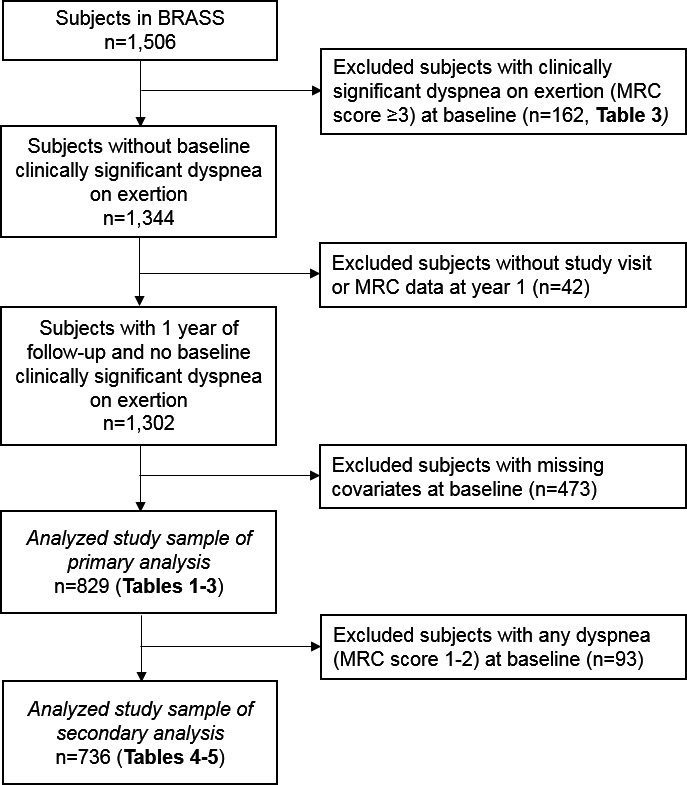
We investigated dyspnea on exertion using a prospective cohort, the Brigham RA Sequential Study (BRASS). Clinically significant dyspnea on exertion was defined as a score of ≥3 (unable to ambulate without breathlessness or worse) on the validated Medical Research Council (MRC) scale (range 0-5). We analyzed subjects with MRC score <3 at BRASS baseline and ≥1 year of follow-up. The MRC scale was administered annually. We determined the incidence rate (IR) of dyspnea on exertion. We used Cox regression to estimate the HR for dyspnea on exertion occurring one year after potential predictors were assessed.
We analyzed 829 subjects with RA and no clinically significant dyspnea on exertion during mean follow-up of 3.0 years (SD 1.9). At baseline, mean age was 55.7 years (SD 13.6), 82.4% were female, and median RA duration was 8 years. During follow-up, 112 subjects (13.5%) developed incident dyspnea on exertion during 2,476 person-years of follow-up (IR 45.2 per 1000 person-years). Independent predictors of incident dyspnea on exertion were: older age (HR 1.03 per year, 95%CI 1.01-1.04), female sex (HR 2.22, 95%CI 1.14-4.29), mild dyspnea (HR 2.62, 95%CI 1.60-4.28), and worsened MDHAQ (HR 2.36 per unit, 95%CI 1.54-3.60). Methotrexate use, RA disease activity, and seropositivity were not associated with incident dyspnea on exertion.
Dyspnea on exertion occurred commonly in patients with RA. Older women with impaired physical function were especially vulnerable to developing dyspnea on exertion.
调查类风湿关节炎(RA)患者运动性呼吸困难的发生率及预测因素。
我们使用前瞻性队列研究——布莱根妇女医院类风湿关节炎序贯研究(BRASS),对运动性呼吸困难进行调查。经验证的医学研究委员会(MRC)量表(范围0 - 5)将具有临床意义的运动性呼吸困难定义为评分≥3(不气喘吁吁或更严重就无法行走)。我们分析了在BRASS基线时MRC评分<3且随访≥1年的受试者。MRC量表每年进行一次评估。我们确定了运动性呼吸困难的发病率(IR)。我们使用Cox回归来估计在评估潜在预测因素一年后发生运动性呼吸困难的风险比(HR)。
我们分析了829例RA患者,在平均3.0年(标准差1.9)的随访期间,这些患者无具有临床意义的运动性呼吸困难。基线时,平均年龄为55.7岁(标准差13.6),82.4%为女性,类风湿关节炎病程中位数为8年。在随访期间,112名受试者(13.5%)在2476人年的随访期间发生了新发运动性呼吸困难(发病率为每1000人年45.2例)。运动性呼吸困难新发的独立预测因素为:年龄较大(每年HR 1.03,95%置信区间1.01 - 1.04)、女性(HR 2.22,95%置信区间1.14 - 4.29)、轻度呼吸困难(HR 2.62,95%置信区间1.60 - 4.28)以及MDHAQ恶化(每单位HR 2.36,95%置信区间1.54 - 3.60)。使用甲氨蝶呤、类风湿关节炎疾病活动度及血清阳性与运动性呼吸困难新发无关。
运动性呼吸困难在类风湿关节炎患者中普遍存在。身体功能受损的老年女性尤其容易发生运动性呼吸困难。