a Julius Center for Health Sciences and Primary Care , University Medical Center Utrecht , Utrecht , The Netherlands.
b Institute for Training of General Practitioners Utrecht , Zeist , The Netherlands.
Eur J Gen Pract. 2019 Apr;25(2):77-84. doi: 10.1080/13814788.2018.1543396. Epub 2019 Mar 29.
Care transitions between general practice and hospital are hazardous regarding patient safety. For developing an improvement strategy adjusted to local settings, understanding of type and potential causes of transitional safety incidents (TSIs) is needed.
To provide a broad overview of the nature of TSIs reported by patients and healthcare professionals.
We collected data (2011-2015) from three hospitals and 56 affiliated general practitioners (GPs) in two Dutch regions (one urban, one rural). We collected data from patients through a survey, interviews and incident reporting weeks, and from GPs and hospital specialists through incident reporting systems, surveys, interviews and focus group discussions. We classified reported TSIs according to type, cause and severity.
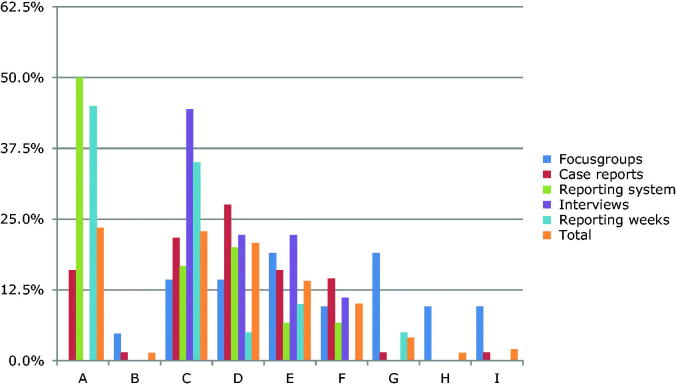
In total, 548 TSIs were reported by 411 patients and 137 healthcare professionals; 368 of 548 TSI reports contained sufficient information for classification into aspects of the care transition process, 191 of 548 for cause, and 149 of 548 for severity. Most TSIs concerned handover correspondence from hospital to GP (26%), referral (14%) and communication/collaboration (14%). Concerning cause, reported TSIs could be attributed to organizational (48%) and human factors (43%). Twenty-four percent concerned unsafe situations, 45% near misses and 31% adverse events. Patients and healthcare professionals reported differently on referral (17% vs 9%), repeated diagnostic testing (20% vs 1%), and uncertainty about assigned responsible physician (10% vs 3%).
Reported TSIs typically concerned informational discontinuity. One third caused harm to the patient. Patients report different TSIs than healthcare professionals, suggesting a different view.
在一般实践和医院之间的护理交接对患者安全存在风险。为了制定适应当地情况的改进策略,需要了解过渡安全事件(TSI)的类型和潜在原因。
提供患者和医疗保健专业人员报告的 TSI 性质的广泛概述。
我们从荷兰两个地区(一个城市,一个农村)的三家医院和 56 家附属全科医生(GP)中收集了数据(2011-2015 年)。我们通过调查、访谈和事件报告周从患者那里收集数据,通过事件报告系统、调查、访谈和焦点小组讨论从 GP 和医院专家那里收集数据。我们根据类型、原因和严重程度对报告的 TSI 进行分类。
共有 411 名患者和 137 名医疗保健专业人员报告了 548 起 TSI;548 份 TSI 报告中有 368 份报告包含足够的信息可用于分类为护理交接过程的各个方面,191 份报告可用于原因,149 份报告可用于严重程度。大多数 TSI 涉及从医院到 GP 的交接对应(26%)、转诊(14%)和沟通/协作(14%)。关于原因,报告的 TSI 可归因于组织因素(48%)和人为因素(43%)。24%涉及不安全情况,45%为接近失误,31%为不良事件。患者和医疗保健专业人员对转诊(17%对 9%)、重复诊断测试(20%对 1%)和对指定负责医生的不确定性(10%对 3%)的报告不同。
报告的 TSI 通常涉及信息不连续。三分之一对患者造成伤害。患者报告的 TSI 与医疗保健专业人员不同,表明看法不同。