Smits Marleen, Keizer Ellen, Giesen Paul, Deilkås Ellen Catharina Tveter, Hofoss Dag, Bondevik Gunnar Tschudi
a Radboud Scientific Center for Quality of Healthcare (IQ healthcare), Radboud Institute for Health Sciences , Radboud university medical center , Nijmegen , The Netherlands.
b NIVEL , Netherlands Institute for Health Services Research , Utrecht , The Netherlands.
Scand J Prim Health Care. 2018 Mar;36(1):28-35. doi: 10.1080/02813432.2018.1426150. Epub 2018 Jan 15.
To examine patient safety culture in Dutch out-of-hours primary care using the safety attitudes questionnaire (SAQ) which includes five factors: teamwork climate, safety climate, job satisfaction, perceptions of management and communication openness.
Cross-sectional observational study using an anonymous web-survey. Setting Sixteen out-of-hours general practitioner (GP) cooperatives and two call centers in the Netherlands. Subjects Primary healthcare providers in out-of-hours services. Main outcome measures Mean scores on patient safety culture factors; association between patient safety culture and profession, gender, age, and working experience.
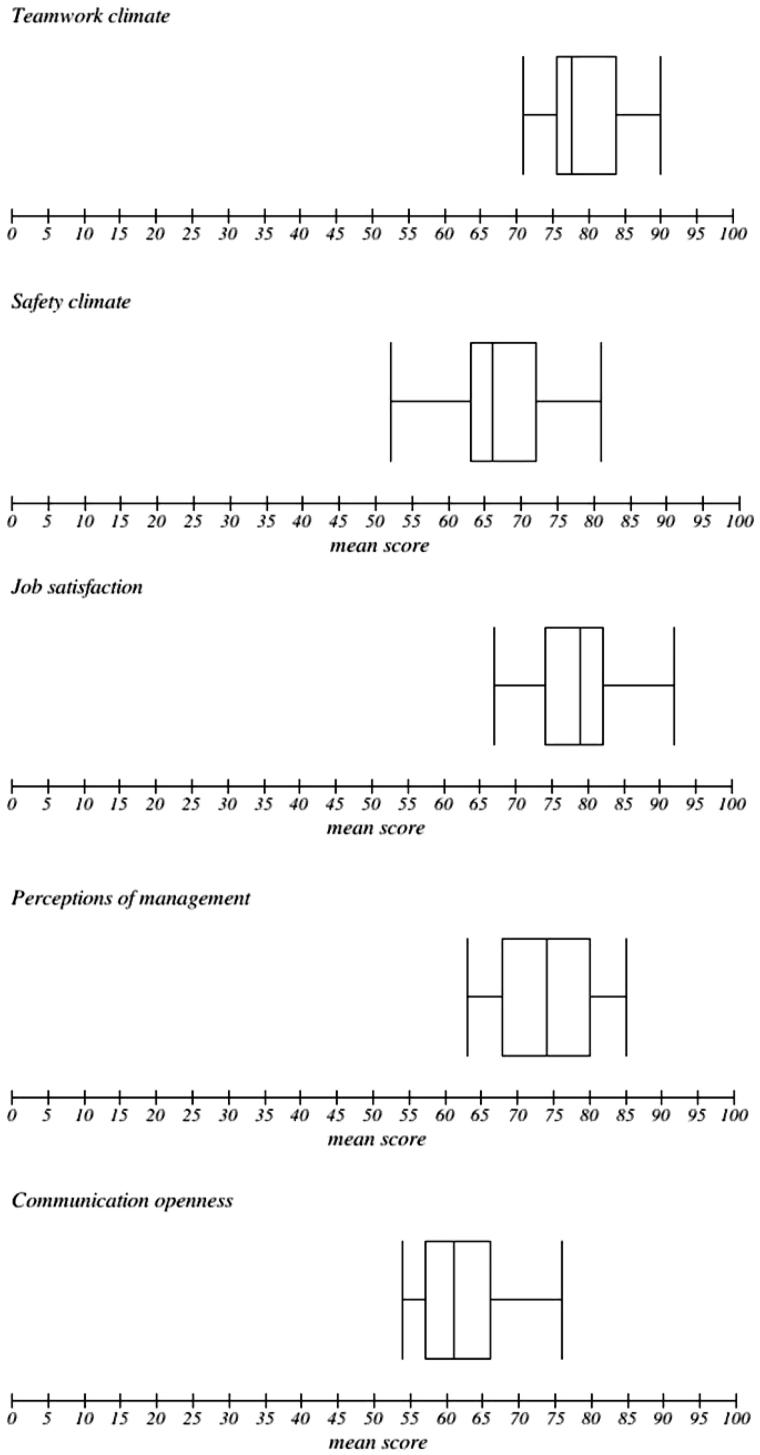
Overall response rate was 43%. A total of 784 respondents were included; mainly GPs (N = 470) and triage nurses (N = 189). The healthcare providers were most positive about teamwork climate and job satisfaction, and less about communication openness and safety climate. The largest variation between clinics was found on safety climate; the lowest on teamwork climate. Triage nurses scored significantly higher than GPs on each of the five patient safety factors. Older healthcare providers scored significantly higher than younger on safety climate and perceptions of management. More working experience was positively related to higher teamwork climate and communication openness. Gender was not associated with any of the patient safety factors.
Our study showed that healthcare providers perceive patient safety culture in Dutch GP cooperatives positively, but there are differences related to the respondents' profession, age and working experience. Recommendations for future studies are to examine reasons for these differences, to examine the effects of interventions to improve safety culture and to make international comparisons of safety culture. Key Points Creating a positive patient safety culture is assumed to be a prerequisite for quality and safety. We found that: • healthcare providers in Dutch GP cooperatives perceive patient safety culture positively; • triage nurses scored higher than GPs, and older and more experienced healthcare professionals scored higher than younger and less experienced professionals - on several patient safety culture factors; and • within the GP cooperatives, safety climate and openness of communication had the largest potential for improvement.
使用安全态度问卷(SAQ)来调查荷兰非工作时间初级医疗中的患者安全文化,该问卷包含五个因素:团队合作氛围、安全氛围、工作满意度、对管理的认知以及沟通开放性。
采用匿名网络调查的横断面观察性研究。地点:荷兰的16个非工作时间全科医生(GP)合作社和2个呼叫中心。研究对象:非工作时间服务中的初级医疗服务提供者。主要观察指标:患者安全文化因素的平均得分;患者安全文化与职业、性别、年龄和工作经验之间的关联。
总体回复率为43%。共纳入784名受访者;主要是全科医生(N = 470)和分诊护士(N = 189)。医疗服务提供者对团队合作氛围和工作满意度最为积极,而对沟通开放性和安全氛围则较不积极。各诊所之间在安全氛围方面差异最大;在团队合作氛围方面差异最小。在五个患者安全因素中的每一个方面,分诊护士的得分均显著高于全科医生。年龄较大的医疗服务提供者在安全氛围和对管理的认知方面得分显著高于年轻者。更多的工作经验与更高的团队合作氛围和沟通开放性呈正相关。性别与任何患者安全因素均无关联。
我们的研究表明,医疗服务提供者对荷兰全科医生合作社中的患者安全文化持积极看法,但与受访者的职业、年龄和工作经验存在差异。对未来研究的建议是,研究这些差异的原因,研究改善安全文化的干预措施的效果,并进行安全文化的国际比较。要点 创建积极的患者安全文化被认为是质量和安全的先决条件。我们发现:• 荷兰全科医生合作社中的医疗服务提供者对患者安全文化持积极看法;• 在几个患者安全文化因素方面,分诊护士的得分高于全科医生,年龄较大和经验更丰富的医疗专业人员得分高于年轻和经验较少的专业人员;• 在全科医生合作社内部,安全氛围和沟通开放性具有最大的改进潜力。