Inovation Center for Neurological Disorders, Department of Neurology, Xuan Wu Hospital, Capital Medical University, Beijing 100053, PR China; Beijing Key Laboratory of Geriatric Cognitive Disorders, Beijing 100053, PR China.
Inovation Center for Neurological Disorders, Department of Neurology, Xuan Wu Hospital, Capital Medical University, Beijing 100053, PR China.
EBioMedicine. 2019 Apr;42:174-187. doi: 10.1016/j.ebiom.2019.03.049. Epub 2019 Mar 27.
Soluble amyloid-β oligomer (AβO) induced deleterious cascades have recently been considered to be the initiating pathologic agents of Alzheimer's disease (AD). However, little is known about the neurotoxicity and production of different AβOs. Understanding the production and spread of toxic AβOs within the brain is important to improving understanding of AD pathogenesis and treatment.
Here, PS1V97L transgenic mice, a useful tool for studying the role of AβOs in AD, were used to identify the specific AβO assembly that contributes to neuronal injury and cognitive deficits. Then, we investigated the production and spread of toxic Aβ assemblies in astrocyte and neuron cultures, and further tested the results following intracerebroventricular injection of AβOs in animal model.
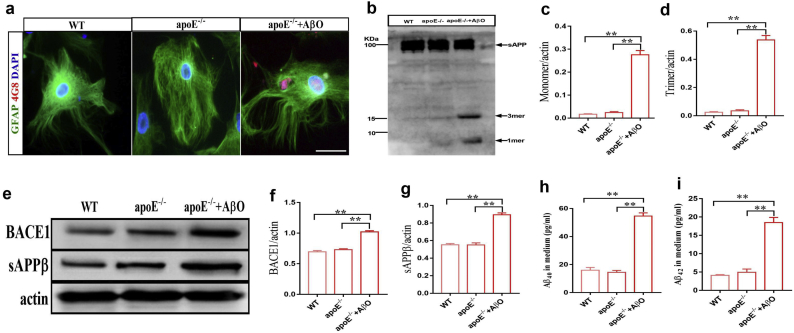
The results showed that cognitive deficits were mainly caused by the accumulation of nonameric and dodecameric Aβ assemblies in the brains. In addition, we found that the toxic AβOs were duplicated in a time-dependent manner when BACE1 and apolipoprotein E were overexpressed, which were responsible for producing redundant Aβ and forming nonameric and dodecameric assemblies in astrocytes, but not in neurons.
Our results suggest that astrocytes may play a central role in the progression of AD by duplicating and spreading toxic AβOs, thus triggering neuronal injury. FUND: This study was supported by the Key Project of the National Natural Science Foundation of China; the National Key Scientific Instrument and Equipment Development Project; Beijing Scholars Program, and Beijing Brain Initiative from Beijing Municipal Science & Technology Commission.
可溶性淀粉样β寡聚体(AβO)诱导的有害级联最近被认为是阿尔茨海默病(AD)的起始病理因子。然而,对于不同 AβO 的神经毒性和产生知之甚少。了解有毒 AβO 在大脑内的产生和扩散对于提高对 AD 发病机制和治疗的理解非常重要。
在这里,使用 PS1V97L 转基因小鼠,这是研究 AβO 在 AD 中的作用的有用工具,来确定导致神经元损伤和认知缺陷的特定 AβO 组装。然后,我们研究了在星形胶质细胞和神经元培养物中有毒 Aβ 组装的产生和扩散,并在动物模型中进一步测试了 AβO 脑室内注射后的结果。
结果表明,认知缺陷主要是由脑内非三聚体和十二聚体 Aβ 组装的积累引起的。此外,我们发现当 BACE1 和载脂蛋白 E 过表达时,有毒 AβO 以时间依赖性方式复制,这负责产生冗余 Aβ 并在星形胶质细胞中形成非三聚体和十二聚体组装,但不在神经元中。
我们的结果表明,星形胶质细胞可能通过复制和传播有毒的 AβO ,从而引发神经元损伤,在 AD 的进展中发挥核心作用。
本研究得到了国家自然科学基金重点项目、国家重大科学仪器设备开发专项、北京学者计划和北京市科委北京脑计划的支持。