Key Laboratory of Resource Chemistry of Ministry of Education, Shanghai Key Laboratory of Rare Earth Functional Materials, and Department of Chemistry, Shanghai Normal University, Shanghai, 200234, China.
Shanghai Synchrotron Radiation Facility, Shanghai Institute of Applied Physics, Chinese Academy of Sciences, Shanghai, 201204, China.
Nat Commun. 2019 Mar 29;10(1):1428. doi: 10.1038/s41467-019-09421-5.
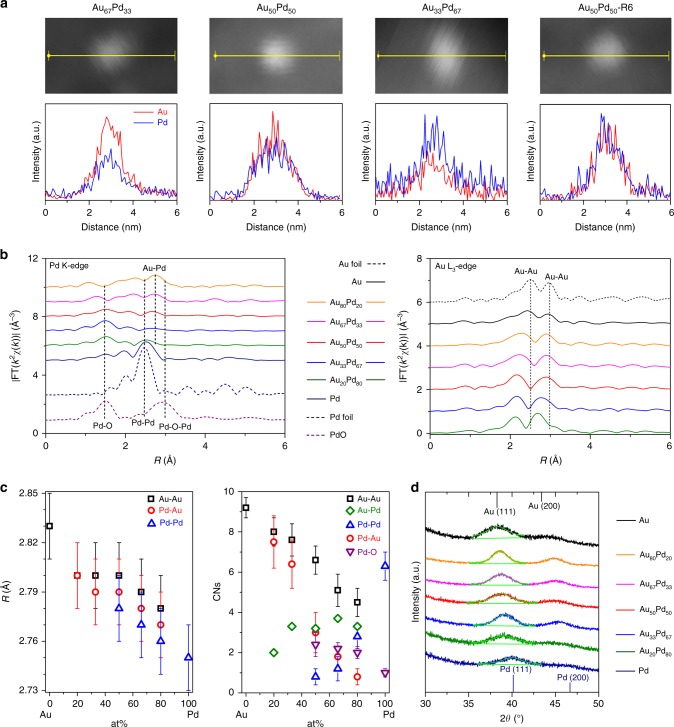
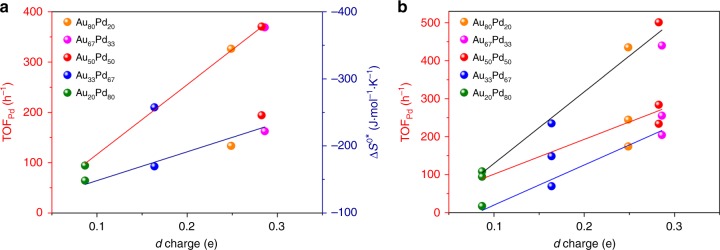
Understanding the catalytic mechanism of bimetallic nanocatalysts remains challenging. Here, we adopt an adsorbate mediated thermal reduction approach to yield monodispersed AuPd catalysts with continuous change of the Pd-Au coordination numbers embedded in a mesoporous carbonaceous matrix. The structure of nanoalloys is well-defined, allowing for a direct determination of the structure-property relationship. The results show that the Pd single atom and dimer are the active sites for the base-free oxidation of primary alcohols. Remarkably, the d-orbital charge on the surface of Pd serves as a descriptor to the adsorbate states and hence the catalytic performance. The maximum d-charge gain occurred in a composition with 33-50 at% Pd corresponds to up to 9 times enhancement in the reaction rate compared to the neat Pd. The findings not only open an avenue towards the rational design of catalysts but also enable the identification of key steps involved in the catalytic reactions.
理解双金属纳米催化剂的催化机制仍然具有挑战性。在这里,我们采用吸附物介导的热还原方法,在介孔碳质基质中生成具有连续变化的 Pd-Au 配位数的单分散 AuPd 催化剂。纳米合金的结构得到了很好的定义,允许直接确定结构-性能关系。结果表明,Pd 单原子和二聚体是无碱氧化伯醇的活性位点。值得注意的是,Pd 表面的 d 轨道电荷可用作吸附物状态的描述符,从而影响催化性能。在 Pd 含量为 33-50 at%的组成中,最大的 d 电荷增益对应于反应速率比纯 Pd 提高了 9 倍。这些发现不仅为催化剂的合理设计开辟了一条途径,而且还能够确定催化反应中涉及的关键步骤。