Jane and Terry Semel Institute for Neuroscience and Human Behavior at UCLA, Department of Psychiatry and Biobehavioral Sciences, David Geffen School of Medicine, UCLA, Los Angeles, CA, USA.
Center for Social Medicine and Humanities, UCLA, Los Angeles, CA, USA.
Curr Psychiatry Rep. 2019 Mar 29;21(5):35. doi: 10.1007/s11920-019-1017-0.
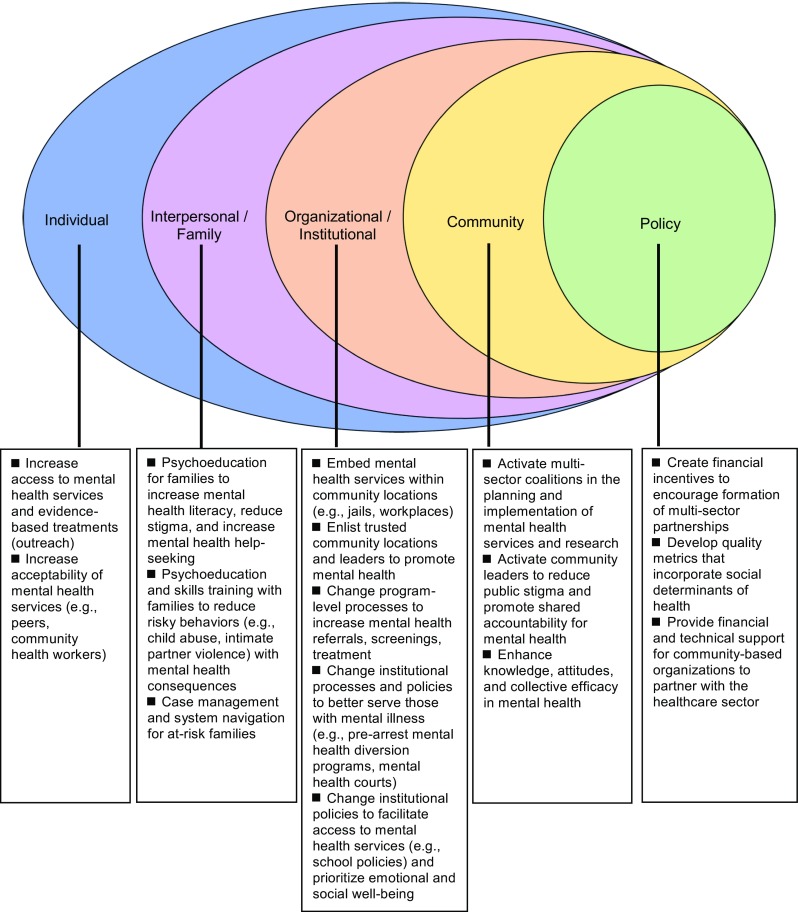
We review recent community interventions to promote mental health and social equity. We define community interventions as those that involve multi-sector partnerships, emphasize community members as integral to the intervention, and/or deliver services in community settings. We examine literature in seven topic areas: collaborative care, early psychosis, school-based interventions, homelessness, criminal justice, global mental health, and mental health promotion/prevention. We adapt the social-ecological model for health promotion and provide a framework for understanding the actions of community interventions.
There are recent examples of effective interventions in each topic area. The majority of interventions focus on individual, family/interpersonal, and program/institutional social-ecological levels, with few intervening on whole communities or involving multiple non-healthcare sectors. Findings from many studies reinforce the interplay among mental health, interpersonal relationships, and social determinants of health. There is evidence for the effectiveness of community interventions for improving mental health and some social outcomes across social-ecological levels. Studies indicate the importance of ongoing resources and training to maintain long-term outcomes, explicit attention to ethics and processes to foster equitable partnerships, and policy reform to support sustainable healthcare-community collaborations.
我们回顾了最近促进心理健康和社会公平的社区干预措施。我们将社区干预定义为涉及多部门合作、强调社区成员是干预的重要组成部分、以及/或在社区环境中提供服务的干预措施。我们检查了七个主题领域的文献:协作式护理、早期精神病、学校为基础的干预措施、无家可归、刑事司法、全球心理健康和精神健康促进/预防。我们为理解社区干预措施的行动改编了健康促进的社会生态学模型,并提供了一个框架。
在每个主题领域都有最近有效的干预措施的例子。大多数干预措施侧重于个体、家庭/人际关系和计划/机构社会生态层面,很少有干预整个社区或涉及多个非卫生保健部门的措施。许多研究的结果都证实了心理健康、人际关系和健康决定因素之间的相互作用。有证据表明,社区干预措施在改善心理健康和一些社会结果方面在社会生态层面上是有效的。研究表明,持续的资源和培训对于维持长期结果、明确关注促进公平伙伴关系的道德和过程以及支持可持续医疗保健-社区合作的政策改革非常重要。