Department of Gastroenterology, Guangzhou First People's Hospital, The Second Affiliated Hospital of South China University of Technology, Guangzhou, China.
Department of Gastrointestinal Surgery, Guangzhou First People's Hospital, The Second Affiliated Hospital of South China University of Technology, Guangzhou, China.
Cancer Med. 2019 May;8(5):2496-2502. doi: 10.1002/cam4.1867. Epub 2019 Mar 29.
To analyze the detection rates of colorectal cancer (CRC) and polyps by population-based screening in Guangzhou.
From January 2011 to December 2015, the residents aged 30-79 were selected for CRC screening. The residents were conducted Questionnaires and/or FOBT to assess high-risk groups, the free colonoscopy examination was recommended, and the results were evaluated in detail.
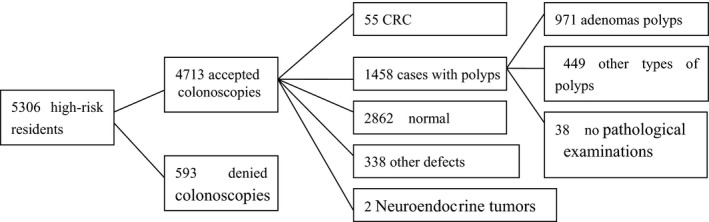
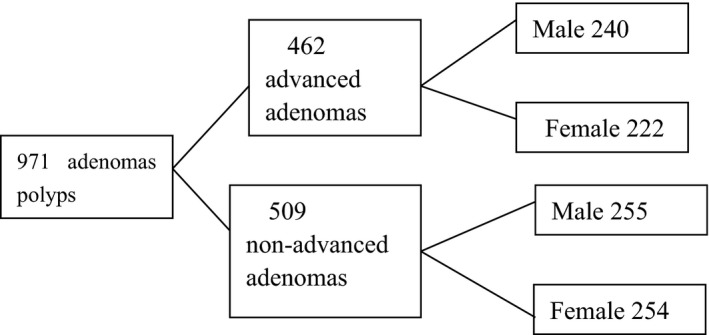
There were 98 927 residents involving screening, 5306 high-risk residents identified (males 1859 and females 3447), and 4713 subjects underwent colonoscopy (males 1690 and females 3023). CRC was seen in 55 individuals (males 28 and females 27), and the detection rates in male were higher than in female (P = 0.019). And the detection rates increasing with age, for people over 60 years old, were obviously higher than those younger (x = 18.64, P = 0.000924). The polyps were seen in 1458 (30.94%) cases, and 1420 subjects received pathological examination (adenomas 971 and non-adenomatous polyps 449). Advanced adenomas were seen in 462 cases (males 240 and females 222) and 509 cases of non-advanced adenomas (males 255 and females 254). For advanced adenomas, the detection rates in male were higher than female (14.20% vs 7.34%, P = 2.64 × 10 ). For the detection rates of adenomas or advanced adenomas by age, the people over 40 years were higher than younger (20.91% vs 3.61% P = 7.87 × 10 ; 9.94% vs 2.41%, P = 0.009).
For Guangzhou residents, the detection rates of CRC and adenoma were 1.17% and 20.60%. The detection rates of CRC increasing with age, for people over 60 years old, were obviously higher than those younger. But for people over 40 years, the detection rate of adenoma and advanced adenoma was higher than younger. So for people over 40 years, the CRC screening is recommended.
分析广州基于人群的结直肠癌(CRC)和息肉筛查的检出率。
2011 年 1 月至 2015 年 12 月,选取年龄在 30-79 岁的居民进行 CRC 筛查。对居民进行问卷调查和/或粪便潜血试验(FOBT)评估高危人群,建议进行免费结肠镜检查,并对结果进行详细评估。
共纳入 98927 名筛查对象,发现 5306 名高危居民(男性 1859 名,女性 3447 名),4713 名受试者接受结肠镜检查(男性 1690 名,女性 3023 名)。共检出 55 例 CRC(男性 28 例,女性 27 例),男性检出率高于女性(P=0.019)。且检出率随年龄增长而升高,60 岁以上人群明显高于 60 岁以下人群(x²=18.64,P=0.000924)。共检出息肉 1458 例(30.94%),1420 例接受病理检查(腺瘤 971 例,非腺瘤性息肉 449 例)。检出高级别腺瘤 462 例(男性 240 例,女性 222 例),检出非高级别腺瘤 509 例(男性 255 例,女性 254 例)。高级别腺瘤男性检出率高于女性(14.20%比 7.34%,P=2.64×10⁻³)。按年龄分组,高级别腺瘤和腺瘤的检出率,40 岁以上人群均高于 40 岁以下人群(20.91%比 3.61%,P=7.87×10⁻³;9.94%比 2.41%,P=0.009)。
广州居民 CRC 和腺瘤的检出率分别为 1.17%和 20.60%。CRC 检出率随年龄增长而升高,60 岁以上人群明显高于 60 岁以下人群。但 40 岁以上人群的腺瘤和高级别腺瘤检出率高于 40 岁以下人群。因此,建议 40 岁以上人群进行 CRC 筛查。