Division of Epilepsy and Clinical Neurophysiology, Department of Neurology, Boston Children's Hospital, Boston, Massachusetts.
Children's Hospital Colorado, University of Colorado, School of Medicine, Aurora, Colorado; Department of Pediatrics, University of Colorado, School of Medicine, Aurora, Colorado.
Pediatr Neurol. 2019 Aug;97:18-25. doi: 10.1016/j.pediatrneurol.2019.02.015. Epub 2019 Feb 23.
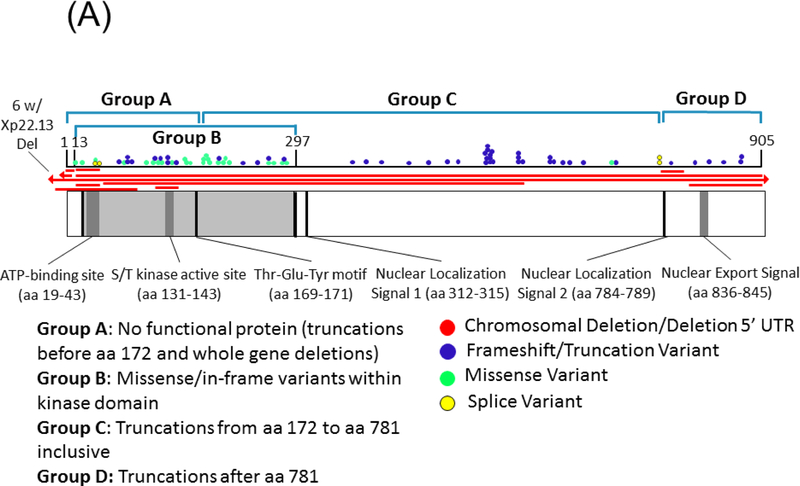
Cyclin-dependent kinase-like 5 (CDKL5) deficiency disorder (CDD) is a developmental encephalopathy caused by pathogenic variants in the gene CDKL5. This unique disorder includes early infantile onset refractory epilepsy, hypotonia, developmental intellectual and motor disabilities, and cortical visual impairment. We review the clinical presentations and genetic variations in CDD based on a systematic literature review and experience in the CDKL5 Centers of Excellence. We propose minimum diagnostic criteria. Pathogenic variants include deletions, truncations, splice variants, and missense variants. Pathogenic missense variants occur exclusively within the kinase domain or affect splice sites. The CDKL5 protein is widely expressed in the brain, predominantly in neurons, with roles in cell proliferation, neuronal migration, axonal outgrowth, dendritic morphogenesis, and synapse development. The molecular biology of CDD is revealing opportunities in precision therapy, with phase 2 and 3 clinical trials underway or planned to assess disease specific and disease modifying treatments.
细胞周期蛋白依赖性激酶样 5(CDKL5)缺乏症(CDD)是一种由 CDKL5 基因突变引起的发育性脑病。这种独特的疾病包括早发性婴儿期难治性癫痫、肌张力低下、发育性智力和运动障碍以及皮质视觉障碍。我们根据系统文献回顾和 CDKL5 卓越中心的经验,综述了 CDD 的临床表现和遗传变异。我们提出了最低诊断标准。致病性变异包括缺失、截断、剪接变异体和错义变异体。致病性错义变异体仅发生在激酶结构域内或影响剪接位点。CDKL5 蛋白在大脑中广泛表达,主要在神经元中,在细胞增殖、神经元迁移、轴突生长、树突形态发生和突触发育中发挥作用。CDD 的分子生物学揭示了精准治疗的机会,正在进行或计划进行 2 期和 3 期临床试验,以评估针对疾病的和疾病修饰的治疗方法。