Royal Life Saving Society - Australia, Broadway, New South Wales, Australia
College of Public Health, Medical and Veterinary Sciences, James Cook University, Townsville, Queensland, Australia.
Inj Prev. 2020 Jun;26(3):240-247. doi: 10.1136/injuryprev-2019-043156. Epub 2019 Mar 30.
Internationally, rivers are a leading drowning location, yet little evidence exists evaluating river drowning prevention strategies. This study aims to use expert opinion to identify strategies more likely to be effective.
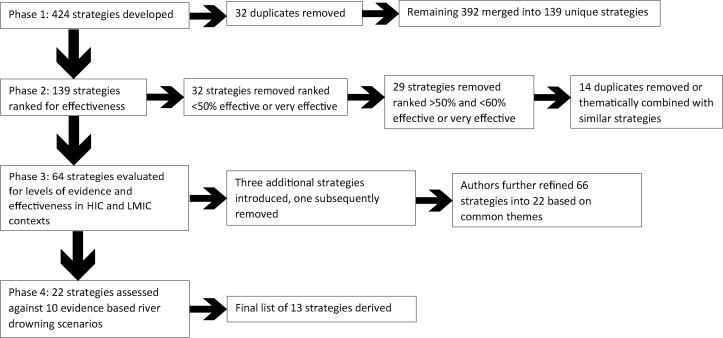
Using a modified Delphi process, a virtual panel of 30 experts from 12 countries considered, grouped and prioritised strategies for river drowning prevention. Proposed strategies were assessed against known evidence and suitability in high-income countries (HICs) as well as low-income and middle-income countries (LMICs) using expert opinion. The final phase consolidated a list of strategies whose effectiveness was assessed against 10 evidence-based river drowning scenarios.
An initial list of 424 prevention strategies was refined to 22. After being assessed against the 10 scenarios, a final list of 13 strategies was derived. Strategies addressed alcohol consumption around rivers, flood mitigation, improving child supervision, learning to swim, increased lifejacket wear and achieving community-wide resuscitation skills.
While all 13 strategies were assessed as being effective in both LMICs and HICs by at least 60% of the respondents, further work is required to define river drowning at a country level and therefore allow for effective solutions to be developed, particularly in LMICs. No strategy will be effective in isolation and must be implemented alongside policy and behaviour change, public awareness and education. Evaluation should be incorporated as part of any future implementation of strategies.
This Delphi process identified 13 drowning prevention strategies for rivers. Further research is required to validate the efficacy of these findings through implementation and evaluation.
在国际上,河流是导致溺水的主要场所,但几乎没有证据表明可以评估预防河流溺水的策略。本研究旨在利用专家意见来确定更有可能有效的策略。
使用改良 Delphi 法,由来自 12 个国家的 30 名专家组成虚拟小组,对预防河流溺水的策略进行分组和优先排序。利用专家意见,根据已知证据和高收入国家(HICs)以及中低收入国家(LMICs)的适用性,对提出的策略进行评估。最后一阶段对一组策略进行了整合,这些策略的有效性是根据 10 个基于证据的河流溺水情景进行评估的。
最初的 424 项预防策略被精简至 22 项。在根据 10 个情景进行评估后,得出了最终的 13 项策略。这些策略涉及河流周边的饮酒问题、洪水缓解、加强儿童监管、学习游泳、增加救生衣穿戴率以及实现社区范围内的复苏技能。
虽然所有 13 项策略都被至少 60%的受访者评估为在 LMICs 和 HICs 中都有效,但仍需要进一步的工作来确定国家层面的河流溺水问题,从而制定有效的解决方案,特别是在 LMICs 中。任何策略都不可能单独发挥作用,必须与政策和行为改变、公众意识和教育相结合实施。评估应作为未来任何策略实施的一部分纳入。
本 Delphi 流程确定了 13 项预防河流溺水的策略。需要进一步的研究通过实施和评估来验证这些发现的效果。