Murata Koshi, Kinoshita Tomoki, Fukazawa Yugo, Kobayashi Kenta, Yamanaka Akihiro, Hikida Takatoshi, Manabe Hiroyuki, Yamaguchi Masahiro
Division of Brain Structure and Function, Faculty of Medical Sciences, University of Fukui, Fukui, Japan.
Life Science Innovation Center, Faculty of Medical Science, University of Fukui, Fukui, Japan.
Front Behav Neurosci. 2019 Mar 15;13:50. doi: 10.3389/fnbeh.2019.00050. eCollection 2019.
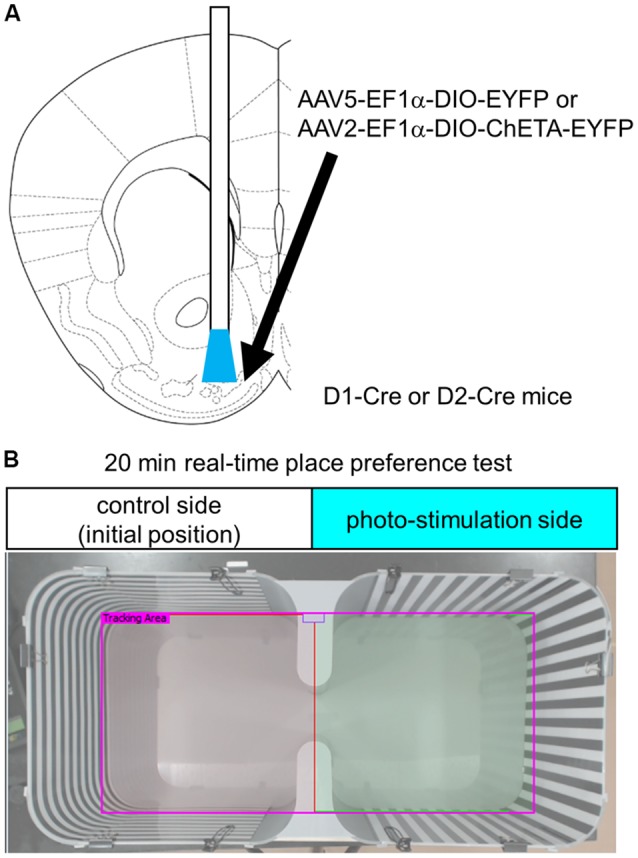
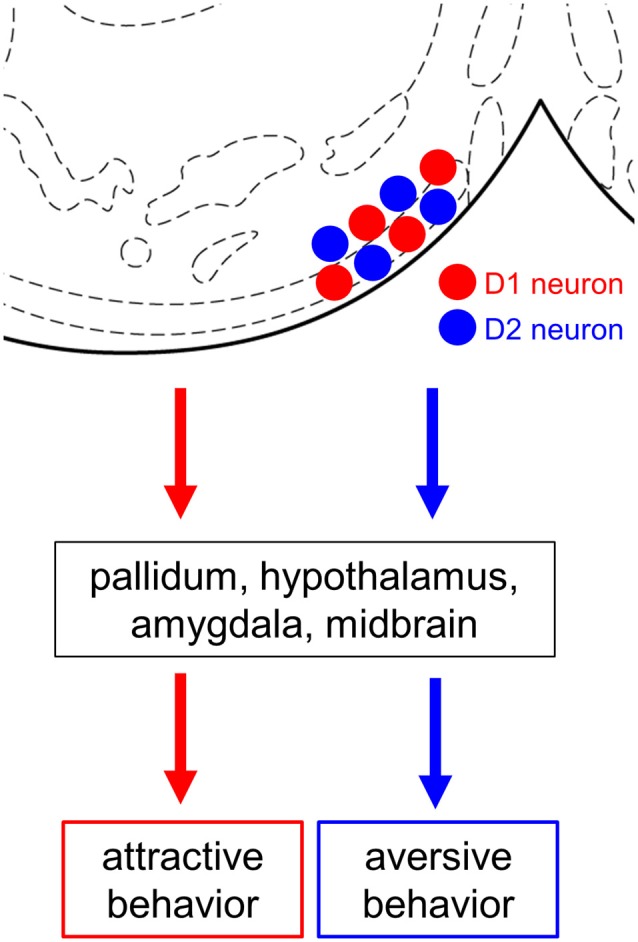
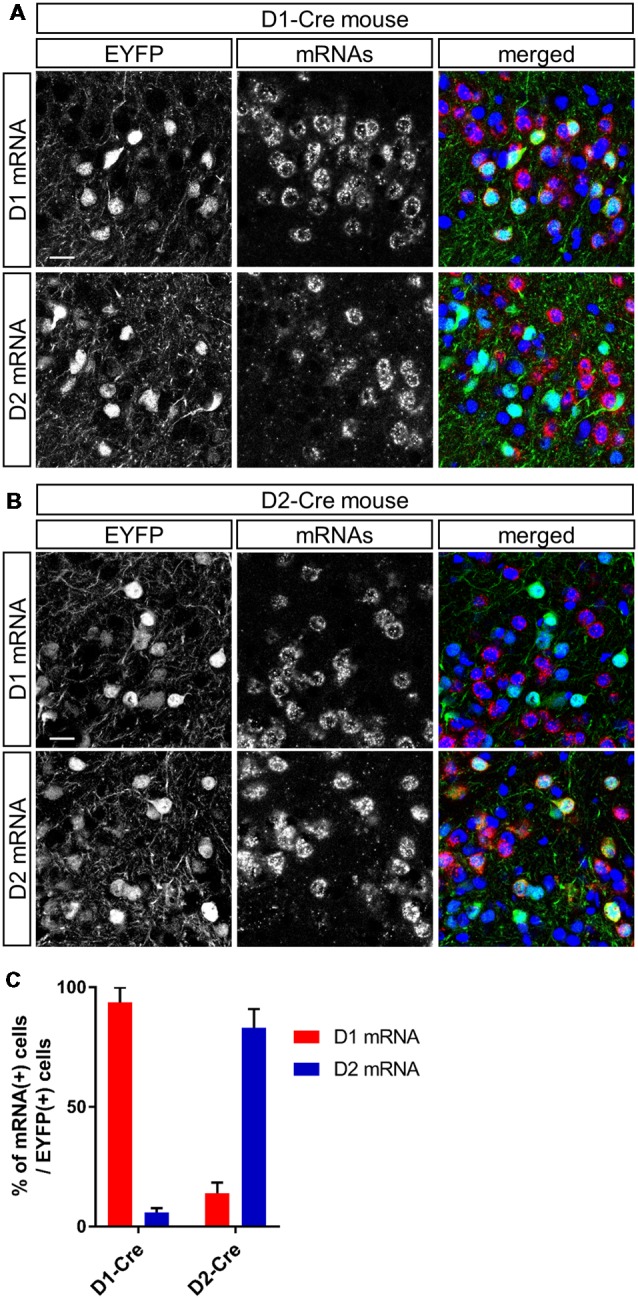
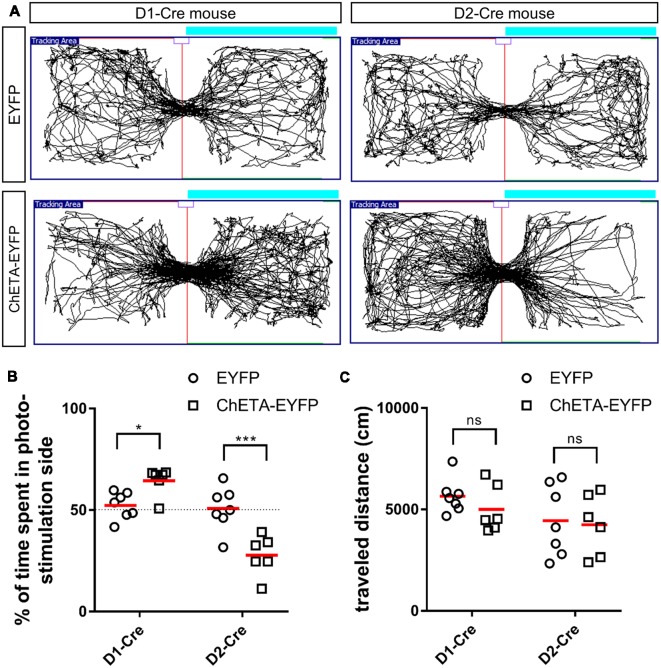
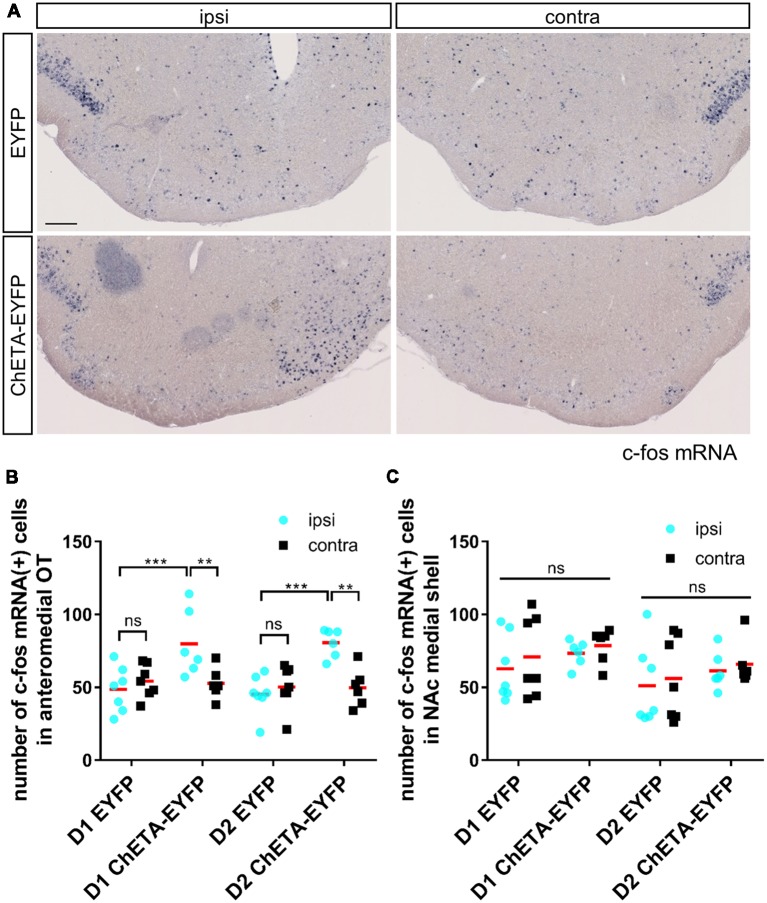
Olfaction induces adaptive motivated behaviors. Odors associated with food induce attractive behavior, whereas those associated with dangers induce aversive behavior. We previously reported that learned odor-induced attractive and aversive behaviors accompany activation of the olfactory tubercle (OT) in a domain- and cell type-specific manner. Odor cues associated with a sugar reward induced attractive behavior and c-fos expression in the dopamine receptor D1-expressing neurons (D1 neurons) in the anteromedial OT. In contrast, odor cues associated with electrical shock induced aversive behavior and c-fos expression in the pamine receptor D2-expressing neurons (D2 neurons) in the anteromedial OT, as well as the D1 neurons in the lateral OT. Here, we investigated whether the D1 and D2 neurons in the anteromedial OT play distinct roles in attractive or aversive behaviors, using optogenetic stimulation and real-time place preference (RTPP) tests. Mice expressing ChETA (ChR2/E123T)-enhanced yellow fluorescent protein (EYFP) in the D1 neurons in the anteromedial OT spent a longer time in the photo-stimulation side of the place preference chamber than the control mice expressing EYFP. On the other hand, upon optogenetic stimulation of the D2 neurons in the anteromedial OT, the mice spent a shorter time in the photo-stimulation side than the control mice. Local neural activation in the anteromedial OT during the RTPP tests was confirmed by c-fos mRNA expression. These results suggest that the D1 and D2 neurons in the anteromedial OT play opposing roles in attractive and aversive behaviors, respectively.
嗅觉引发适应性动机行为。与食物相关的气味引发吸引行为,而与危险相关的气味则引发厌恶行为。我们之前报道过,习得的气味诱导的吸引和厌恶行为以区域和细胞类型特异性的方式伴随着嗅结节(OT)的激活。与糖奖励相关的气味线索在前内侧OT中诱导吸引行为,并在表达多巴胺受体D1的神经元(D1神经元)中诱导c-fos表达。相反,与电击相关的气味线索在前内侧OT中诱导厌恶行为,并在表达多巴胺受体D2的神经元(D2神经元)以及外侧OT中的D1神经元中诱导c-fos表达。在此,我们使用光遗传学刺激和实时位置偏好(RTPP)测试,研究前内侧OT中的D1和D2神经元在吸引或厌恶行为中是否发挥不同作用。在前内侧OT的D1神经元中表达ChETA(ChR2/E123T)-增强型黄色荧光蛋白(EYFP)的小鼠,在位置偏好箱的光刺激侧停留的时间比表达EYFP的对照小鼠更长。另一方面,在前内侧OT的D2神经元受到光遗传学刺激后,小鼠在光刺激侧停留的时间比对照小鼠更短。通过c-fos mRNA表达证实了RTPP测试期间前内侧OT中的局部神经激活。这些结果表明,前内侧OT中的D1和D2神经元分别在吸引和厌恶行为中发挥相反的作用。