Chen Yen-Hao, Lu Hung-I, Lo Chien-Ming, Wang Yu-Ming, Chou Shang-Yu, Hsiao Chang-Chun, Li Shau-Hsuan
Department of Hematology-Oncology, Kaohsiung Chang Gung Memorial Hospital and Chang Gung University College of Medicine, Kaohsiung 833, Taiwan.
Graduate Institute of Clinical Medical Sciences, College of Medicine, Chang Gung University, Taoyuan 333, Taiwan.
Cancers (Basel). 2019 Mar 30;11(4):451. doi: 10.3390/cancers11040451.
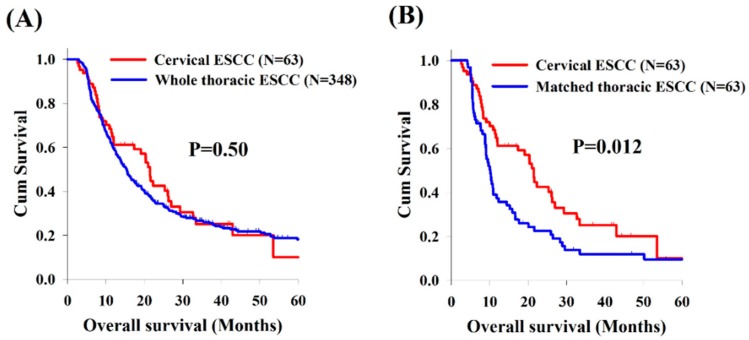
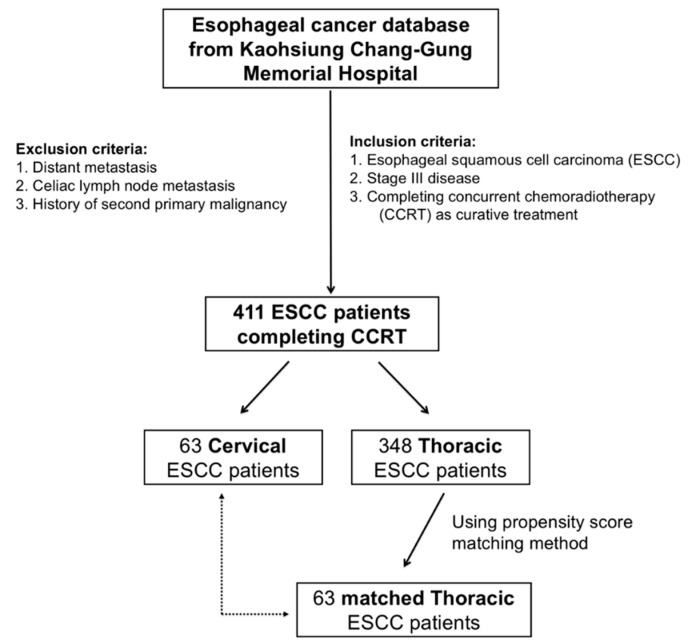
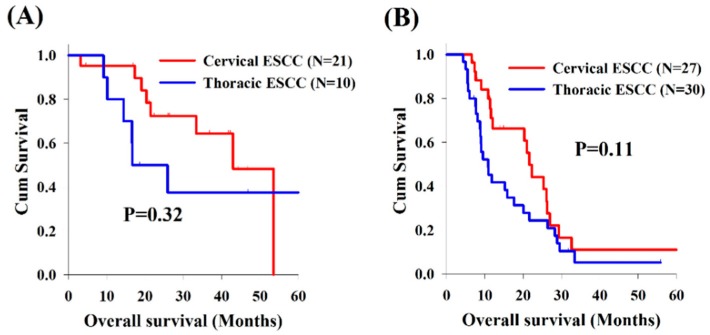
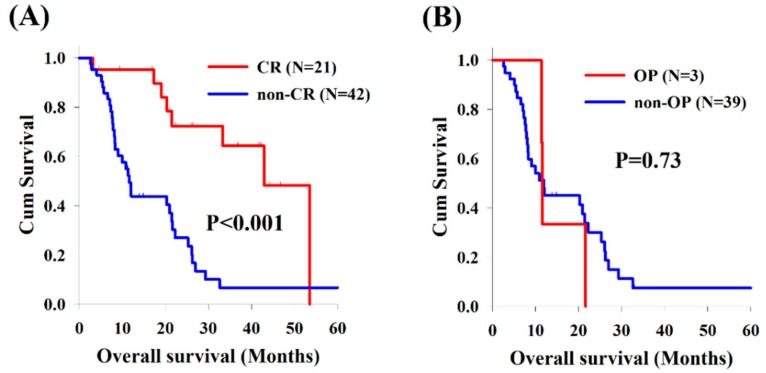
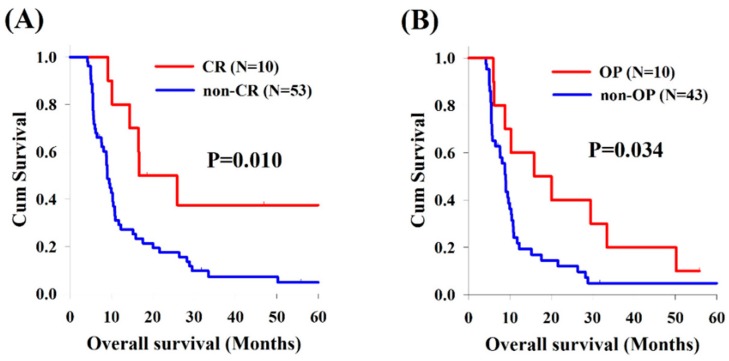
This study investigated the clinical outcome of locally advanced cervical esophageal squamous cell carcinoma (ESCC) patients who received curative concurrent chemoradiotherapy (CCRT) and their differences from thoracic ESCC patients. Among 411 enrolled ESCC patients, including 63 with cervical and 348 with thoracic ESCC, 63 thoracic patients were propensity score-matched to the 63 cervical patients. For cervical ESCC, T4b and high tumor grade were independent prognostic factors of a worse overall survival (OS) in univariate and multivariate analyses. The response rates to curative CCRT between cervical and the matched thoracic ESCC groups were similar but cervical ESCC had a better OS than that of the matched thoracic group (21.4 versus 10.1 months, = 0.012). Better OS was mentioned to be in the patients with complete response (CR), whether in the cervical or matched thoracic ESCC group. For patients without CR, patients who underwent esophagectomy had superior OS than those without operation in the matched thoracic ESCC group (11.6 versus 11.9 months, = 0.73). Only three patients received operation in the cervical ESCC group, thus the survival difference was not significant. Curative CCRT may be a reasonable treatment for cervical ESCC in clinical practice, and the role of surgery should be considered as salvage therapy if residual disease is evident.
本研究调查了接受根治性同步放化疗(CCRT)的局部晚期颈段食管鳞状细胞癌(ESCC)患者的临床结局及其与胸段ESCC患者的差异。在411例入组的ESCC患者中,包括63例颈段ESCC患者和348例胸段ESCC患者,对63例胸段患者与63例颈段患者进行倾向评分匹配。对于颈段ESCC,在单因素和多因素分析中,T4b和高肿瘤分级是总生存期(OS)较差的独立预后因素。颈段ESCC组与匹配的胸段ESCC组对根治性CCRT的缓解率相似,但颈段ESCC的OS优于匹配的胸段组(21.4个月对10.1个月,P = 0.012)。无论是颈段还是匹配的胸段ESCC组,完全缓解(CR)的患者OS较好。对于未达到CR的患者,在匹配的胸段ESCC组中,接受食管切除术的患者OS优于未手术的患者(11.6个月对11.9个月,P = 0.73)。颈段ESCC组只有3例患者接受了手术,因此生存差异不显著。在临床实践中,根治性CCRT可能是颈段ESCC的合理治疗方法,如果有明显的残留病灶,应考虑将手术作为挽救治疗手段。